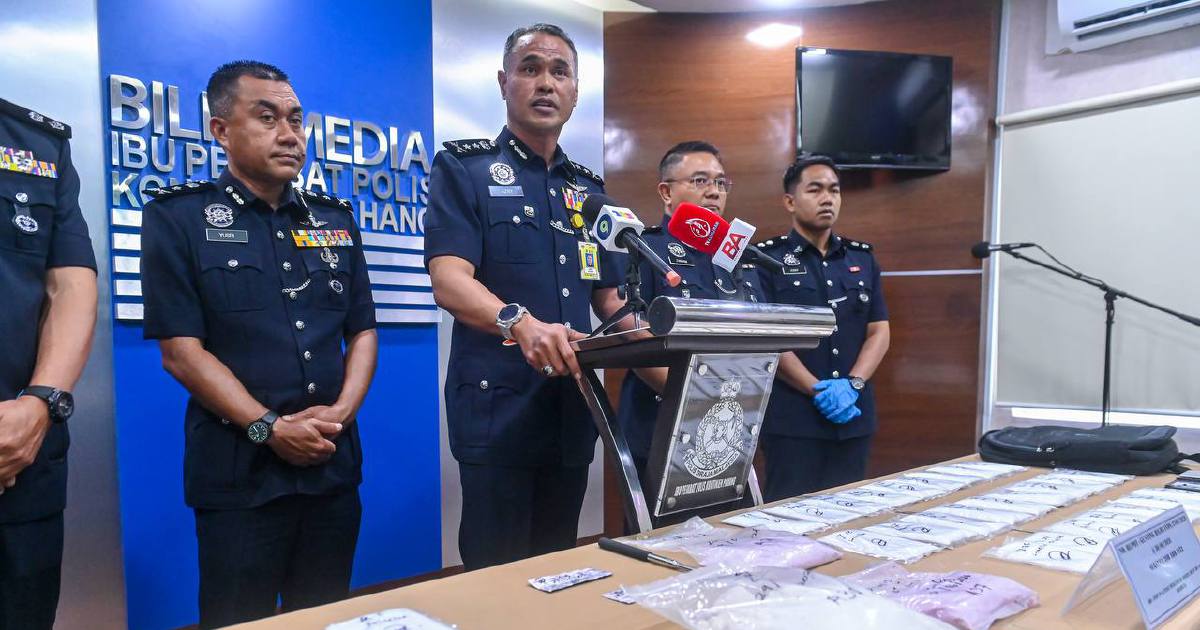
Law enforcement authorities in Kuantan have detained a Thai national and her Malaysian partner following what officials describe as a significant anti-narcotics operation in Genting Permai, Bentong. The suspects are believed to have been actively involved in the courier business for an organized drug syndicate, allegedly conducting regular drug runs over a three-month operational window before their apprehension. The seizure of narcotics valued at around RM728,000 marks a notable recovery for regional drug enforcement efforts.
The arrest represents another entry point in what appears to be a broader pattern of cross-border drug trafficking activity affecting Malaysia and its northern neighbor. Thai nationals have increasingly featured in drug-related arrests across Malaysia, reflecting the country's position as a transit route for narcotics destined for consumption within Southeast Asia and potentially for export to other regions. The involvement of a local Malaysian partner suggests a network with logistical knowledge of domestic routes and distribution channels, a typical operational structure for larger trafficking organizations.
The Bentong district, located in Pahang's northern reaches, has become an area of increasing focus for anti-drug operations. Its proximity to the Thai border and role as a transit point for commercial goods make it strategically vulnerable to smuggling operations. The capture of the couple in Genting Permai, a residential development in the district, indicates that distributors are embedding themselves within established communities rather than solely relying on isolated rural operations, which presents new challenges for law enforcement.
Investigators describe the suspects as having operated as active couriers rather than as high-level traffickers, suggesting they occupied mid-tier positions within a larger syndicate structure. This classification typically indicates the existence of more significant operations upstream, with suppliers and financial coordinators yet to be identified. The three-month window of alleged activity hints that authorities may have been conducting preliminary surveillance before executing the arrest, potentially allowing them to build stronger evidentiary foundations.
The monetary value of the seizure underscores the considerable financial stakes involved in narcotics distribution at the regional level. RM728,000 represents substantial street-level capital, suggesting the shipment was likely intended for bulk supply to secondary distributors rather than being destined for retail-level sales. This operational scale indicates a network with sophisticated procurement and distribution logistics, characteristics typical of organizations with established client bases and reliable market access.
The partnership between the Thai national and her Malaysian counterpart mirrors patterns observed in other regional trafficking investigations, where international elements work alongside local facilitators. These arrangements typically leverage the outsider's access to foreign suppliers while utilizing the local partner's knowledge of domestic enforcement patterns, safe houses, and established distribution networks. Such cooperation reduces operational risk for primary traffickers by creating distance between source and final consumption point.
The Pahang Police, leading this operation, continue to intensify narcotics suppression activities across the state following increased resources allocated to border security initiatives. These efforts have yielded multiple seizures over recent months, though the frequency of arrests suggests that trafficking volumes remain substantial despite enforcement pressure. The arrest in Bentong demonstrates that operational focus extends beyond major urban centers to secondary cities and district towns where enforcement resources are sometimes more limited.
Malaysia's role in regional drug trafficking has become increasingly prominent, with the country identified as both a consumer market and transit territory. The involvement of foreign nationals in mid-level trafficking operations reflects how international criminal networks have adapted to enforcement pressure by distributing operational risk across multiple jurisdictions and compartmentalizing their organizational structures. This tactical approach complicates investigations and enables networks to absorb losses from individual arrests without dismantling core operations.
The case will now move through Malaysia's criminal justice system, with both suspects facing potential charges under the Dangerous Drugs Act. Prosecution of foreign nationals in Malaysian courts often involves coordination with diplomatic channels and can establish important precedents regarding sentencing consistency for international trafficking offenses. The evidence gathered during this operation may also contribute to broader intelligence assessments regarding trafficking route priorities and syndicate operating methods.
Beyond the immediate arrest, this operation highlights the persistent challenge of maintaining border integrity in an era of porous regional movement and sophisticated criminal organization. While individual seizures provide tactical victories for enforcement agencies, the continuation of trafficking activities at observable volumes suggests that sustained disruption will require not merely increased arrests but comprehensive strategies addressing demand reduction, international cooperation protocols, and financial investigation capabilities that target the economic incentive structures enabling such networks.

