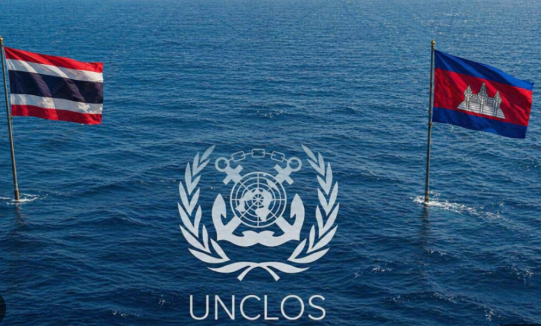
Thailand has formally responded to Cambodia's request to enter compulsory conciliation proceedings under the 1982 United Nations Convention on the Law of the Sea, or Unclos, over their disputed maritime boundary in the Gulf of Thailand. The Thai government submitted its formal acceptance on June 19, nearly three weeks after Cambodia initiated the process on June 2. However, Bangkok has taken considerable care to frame this acceptance within strict parameters, repeatedly emphasising that the conciliation mechanism is neither a court proceeding nor a binding arbitration, and that any recommendations emerging from the process will carry no legal force.
The positioning reflects a careful diplomatic balancing act by the Thai government. While accepting the international process signals Bangkok's willingness to engage with Cambodia through established multilateral frameworks, the consistent messaging about non-binding outcomes appears designed to reassure domestic constituencies that Thailand is not surrendering sovereignty or control over its maritime claims. Deputy Prime Minister and Foreign Minister Sihasak Phuangketkeow has been appointed as Thailand's Agent in the proceedings, with Songchai Chaipatiyut, Thailand's ambassador to Kuwait and a former senior legal affairs official, serving as Deputy Agent. Thailand has also nominated two conciliators: Judge Albert J Hoffmann of South Africa and Judge Rudiger Wolfrum of Germany, both described as internationally recognised experts in maritime law.
The conciliation process itself operates under specific procedural constraints. The four conciliators appointed by both Thailand and Cambodia will have 30 days to select a fifth conciliator who will chair the commission. Once constituted, the commission is expected to produce a report with recommendations within approximately 12 months, though both parties may agree to extend this timeline. Thai officials have been careful to distinguish conciliation from litigation, stressing that the conciliators function as neutral facilitators rather than judges or advocates for either side. Their role, according to Thai government statements, centres on listening to both nations, understanding the context of the dispute, and identifying pathways toward a mutually agreeable settlement.
Thailand's insistence on limiting the conciliation scope reveals a potential friction point with Cambodia. Bangkok has explicitly stated that the process should address only maritime boundary delimitation under Unclos, excluding other matters that Cambodia may have intended to bring into the proceedings. The Thai Foreign Ministry noted that Cambodia's original notification appeared to encompass not just boundary delimitation but also provisional arrangements for joint resource development and equitable sharing of hydrocarbon revenues. This distinction is significant because it indicates Thailand wishes to compartmentalise the dispute, addressing the technical question of where the maritime boundary lies while potentially keeping other arrangements subject to separate bilateral negotiations.
The dispute itself centres on overlapping maritime claims in the Gulf of Thailand, an economically significant region believed to contain substantial natural gas reserves and other hydrocarbon resources. The stakes extend beyond abstract questions of maritime law into tangible questions about resource access and revenue rights. The issue has historically intertwined maritime boundary delimitation with the prospect of joint development arrangements, making it difficult to separate one from the other in practice. This explains why Cambodia may have sought to broaden the conciliation scope beyond pure delimitation.
Recent actions by the Thai government add context to its cautious approach to conciliation. In May, the Thai Cabinet voted to terminate the 2001 memorandum of understanding with Cambodia, sometimes referred to as MoU 44 in Thai diplomatic circles, which had previously provided the framework for managing overlapping continental shelf claims. Prime Minister Anutin Charnvirakul stated the decision reflected lack of progress over 25 years rather than any new conflict with Cambodia. However, this cancellation occurred just as Cambodia was preparing its Unclos conciliation request, and Thai officials have had to repeatedly clarify that terminating the 2001 MoU did not signal an end to negotiations or a deterioration in bilateral relations. Instead, Bangkok framed the move as an effort to modernise the cooperation framework by anchoring discussions in Unclos itself, to which both countries are now signatories.
The Thai government has made clear that it views conciliation as a supplementary mechanism rather than a replacement for direct bilateral negotiation. According to Foreign Ministry statements, the conciliation process should provide structure and international credibility to the discussions rather than supplant the traditional channel of government-to-government talks. The final report and recommendations from the conciliation commission, even if intellectually persuasive, will remain non-binding, meaning both countries retain complete discretion over whether to accept, reject, or selectively implement any conclusions. This framework leaves open the possibility that the conciliation process could facilitate agreement if both sides find the recommendations acceptable, but equally allows either party to ignore the process if the recommendations prove unfavourable.
Under Unclos Annex V, which governs compulsory conciliation, the legal framework itself supports Thailand's position. A conciliation commission's report, conclusions, and recommendations explicitly carry no binding effect on the parties involved. This provision reflects a compromise in international law between states seeking stronger dispute resolution mechanisms and those insisting on preserving national sovereignty. For Thailand, this structural feature of Unclos conciliation aligns well with its preference for maintaining negotiating flexibility and avoiding any external determination of its maritime claims.
Cambodia initiated the compulsory conciliation specifically to achieve what it views as a peaceful resolution grounded in international law. By invoking Unclos procedures, Phnom Penh was asserting that the dispute should be resolved according to established international legal principles rather than through power dynamics or bilateral pressure. Thailand's acceptance of this position, while qualifying it heavily, suggests Bangkok recognises the value of international legitimacy even while insisting on the non-binding character of the process. The conciliation mechanism, if it proceeds smoothly, could potentially clarify the legal positions of both countries and provide technical analysis that might later facilitate negotiated settlement.
For Malaysia and other Southeast Asian nations watching the Thailand-Cambodia dispute, the unfolding conciliation process offers instructive lessons about managing maritime disagreements in the region. The case demonstrates that nations can simultaneously accept international dispute resolution procedures while maintaining firm positions on the binding character of outcomes. It also illustrates the complex relationship between maritime boundary delimitation and resource-sharing arrangements in Southeast Asia, where many disputes involve overlapping claims to economically valuable hydrocarbon reserves. Malaysia itself faces similar maritime boundary questions with Thailand, Brunei, and other neighbours, making the mechanisms and precedents established in the Thailand-Cambodia proceedings potentially relevant to future regional maritime negotiations.
The coming months will test whether the conciliation framework can facilitate genuine progress toward settlement. The appointment of respected international experts suggests both sides view the process as credible, even if not binding. However, Thailand's repeated emphasis on the non-binding nature of recommendations, combined with Cambodia's apparent desire to broaden the scope beyond delimitation, indicates underlying disagreements remain about what the process should achieve. The conciliation commission will need to navigate these tensions while producing analysis that both countries find sufficiently coherent and well-reasoned to serve as a foundation for continued direct negotiations. Whether this Unclos mechanism ultimately contributes to resolving the dispute or merely clarifies positions for further bilateral talks remains to be determined by events in the coming year.

