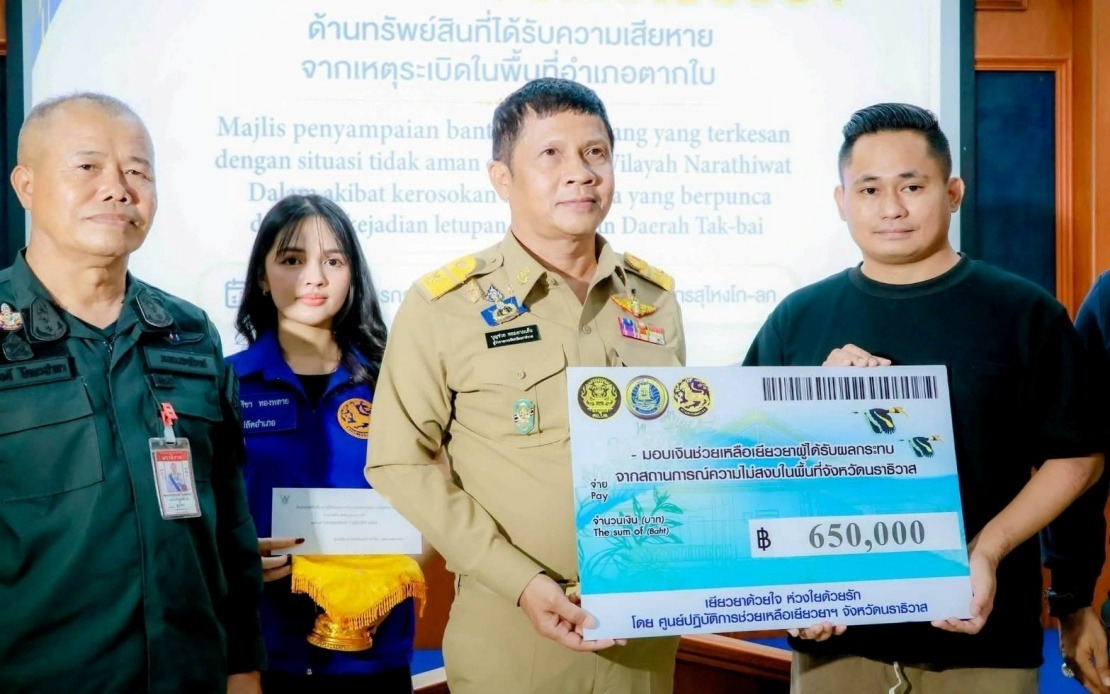
The Thai government has moved swiftly to provide financial reparations following a bombing incident that left two Malaysian nationals wounded in the southern province of Narathiwat. On Friday, authorities handed over compensation totalling 650,000 baht—equivalent to roughly RM80,000—to Muhammad Yusri Udin, one of the two injured Malaysians, during a ceremony conducted at the Sungai Golok Customs Office. This gesture marks an early governmental response to an incident that underscores the security challenges facing Thailand's southern border region and the potential risks faced by cross-border travellers and merchants.
The bombing occurred on June 29 when Muhammad Yusri, aged 38, and Abdullah Syarapi Abd Rahman, aged 45, fell victim to an improvised explosive device that detonated near the Sapom junction in Tak Bai district at approximately 11:40 am local time. The device had been concealed within a roadside drainage facility, a tactic that illustrates the evolving methods employed by those responsible for security disturbances in the area. Both men sustained injuries from the blast, though neither was believed to have been the intended target of the attack. Investigators subsequently determined that a rebel organisation likely carried out the operation, though the actual objectives remain the subject of ongoing inquiry.
Narathiwat Governor Boonchuay Homyamyen articulated the Thai government's official position during the compensation handover, emphasising that the nation has deep regret regarding the incident and the harm inflicted upon the Malaysian victims. His public statements reflected a diplomatic acknowledgement of cross-border responsibility, particularly important given the economic and social ties that bind Thailand and Malaysia through shared communities, trade routes, and tourism flows. The governor's remarks were carefully calibrated to reassure both populations that security remains a paramount concern for Bangkok's administration.
The compensation mechanism itself operates through an established Thai government fund designed to support individuals harmed by security-related incidents. This fund covers both physical injuries sustained and damage to personal property, providing a structured pathway for affected parties to receive assistance. The existence of such a fund reflects the Thai state's recognition that its southern provinces have endured prolonged security challenges, requiring institutional mechanisms to address civilian casualties. For Malaysian citizens affected by incidents within Thai territory, such arrangements become crucial in maintaining cross-border relations and public confidence.
Authorities in Tak Bai moved quickly to apprehend a 40-year-old suspect in connection with the bombing. Thai security forces launched a comprehensive investigative operation encompassing explosive ordnance disposal specialists and forensic examination teams deployed to the blast site. These technical investigations aim to establish precise details regarding the device's construction, materials, and the methods used to deploy it—intelligence that feeds into broader counterinsurgency and security frameworks being pursued across the region. The detained suspect remains under interrogation as investigators piece together the circumstances surrounding the explosion.
The incident occurs against a backdrop of persistent security concerns in Thailand's southern provinces, where insurgent groups have conducted sporadic attacks targeting both military and civilian interests. The fact that Malaysian nationals were caught in crossfire highlights how regional instability does not respect international boundaries and poses risks to legitimate cross-border movement. Many Malaysians conduct business, visit relatives, or transit through southern Thailand regularly, making the security environment in provinces like Narathiwat, Yala, and Pattani a matter of direct concern to Kuala Lumpur.
Governor Boonchuay's public commitment to strengthening security measures reflects Thailand's awareness that incidents affecting foreign nationals can damage its international reputation and deter tourism—a critical economic sector. His assurance that "the Thai government is committed to ensuring the safety of all parties" and will "continue to work on restoring tourist confidence" suggests that Bangkok views this compensation and security review as part of a broader damage-control strategy. The messaging emphasises that Thailand remains a welcoming destination despite occasional security flare-ups in its peripheral zones.
For Malaysian policymakers and citizens, the incident and subsequent compensation represent both reassurance and caution. The Thai government's willingness to provide compensation and acknowledge responsibility demonstrates functional bilateral relations. Simultaneously, the bombing serves as a reminder that travel to southern Thailand carries inherent risks that travellers should weigh carefully. Malaysian authorities have periodically issued advisories regarding travel to specific provinces, guidance that this incident may influence.
The broader context of southern Thai insurgency involves complex historical, ethnic, and religious dimensions that have resisted resolution for decades. While the immediate perpetrators remain under investigation, the underlying grievances and organisational structures driving such violence persist. This creates an environment where isolated incidents will likely continue, necessitating sustained cooperation between Thai and Malaysian security agencies and ongoing diplomatic engagement to manage cross-border challenges. The compensation payment, while financially modest, represents Thailand's recognition that civilian harm requires acknowledgement and redress.

