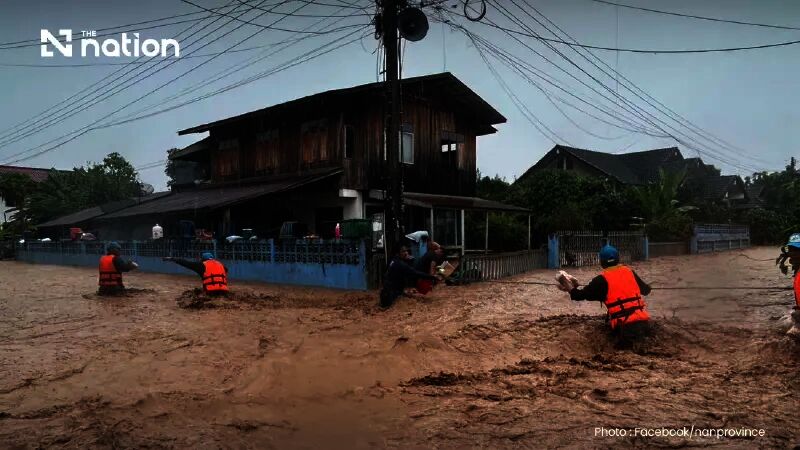
Thailand's government has officially designated Nan province a disaster zone following intense rainfall that has triggered widespread flooding and forced communities to evacuate. The declaration came on Wednesday as authorities grappled with the scale of damage across the northern region, with two neighbouring provinces—Phayao and Lamphun—placed under heightened alert status as weather conditions continue to deteriorate.
Prime Minister Anutin Charnvirakul, despite being on an official visit to Australia, has taken direct command of Thailand's response to the crisis. Through his spokesperson Rachada Dhnadirek, the prime minister instructed all government ministries and the armed forces to coordinate relief operations and prioritise emergency assistance. This directive underscores the severity with which Bangkok's leadership views the unfolding situation and reflects a commitment to moving beyond bureaucratic channels to mobilise resources rapidly.
The core of the government's strategy focuses on rapid deployment of response teams and heavy machinery to zones identified as high-risk. Rather than waiting for disasters to occur, authorities are positioning equipment and personnel ahead of anticipated incidents, with particular emphasis on managing water drainage in areas with historical patterns of flooding. This proactive stance represents an attempt to mitigate suffering before conditions become critical, though success depends heavily on accurate weather forecasting and adequate resource allocation across multiple provinces simultaneously.
Prime Minister Anutin has stressed that protecting vulnerable populations must remain the overriding priority in all response operations. This includes elderly residents, hospitalised patients requiring continuous care, children in evacuation zones, and those living in geographically precarious locations. Officials have been instructed to conduct rapid surveys of affected communities to identify who requires assistance and what level of support they need, rather than relying on general provisions that may miss those in greatest peril.
The government's strategy also emphasises constant environmental monitoring as a cornerstone of early warning systems. By maintaining close observation of rainfall patterns and water levels across northern Thailand, authorities can issue timely alerts when conditions approach dangerous thresholds, giving residents critical hours to move to safer ground or prepare for impacts. This data-driven approach represents Thailand's attempt to shift from reactive crisis management to preventative disaster response.
Deputy Prime Minister Yodchanan Wongsawat, who holds specific responsibility for flood management in Thailand's northern region, issued urgent orders on Wednesday to provincial governors in Nan, Phayao, and Lamphun. These directives required comprehensive preparation across all three provinces, signalling that decision-makers expect the weather situation to worsen before improving. Wongsawat's direct intervention suggests that standard protocols and routine procedures were deemed insufficient given meteorological forecasts, necessitating elevated alert levels and enhanced resource positioning.
The Meteorological Department's August forecast provides crucial context for understanding why authorities have elevated their response posture. Predictions indicate sustained thunderstorm activity coupled with locally heavy rainfall and strong winds across the forecast period. These conditions create the precise atmospheric circumstances that generate flash floods—sudden water surges that can overwhelm drainage systems and sweep away structures—as well as runoff that accumulates in low-lying areas and destabilises hillsides, triggering landslides in mountainous terrain.
For Malaysia and other Southeast Asian nations monitoring the situation, Thailand's flooding crisis carries significant implications. The region's interconnected geography means that extreme weather systems often affect multiple countries sequentially, and heavy rainfall in Thai northern provinces can influence water levels in transboundary river systems. Thailand's response strategies and success in managing the current disaster may offer lessons for Malaysian authorities managing their own flood-prone regions, particularly in Peninsular Malaysia's northern states that share similar meteorological vulnerabilities.
The declaration of a disaster zone streamlines bureaucratic processes, enabling faster mobilisation of resources, suspension of normal administrative procedures that might impede relief efforts, and prioritisation of government spending toward emergency response. This administrative shift typically includes granting provincial governors enhanced authority to requisition equipment, commandeer transport, and redirect funding without awaiting central approval—mechanisms essential when responding to rapidly evolving natural disasters where delays measured in hours can prove catastrophic.
Thailand's experience with seasonal flooding means the country has developed institutional knowledge about disaster response, though this familiarity does not reduce the fundamental challenges posed by extreme weather events. Each monsoon season presents variations that can confound predictions, and the increasing intensity of rainfall in some regions due to broader climate patterns suggests that historical response models may require adaptation. The government's emphasis on positioning resources ahead of anticipated crises rather than deploying them after impacts occur reflects this evolving understanding.
As the situation develops through Friday, when meteorological services indicate that hazardous conditions may persist, the true measure of Thailand's preparedness will emerge. The government's initial response has been swift and centrally coordinated, but the actual test lies in whether resources reach affected communities promptly, whether early warning systems function reliably when communications infrastructure is damaged by flooding, and whether vulnerable populations receive protection before they face life-threatening exposure to water, landslides, or other hazards.

