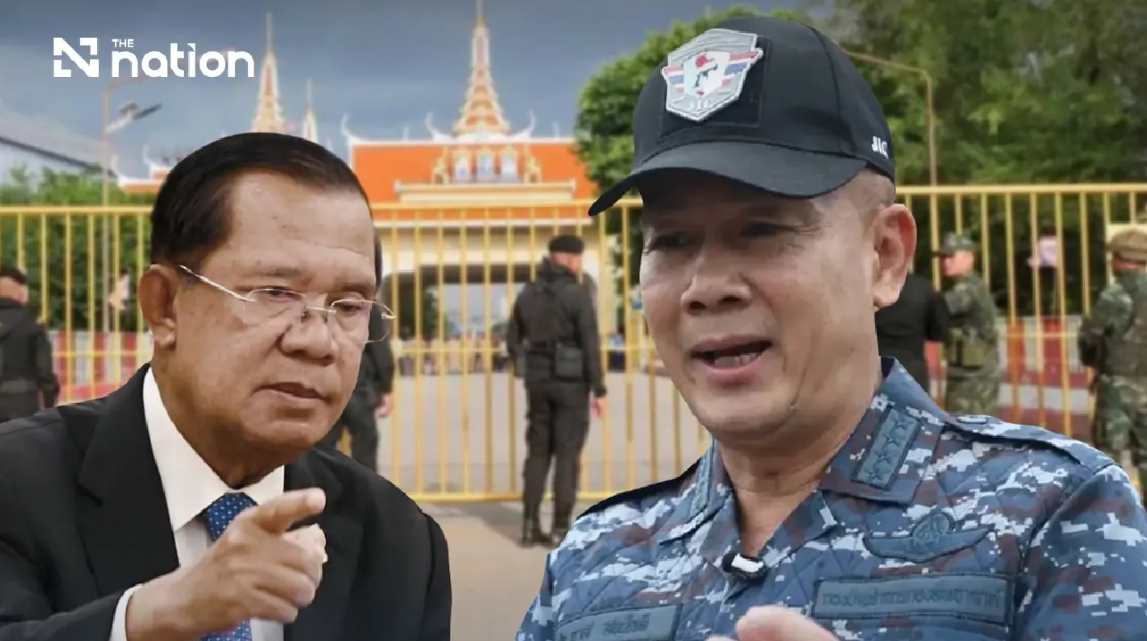
Thailand's military establishment has pushed back decisively against Cambodia's Senate President Hun Sen following his recent assertion that Bangkok has engaged in "modern warfare" by leveraging its crackdown on online scam operations as a smokescreen for territorial encroachment. ACM Prapas Sonjaidee, who heads the Joint Information Centre on the Thailand-Cambodia Situation, rejected the characterisation outright on Friday, arguing that serious allegations raised on the international stage must be grounded in verifiable evidence rather than rhetorical flourish.
The dispute centres on competing narratives about events along the border region. Hun Sen has characterised Thailand's actions as a form of modern conflict that conflates legitimate law enforcement efforts against transnational cybercrime with military expansion. However, Thai officials contend that the two phenomena represent entirely separate issues that should not be conflated for political purposes. The distinction matters considerably in how the international community might assess culpability and intent, particularly given growing concerns about border stability in Southeast Asia.
Prapas articulated what Bangkok sees as a fundamental logical problem with Hun Sen's framing: conflating the nature of a location's previous criminal activity with its current military use. He argued that if a particular site had been associated with scam operations, that historical fact was analytically distinct from whether forces had subsequently been positioned there for military purposes. The Thai position holds that determining military use requires examining actual troop deployments, equipment storage, and operational support—matters amenable to independent verification rather than accusation.
Central to Thailand's counter-narrative is the sequencing of events that led to armed clashes. Thai officials emphasise that understanding any conflict requires establishing which party initiated violence, a principle Prapas stressed repeatedly. He contended that Cambodia was the first to deploy weapons in ways that affected Thai civilian areas, making Thailand's military response a defensive action rather than an unprovoked assault. This argument reframes Thailand from aggressor to protector, a crucial distinction in international law and perception.
The ceasefire agreement between the two countries established specific principles governing military positioning. Thailand argues that maintaining forces at their designated ceasefire positions, as originally stipulated in the joint statement, does not constitute occupation. Rather, it represents compliance with the agreed framework. Prapas noted the logical contradiction he sees in Cambodia simultaneously signing an agreement requiring forces to remain in place while characterising that same maintenance of positions as illegal occupation. This technical argument shifts the dispute from military ambitions to procedural compliance.
Thailand has proposed that if genuine disagreements exist about border demarcation, the proper mechanism for resolving such disputes lies not with unilateral military action or international denunciations but through established bilateral border mechanisms. Both countries have ostensibly agreed to these procedures, suggesting that escalatory rhetoric might be circumventing institutional pathways that could yield more durable solutions. Prapas stressed that neither military forces nor media narratives should unilaterally determine borders—only agreed mechanisms should do so.
The question of civilian protection emerged as another significant dimension of Prapas's response. He acknowledged the fundamental humanitarian principle that non-combatants deserve protection regardless of nationality, emphasising that Thai and Cambodian children deserve equal safety and that schools in both countries must remain secure zones. Yet he simultaneously argued that assessing civilian harm requires examining evidence from both sides, including weapon types, firing directions, precise coordinates, and targeting information. This framing prevents accusations of one-sidedness while maintaining pressure on Cambodia to provide equivalent transparency.
Hun Sen's invocation of information warfare and psychological operations as tools allegedly deployed against Cambodia prompted Prapas to acknowledge that disinformation represents a genuine 21st-century challenge. However, he contended that the solution to information warfare is not spawning additional competing narratives but rather making evidence, chronologies, and documentation publicly available for scrutiny. He warned that if each side merely presents information supporting its own narrative while accusing the other of propaganda, the cycle perpetuates indefinitely without resolution. This argument positions transparency and evidence-sharing as the antidote to information conflict.
Regarding the broader question of Thailand's intentions, Prapas reiterated that Bangkok harbours no ambitions to annex Cambodian territory, does not regard the Cambodian people as enemies, and most crucially, does not want war. Instead, Thailand maintains it seeks to protect its own civilians and military personnel from genuine security threats. On the matter of online scammers, Prapas invited Cambodia to collaborate in suppression efforts, positioning crime-fighting as a potential area of bilateral cooperation rather than controversy.
The Thai official's statement essentially constructs a five-point framework for productive dialogue: silence the guns through ceasefire adherence; clarify facts through disclosed evidence and chronologies rather than selective narratives; allow border mechanisms established by both nations to determine demarcation; reduce provocative military actions while maintaining agreed positions; and create conditions in which genuine negotiations can advance. This framework appeals to shared interests in stability while rejecting what Bangkok characterises as Hun Sen's attempt to redefine compliance with ceasefire terms as territorial occupation.
For Malaysian and broader Southeast Asian observers, this dispute illustrates the precarious nature of border management in a region where overlapping historical claims, complex demarcation issues, and internal political pressures can rapidly escalate rhetoric into armed confrontation. The dispute also highlights how framing disputes in international forums—as Hun Sen did—can politicise military matters and complicate diplomatic resolution. Thailand's response strategy relies heavily on evidence-based argumentation and appeals to agreed procedures, suggesting Bangkok believes it occupies higher procedural and factual ground than its interlocutor.
The emphasis on distinguishing between separate issues—scam networks, military positioning, border demarcation, and civilian protection—reflects recognition that conflating these matters obscures rather than clarifies. Both nations claim concern for civilian welfare and respect for international norms, yet their competing narratives about causation, sequence, and intent remain fundamentally at odds. Whether Thailand's invitation to bilateral examination of evidence and adherence to established mechanisms will produce substantive progress remains uncertain, but the alternative of escalating international accusations appears only to entrench positions further.

