Thai authorities have moved swiftly to dismantle what officials describe as a transnational narcotics operation, detaining a husband-and-wife team in Loei province after a Thai Airways flight attendant was apprehended at Melbourne Airport with approximately one kilogram of heroin concealed in her luggage. The arrests represent a significant escalation in law enforcement efforts to map and disrupt cross-border drug smuggling networks that exploit airline personnel as unwitting or willing couriers between Southeast Asia and Australia.
The original trigger for the investigation came when a Thai Airways employee, identified in local reports as Mina, was intercepted by Australian police at Melbourne Airport with the substantial heroin shipment in her baggage. Rather than treating the case as an isolated incident of courier-based trafficking, Thai authorities made the strategic decision to conduct reverse tracing—pursuing leads backward through the supply chain to identify which networks had prepared and dispatched the parcel destined for Australian streets. This investigative methodology proved effective in quickly identifying individuals operating within Thailand itself.
Police from Chiang Khan Police Station in Loei initially sought to locate a man identified as Athit, 43, and a woman named Thatsaphon, 42, at a residence in That subdistrict on July 2. When officers discovered the pair were not at the property, investigators obtained information that both had found employment in rubber tapping operations across the district. This detail proved crucial—it suggested the couple maintained economic mobility and contact with multiple locations, consistent with a distribution or logistics function within a larger trafficking operation.
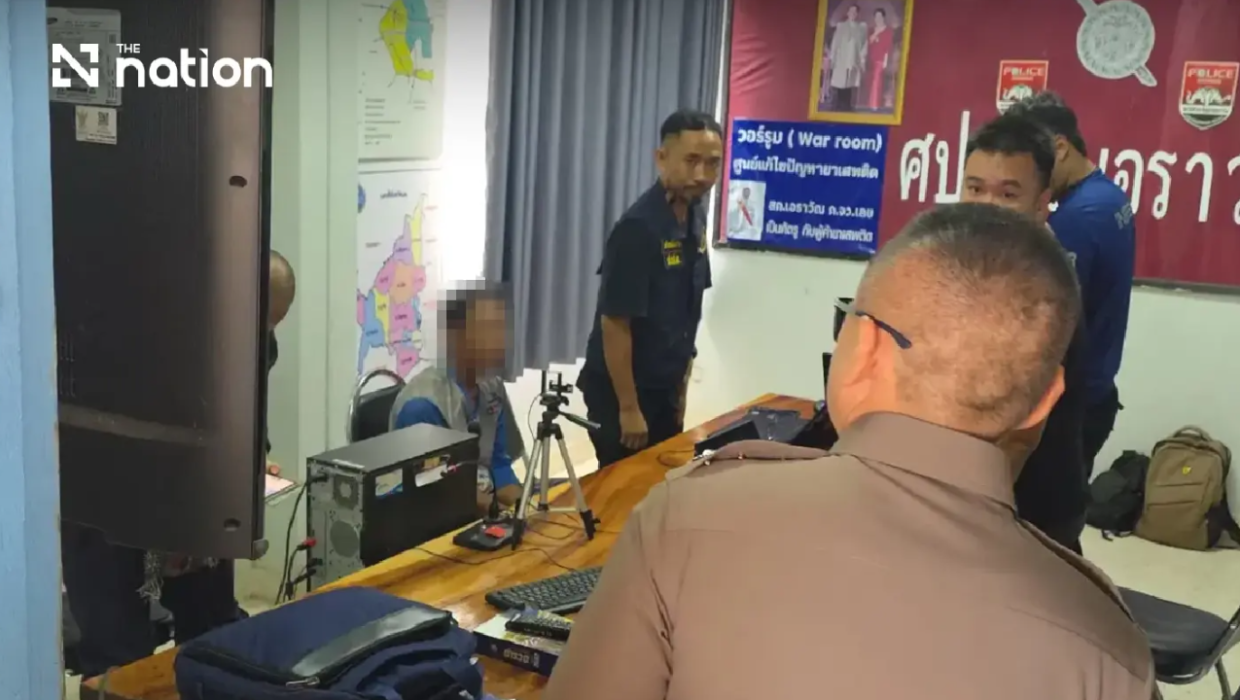
Authorities ultimately located Athit at Wat Tham Pha Mak Ho temple in Wang Saphung district, where he was engaged in roofing work. The Office of the Narcotics Control Board and allied police units coordinated the apprehension and subsequent interrogation at Erawan Police Station. During preliminary questioning, Athit allegedly made admissions that fundamentally implicated him in the parcel operation, providing a firsthand account of his participation in what investigators characterize as a systematic trafficking enterprise.
According to police records, Athit confessed to being compensated for dispatching parcels to Bangkok on six separate occasions, receiving approximately 8,000 baht per delivery. Three shipments were sent through a parcel service operating in Chiang Khan district itself, two originated from Ban That in That subdistrict, and one was dispatched from Erawan district. The most recent parcel, according to the confession, was sent on June 28. These details suggest an established routine rather than spontaneous criminal activity, indicating that Athit occupied a regular operational position within the trafficking pipeline.
Investigators subsequently apprehended Thatsaphon, identified as a Lao national and Athit's spouse, following the discovery of a black Mitsubishi Triton pickup truck bearing Loei registration plates parked in a rubber plantation within the Pha Nang-Pha Koeng area. During her initial questioning at Erawan Police Station, Thatsaphon denied knowledge of or involvement in the alleged operations. Her detention, however, suggests authorities viewed her presence in proximity to the vehicle and her relationship with Athit as factors warranting intensive investigation and further scrutiny through formal ONCB questioning procedures.
The identification of a Lao national within the trafficking network points to established cross-border smuggling patterns that exploit the porous boundaries and geographic proximity between Thailand and Laos. According to ONCB officials, the case exemplifies how sophisticated narcotics organizations structure their operations by employing individuals at different hierarchical levels, thereby creating compartmentalization that complicates detection and prosecution. By using lower-level operatives for specific tasks—parcel dispatch, delivery arrangements, and courier accompaniment—the networks minimize exposure of higher-level organizers and financiers to direct law enforcement risk.
The ONCB secretary-general emphasized that the cooperation between Thai and international law-enforcement agencies proved instrumental in tracing the operational connections from the Melbourne Airport seizure back through the Thai logistics network. This collaborative approach mirrors evolving best practices in Southeast Asian drug enforcement, where agencies increasingly recognize that narcotics trafficking operates across jurisdictions and requires coordinated intelligence sharing and joint investigative operations. The Melbourne arrest served as the critical intelligence spark that illuminated an entire operational chain within Thailand.
The investigation now enters an intensive phase where both Athit and Thatsaphon face questioning aimed at mapping the broader criminal enterprise. Authorities are specifically seeking to identify individuals who ordered the shipments, financial backers who funded operations, and any additional participants who may have facilitated logistics, transportation, or receiver functions. This expanded scope recognizes that the couple's roles were likely operational rather than strategic, suggesting significant upper-level targets remain unidentified within the network structure.
The ONCB has committed to intensified investigation and legal proceedings against all individuals implicated at every operational level. The agency simultaneously signaled a strategic pivot toward strengthening bilateral and multilateral cooperation with foreign law-enforcement partners. This encompasses enhanced capacity for intercepting transnational drug shipments at critical chokepoints, disrupting established trafficking routes, and targeting financial channels that sustain smuggling networks. The government's broader drug-suppression policy drives these institutional commitments.
For Malaysia and other Southeast Asian nations, the case underscores persistent vulnerabilities in the region's aviation security and courier networks that drug trafficking organizations continue to exploit. The use of airline personnel as smugglers reflects the accessibility and relative low-scrutiny of certain employment categories compared to traditional border crossing routes. As air travel recovery accelerates post-pandemic, regional authorities must coordinate enhanced screening protocols and intelligence sharing regarding suspicious booking patterns and personnel behavior anomalies that may indicate courier recruitment.

