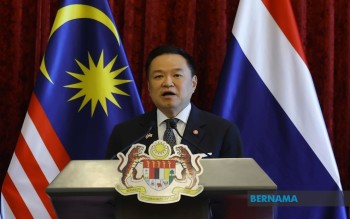
Thailand's Prime Minister Anutin Charnvirakul arrived in Kuala Lumpur on July 9 brimming with optimism about deepening commercial ties with Malaysia, declaring that the two neighbours are positioned to cross the US$30 billion bilateral trade threshold by 2027. Speaking at a joint press conference with Prime Minister Datuk Seri Anwar Ibrahim following an exchange of memoranda of understanding at Perdana Putra Complex in Putrajaya, Anutin framed the ambitious target as an achievable milestone rather than a distant aspiration, emphasising that ongoing collaborative efforts provide a realistic pathway to success.
The trade figure represents incremental but meaningful growth from current levels. Malaysia stands as Thailand's premier trading partner within ASEAN, with bilateral commerce presently valued at approximately US$28 billion annually. This positioning reflects the deep economic interdependencies that have developed between the two countries through decades of integration into regional supply networks and manufacturing ecosystems. The proximity of US$30 billion to the current baseline suggests that reaching the target will require sustained momentum rather than a dramatic acceleration, though both governments clearly view this as a priority that warrants high-level political attention and institutional focus.
Both leaders indicated that achieving this trade objective would serve as a foundation for broader regional cooperation. Anutin signalled Thailand's commitment to bolstering complementary value chains and supply chain architecture by leveraging the respective economic strengths of each country. Rather than competing directly in identical sectors, the approach recognises that Malaysia and Thailand occupy different positions within regional manufacturing and export ecosystems, creating natural opportunities for specialisation and cross-border cooperation. This strategic framing positions the trade target not merely as a numerical goal but as a catalyst for restructuring how the two economies interact and complement one another.
Three critical areas emerged as priority focal points for the deepened bilateral cooperation. Food security featured prominently, reflecting both nations' agricultural heritage and their role as significant producers and exporters within Asia-Pacific food systems. Energy security considerations underscore recognition that as regional economies face volatile global energy markets, cooperation on conventional and renewable energy infrastructure presents mutual benefits. The emphasis on digital economy development and high-tech industries signals both governments' understanding that future competitive advantage in manufacturing and services will increasingly depend on technological sophistication and digital infrastructure capabilities. These three pillars collectively suggest an economic partnership strategy extending well beyond traditional commodity trade.
Malaysia's Prime Minister Anwar Ibrahim pledged concrete institutional commitment to realising the trade target. He indicated that both the Ministry of Foreign Affairs and the Ministry of Investment, Trade and Industry would focus dedicated resources on the effort, acknowledging that achieving bilateral economic goals requires coordinated governmental action across multiple agencies. This approach reflects recognition that trade facilitation involves regulatory alignment, investment promotion, infrastructure development, and diplomatic support working in concert. By elevating the trade objective to a priority involving senior ministry attention, the Malaysian government has signalled seriousness about implementation rather than merely aspirational rhetoric.
Anwar additionally recognised that economic partnership must anchor broader bilateral relations. He stressed that fundamental economic cooperation and trade expansion should undergird friendship and collaboration across multiple fields, explicitly mentioning tourism as a complementary area where Malaysia and Thailand maintain significant mutual interests. Tourism integration speaks to how bilateral relationships increasingly encompass services, cultural exchange, and people-to-people connections alongside traditional goods trade. The recognition that economic ties strengthen diplomatic relationships reflects contemporary understanding that commercial interdependencies create incentives for political stability and conflict avoidance.
Antin's two-day official visit constituted his first journey to Malaysia since his reappointment as prime minister in March 2026. This timing carries diplomatic significance, suggesting that consolidating relationships with key regional partners formed a component of his early-term agenda. The bilateral meeting at Perdana Putra allowed both leaders to conduct comprehensive review of Malaysia-Thailand relations and identify priority areas for enhanced cooperation. Such high-level engagements serve essential functions in maintaining political relationships between neighbouring countries and ensuring that disagreements on any particular issue do not undermine the broader partnership architecture.
For Malaysian observers, the Thai commitment to pursuing expanded trade carries practical implications across multiple sectors. Manufacturing enterprises with regional supply chain exposure benefit from transparent, growing commerce frameworks. Investors considering operations in either country gain confidence from leadership attention to trade facilitation. Export-oriented businesses in agriculture, manufacturing, and services sectors can anticipate improved market access and potentially reduced non-tariff barriers as both governments prioritise the relationship. The explicit focus on high-tech industries and digital economy development also signals that both countries view technological cooperation as central to their future economic models.
The regional context further illuminates the significance of Malaysia-Thailand economic deepening. As ASEAN grapples with varying development levels and competing economic models among member states, successful bilateral partnerships between relatively advanced economies like Malaysia and Thailand demonstrate the possibility of mutually beneficial integration. Both countries have sophisticated manufacturing bases, established financial sectors, and aspirations toward middle-income or high-income status. Their cooperation on value chain development provides a model potentially replicable across ASEAN, showing how regional economies can specialise productively rather than duplicate inefficiently.
The joint commitment to new, more ambitious trade targets beyond the US$30 billion threshold indicates that both governments view this as an opening rather than a ceiling. The decision to convene the joint trade committee for setting subsequent targets suggests an institutionalised mechanism for continuously refreshing bilateral economic ambitions. This framework allows the partnership to adapt to changing regional circumstances, technological developments, and global economic shifts without requiring new high-level political negotiations for each adjustment. Such institutional flexibility enhances the durability of the bilateral relationship across different political administrations.
For Malaysia specifically, the deepening Thailand partnership contributes to a diversified regional engagement strategy. Rather than concentrating trade relationships on single partners or external powers, Malaysia benefits from robust ties with multiple ASEAN neighbours. The Thailand relationship strengthens Malaysia's position within regional frameworks and provides leverage in broader ASEAN negotiations by demonstrating successful bilateral models that could be extended multilaterally. Similarly, Thailand gains from the Malaysia partnership in maintaining its own regional stature and creating counterweights within Southeast Asian commerce.
The focus on supply chain and value chain cooperation reflects how contemporary trade extends beyond simple goods exchange to encompass complex production networks. Both Malaysia and Thailand participate extensively in regional and global value chains, particularly in electronics, automotive components, petrochemicals, and processed foods. Strengthening institutional cooperation around these networks—through regulatory harmonisation, investment protection frameworks, and infrastructure development—can reduce transaction costs and enhance competitiveness against non-Asian competitors. This dimension of the partnership extends economic significance beyond bilateral commerce statistics into questions of regional industrial competitiveness.
As both governments work toward the US$30 billion target by 2027, the broader implications extend to ASEAN's regional architecture and positioning within global trade negotiations. Demonstrating successful bilateral economic integration between major ASEAN members strengthens arguments for deeper regional integration and provides evidence that ASEAN economies can achieve significant mutual gains through cooperation. Against a backdrop of global trade uncertainties and shifting geopolitical alignments, the Malaysia-Thailand partnership exemplifies Southeast Asian resilience and the capacity of the region's economies to forge productive relationships based on complementary interests rather than competition.

