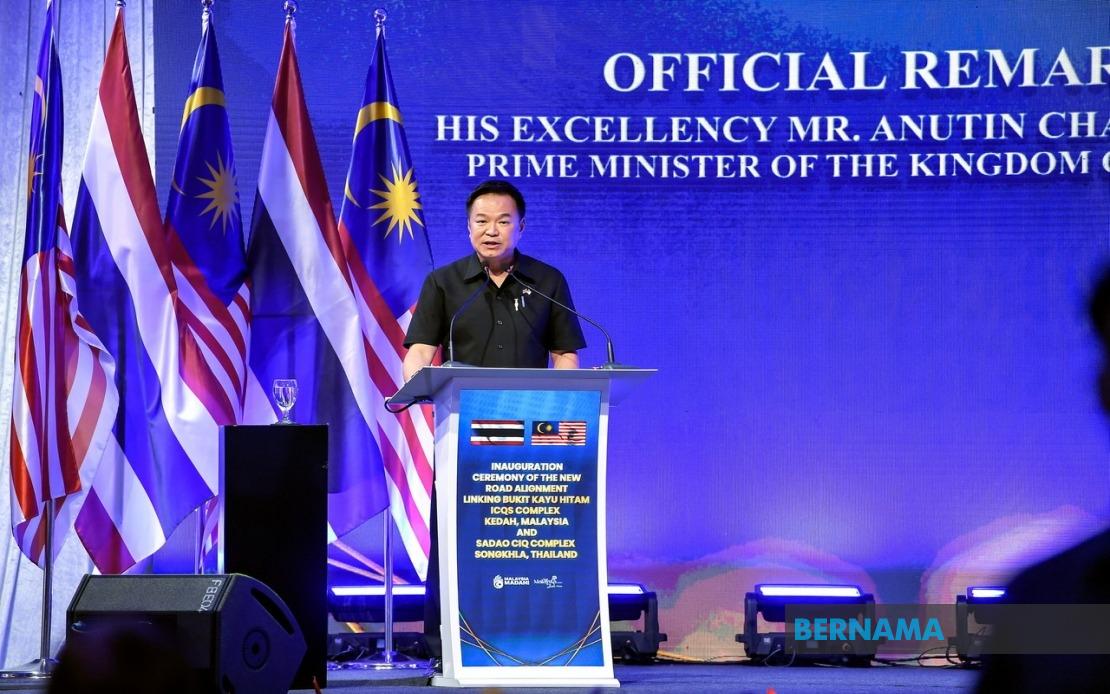
Thailand's government is intensifying efforts to eliminate infrastructure gaps that currently hamper the smooth flow of commerce and people across its border with Malaysia, with Thai Prime Minister Anutin Charnvirakul reaffirming this commitment at the inauguration of a newly aligned road connecting the two countries. Speaking at Bukit Kayu Hitam in Kedah, Anutin outlined an ambitious vision where completed transport connections would eventually enable seamless movement of goods from Malaysia through Thailand to markets in China, Russia, and beyond. The initiative reflects growing recognition in Bangkok that upgrading physical infrastructure is fundamental to capturing untapped trade opportunities that could benefit economies on both sides of the border.
The centrepiece of the current effort is a newly constructed road alignment linking the Sadao Customs, Immigration and Quarantine Complex in Thailand with the Bukit Kayu Hitam Immigration, Customs, Quarantine and Security Complex in Kedah. Both Malaysian Prime Minister Datuk Seri Anwar Ibrahim and Anutin jointly inaugurated this facility, symbolising the bilateral commitment to improving regional connectivity. This specific corridor has become increasingly critical given that the Bukit Kayu Hitam checkpoint ranks among the busiest land crossings on the Malaysia-Thailand border, regularly experiencing significant congestion that impedes trade flows and extends processing times for cross-border travellers.
The new road represents the culmination of coordinated planning between Bangkok and Kuala Lumpur to address longstanding bottlenecks at this vital junction. By streamlining the physical layout and routing of traffic through redesigned infrastructure, authorities anticipate measurable reductions in wait times and smoother transitions for both commercial vehicles and private travellers. The improved efficiency carries particular significance for the logistics sector, where time delays translate directly into operational costs. Transport companies operating across the frontier have long cited the Bukit Kayu Hitam crossing as a constraint on their ability to serve markets throughout mainland Southeast Asia competitively.
Beyond the immediate Bukit Kayu Hitam project, Thai officials are eyeing broader connectivity initiatives that would link additional border regions. Anutin specifically mentioned planned enhancements to transport networks in the Songkhla-Kedah, Satun-Perlis, and Narathiwat-Kelantan corridors. These multi-corridor approach suggests that Bangkok views border infrastructure as part of a comprehensive strategy to revitalise southern Thailand's economy, a region that has historically lagged behind central and northern provinces in development metrics. The interconnected nature of these proposed projects indicates that policymakers on both sides recognise southern Thailand and northern Malaysia possess complementary economic advantages that remain largely untapped due to current infrastructure limitations.
The connectivity initiative functions bidirectionally, meaning improvements benefit Thai exporters seeking access to Malaysian markets and beyond just as much as Malaysian traders looking to penetrate Thai and continental markets. Anutin highlighted how enhanced transport links would facilitate the movement of Thai and Chinese goods through Malaysia towards Singapore and Indonesia, expanding the geographic reach of these supply chains. This observation underscores a critical strategic calculus: improved infrastructure at the Malaysia-Thailand frontier creates value not only for bilateral trade but for broader regional commerce within ASEAN and beyond.
From Malaysia's perspective, enhanced connectivity with Thailand opens pathways to deeper integration with mainland Southeast Asia's supply chains. Malaysian manufacturers and service providers increasingly recognise that direct access to Thai, Cambodian, Laotian, and Vietnamese markets is essential for growth. The current infrastructure gaps create artificial friction costs that make such regional participation less attractive than it might otherwise be. Completion of missing transport links could shift the competitive calculus, making Malaysia a more efficient conduit for goods and services moving through Southeast Asia. For Malaysian logistics companies and exporters, these improvements translate into expanded market opportunities and lower operational expenses.
Anwar's participation in the inauguration ceremony and his wife Datuk Seri Dr Wan Azizah Wan Ismail's attendance at formal proceedings underscored Malaysia's political commitment to the infrastructure initiative. Anutin's two-day official visit to Malaysia, conducted at Anwar's invitation, provided the occasion for discussing not only the completed road project but broader bilateral cooperation frameworks. Both leaders acknowledged that infrastructure alone is insufficient; they committed to addressing regulatory and procedural issues that continue to create friction in cross-border movement, including streamlining customs procedures and facilitating easier passage for citizens of both nations.
The emphasis on resolving outstanding procedural issues alongside physical infrastructure reflects mature understanding among policymakers that seamless regional integration requires attention to both hard and soft infrastructure. Modern supply chains depend not only on physical roads and ports but on predictable, efficient regulatory environments. The discussions between Anwar and Anutin signal recognition that removing bureaucratic bottlenecks carries equal weight with completing road projects. This holistic approach to connectivity—combining physical infrastructure with institutional and procedural improvements—offers Malaysian and Thai stakeholders a more credible pathway toward realising the regional trade benefits that the project promises.
The broader implications for Southeast Asia extend beyond bilateral Malaysia-Thailand relations. The peninsula's geography positions it as a natural land bridge connecting the ASEAN core with continental China. Improved infrastructure along the Malaysia-Thailand corridor strengthens the viability of land-based trade routes connecting East Asia with Southeast Asia, potentially reducing regional economies' dependence on sea routes that face geopolitical uncertainties. For Malaysia specifically, enhanced overland connectivity with Thailand and beyond presents opportunities to position itself as a crucial node in emerging land-based trade corridors, potentially justifying investments in complementary infrastructure on the Malaysian side.
The economic potential unlocked by enhanced connectivity proves particularly significant for communities along the Malaysia-Thailand border. Anutin explicitly recognised that improved transport links would generate employment opportunities and improve living standards for border populations in both countries. Border regions often experience development challenges compared to national centres, partly because geographic peripherality discourages business investment. Infrastructure improvements that reduce transport costs and time can catalyse entrepreneurial activity in these communities, whether in small-scale trading, tourism, or regional manufacturing. The emphasis on local economic development alongside national trade benefits reflects recognition that connectivity initiatives must deliver tangible gains to the populations most directly affected.
Moving forward, the success of the Bukit Kayu Hitam road project and broader connectivity initiatives will depend substantially on follow-through implementation. Completing announced projects in the Songkhla-Kedah, Satun-Perlis, and Narathiwat-Kelantan corridors requires sustained political commitment from both governments, adequate budgetary allocations, and effective project management. For Malaysian observers, monitoring Thai implementation of promised infrastructure improvements provides useful insight into Bangkok's seriousness about regional integration. Similarly, Malaysian investments in complementary border infrastructure would signal Kuala Lumpur's commitment to maximising the benefits of improved connectivity. The ultimate test of these initiatives will be whether completed infrastructure translates into measurable increases in bilateral and regional trade volumes and genuine improvements in cross-border mobility.

