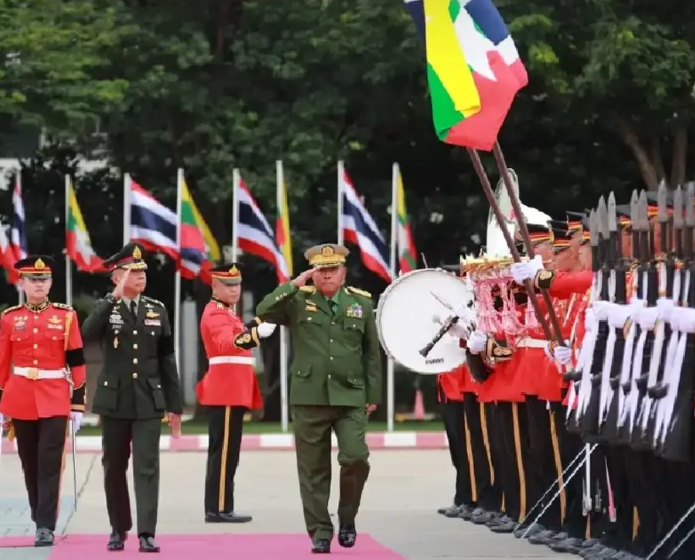
Thailand's military establishment rolled out official ceremonies for Myanmar's military chief Ye Win Oo when he arrived in Bangkok on Thursday for what amounted to a symbolic shift in regional diplomacy. The visit represented Ye Win Oo's inaugural journey abroad since assuming his position, underscoring Myanmar's accelerating diplomatic offensive as the country's ruling generals attempt to shed years of international isolation and pariah status. Thai military chief Ukris Boontanondha presided over the formal reception at a Bangkok hotel, signalling the Thai government's willingness to normalize relations with a regime long condemned by human rights organisations and Western capitals.
Myanmar's recent political trajectory remains shadowed by the 2021 military coup that toppled an elected government and imprisoned its leader Aung San Suu Kyi. The takeover triggered a devastating civil war that has claimed an estimated 100,000 lives and subjected the country to sustained international criticism over documented patterns of extrajudicial killings, torture, and systematic human rights violations. Ye Win Oo himself carries significant baggage as a former spymaster and coup conspirator, prompting sanctions from the United States and other Western nations. Yet this troubling past has not deterred Bangkok from extending formal hospitality, a decision that reveals the complicated calculus of regional statecraft where geographic proximity and shared border concerns often outweigh concerns about governance and human rights.
The junta's attempts at rehabilitation centre on heavily restricted parliamentary elections staged in early 2026, which the military has framed as evidence of a return to democratic normalcy. Following those polls, Min Aung Hlaing, the general who orchestrated the original 2021 coup, transitioned to a civilian presidential role while elevating Ye Win Oo to lead the armed forces. The manoeuvre represented a cosmetic restructuring designed to present military rule in fresh clothing while maintaining substantive control over state apparatus and policy. International observers and democracy advocates have dismissed the elections as theatrical, noting that they excluded popular political figures, banned opposition parties, and proceeded under conditions of severe repression.
The bilateral discussions between Bangkok and Naypyidaw are expected to concentrate on the porous 2,400-kilometre frontier separating the two nations, where Myanmar's ongoing civil conflict has generated regional instability and humanitarian spillovers. For Thailand, bordering a conflict zone poses tangible security and economic challenges, from refugee flows to arms smuggling and cross-border criminal networks. These practical concerns provide justification for Bangkok's diplomatic recalibration, which prioritises managing immediate neighbourhood problems over abstract principles regarding democratic governance or human rights compliance. The pragmatic approach reflects how Southeast Asian nations frequently balance ideological preferences with the demanding realities of border management and regional stability.
Thailand's diplomatic realignment became more visible earlier this month when Prime Minister Anutin Charnvirakul extended red-carpet treatment to Min Aung Hlaing during a state visit to Bangkok. When questioned about hosting Myanmar's coup architect, Thai Foreign Minister Sihasak Phuangketkeow offered a dismissive rationale, declaring that the Thai government's engagement reflected not endorsement of legitimacy but rather acknowledgment of existing power structures and unavoidable diplomatic necessity. This framing—emphasising realpolitik over principle—reflects how regional states categorise Myanmar as a functional reality requiring management rather than a pariah deserving isolation. Bangkok's position finds support among other neighbouring capitals facing similar border and stability challenges, creating a tacit regional consensus that diplomatic engagement serves national interests more effectively than prolonged ostracism.
Yet Thailand's embrace of Myanmar's military leadership has generated sharp criticism from international observers and advocacy organisations. The Special Advisory Council for Myanmar, a campaign group monitoring the country's political situation, condemned Bangkok's diplomatic pivot as morally compromising, suggesting that by welcoming coup perpetrators and military strongmen, Thailand had forfeited credibility as a regional voice for human rights and democratic principles. The council's statement characterised the decision to host Ye Win Oo as compounding Thailand's damage to its international reputation, using particularly harsh language to underscore the perceived inconsistency between Thailand's stated values and its diplomatic practice.
The timing of these visits occurs against backdrop of escalating military violence documented by international monitoring bodies. The United Nations' Independent Investigative Mechanism for Myanmar released findings last week detailing an intensifying campaign of aerial strikes targeting civilian population centres. The UN report additionally catalogued persistent patterns of arbitrary detention, torture infliction, and sexual violence perpetrated by Myanmar's armed forces against non-combatants and detainees. These documented abuses form part of a systematic pattern suggesting that military leadership in Naypyidaw has neither halted nor reformed conduct generating international alarm. Myanmar's government rejected the UN findings as biased and unsubstantiated, dismissing the allegations as propaganda rather than engaging substantively with specific documented incidents.
The divergence between regional pragmatism and international principle reflects deeper tensions within the contemporary global order. Myanmar's military has calculated that neighbouring Southeast Asian states, prioritising border stability and commercial relations over governance concerns, will eventually accommodate the post-coup political structure. Bangkok's receptivity to military delegations suggests this calculation contains validity, at least regarding Thailand's approach. However, this regional accommodation does not extend universally; Western capitals and international institutions continue imposing sanctions and withholding legitimacy from Myanmar's junta-dominated government. The result is a bifurcated international response where Myanmar experiences simultaneous isolation and gradual rehabilitation depending on geographical and strategic context.
For Malaysia and other Southeast Asian observers, Thailand's diplomatic recalibration toward Myanmar carries implications beyond bilateral relations. The precedent suggests that ASEAN members increasingly prioritise managing immediate neighbourhood challenges over coordinated regional stands on governance or human rights. This trend could reshape how the bloc approaches future political crises, potentially reducing pressure on future coup perpetrators or authoritarian consolidators within the region. Simultaneously, Thailand's willingness to host Myanmar's military leadership may complicate ASEAN's already inconsistent stance on Myanmar, where the bloc has simultaneously condemned the coup, maintained nominal engagement with the junta, and avoided enforcement of its own stated principles regarding democratic legitimacy and human rights protection.

