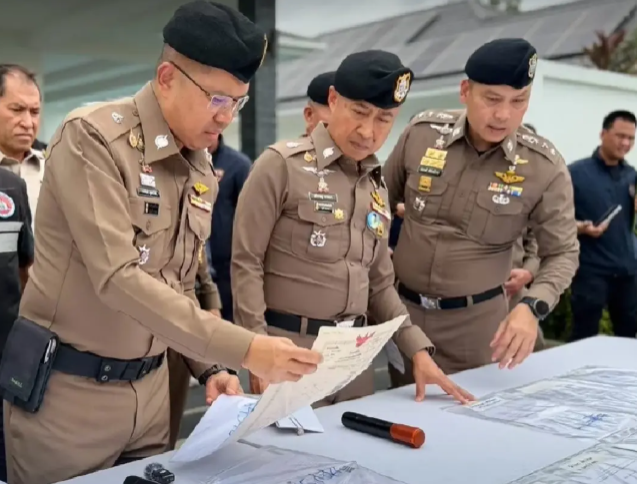
Thai authorities have intensified their campaign against illegal foreign property ownership schemes, with police arresting 13 foreign nationals across 15 locations in the popular beach destination of Hua Hin. The operation, representing the sixth phase of a coordinated nationwide investigation, deployed over 200 officers and government officials to Prachuap Khiri Khan province, where courts had previously authorised arrest warrants for 45 foreigners. The detainees included nationals from Britain, China, Italy, France, the Netherlands, Austria, the Philippines and the United States, all suspected of involvement in structures designed to circumvent Thailand's restrictions on foreign land ownership.
The scale and sophistication of the alleged scheme underscores growing concerns about how well-resourced foreign networks have systematised property acquisition in Thailand. Police investigations suggest that foreign purchasers, often advised by legal and accounting firms, have created shell companies with Thai nationals serving as nominee shareholders who claim to hold no beneficial interest in the enterprises. The properties at the centre of this latest phase include high-end detached houses and modern pool villas in Thap Tai subdistrict, individually valued between 10 and 20 million baht, reflecting the luxury end of Thailand's property market.
When questioned, Thai shareholders allegedly admitted they had never actually paid for their shares, received no financial documentation, and exercised no management control over the companies supposedly bearing their names. This testimony reveals a concerning pattern of organised deception in which Thai nationals become unwitting or complicit participants in schemes that appear designed specifically to obscure foreign beneficial ownership. The statements raise questions about how extensively such arrangements have proliferated across Thailand's property sector and whether enforcement agencies possess adequate resources to detect similar schemes operating less visibly.
The broader investigation encompasses 33 companies suspected of holding property on behalf of foreign nationals, with the combined value of assets under scrutiny reaching approximately 300 million baht. Authorities seized company registration documents, accounting records, computers, mobile phones and electronic data during Monday's operation, materials that investigators will now analyse to reconstruct financial trails and identify any networks extending beyond Thailand's borders. This financial forensics component represents an important shift in approach, moving beyond individual prosecutions toward mapping organised criminal or commercial infrastructure.
For Malaysia and other Southeast Asian nations observing this enforcement action, the implications warrant careful consideration. Thailand's crackdown reflects regulatory pressure to enforce constitutional provisions limiting foreign land ownership, provisions that mirror restrictions in place across the region, including Malaysia. The sophistication of the schemes being uncovered suggests that foreign purchasers seeking to circumvent these legal restrictions possess considerable resources and access to professional advisory services, raising questions about whether legal and accounting firms operating regionally may facilitate similar arrangements elsewhere. Malaysia's own regulatory framework, while generally stricter than Thailand's, could face comparable pressures and may benefit from coordination with Thai authorities in identifying transnational networks.
The investigation's earlier phases provide context for the scope of the problem. Previous operations in Koh Phangan, Phuket, Phang Nga, Krabi, Chonburi and Chiang Mai examined 233 land parcels and structures spanning more than 25.6 hectares, with an estimated combined value exceeding 2.539 billion baht. Courts issued 133 arrest warrants from those earlier phases, while convictions reached 20 cases, suggesting that initial prosecutions are proceeding through Thailand's judicial system. These figures indicate that the phenomenon is neither isolated nor recent, but rather represents an established pattern that has operated with apparent impunity for some time.
What distinguishes this crackdown from routine property investigations is its explicit focus on identifying professional intermediaries who have enabled these arrangements. Police indicated that investigations would examine law firms and accounting practices suspected of advising foreign clients on corporate structures designed to obscure ownership, as well as any government officials potentially complicit through corruption or administrative negligence. This broader accountability framework suggests authorities recognise that enforcement against individual foreign purchasers alone proves insufficient without targeting the professional infrastructure that has facilitated such schemes at scale.
The Royal Thai Police have indicated that the campaign specifically targets unlawful foreign-backed businesses and nominee structures, explicitly stating that legitimate foreign investors operating in compliance with Thai law remain outside the investigative scope. This clarification matters for Thailand's investment climate, as excessive enforcement against law-abiding foreigners could deter legitimate business and tourism investment in a sector vitally important to the Thai economy. The distinction also suggests authorities wish to preserve Thailand's appeal as a destination for compliant foreign investors whilst removing the structural opportunities that have allowed non-compliant actors to acquire property immunity.
The investigation raises important questions about the role of professional service providers in enabling potential law violations. Legal and accounting firms advising foreign clients on Thai property acquisition face a critical juncture in their regulatory environment. Thai authorities' signals about potential investigation of these intermediaries create incentives for such firms to ensure their advice remains strictly compliant with Thai law, fundamentally altering how foreign property transactions are structured and documented going forward. For regional firms providing cross-border advisory services, this enforcement action serves as a pointed reminder that facilitating nominee schemes or misleading clients about legal permissibility carries significant professional and criminal liability.
Looking forward, Thai authorities have signalled commitment to sustained enforcement, with the Royal Thai Police announcing plans to continue investigating suspected nominee networks and foreign-funded entities across tourist destinations nationwide. Members of the public can report suspected illegal foreign business activity through local police stations or the police hotline 1599. This public reporting mechanism suggests authorities recognise that systematic enforcement requires citizen participation and intelligence gathering from within communities where such schemes operate, a practical acknowledgement that policing such sophisticated financial structures demands community engagement alongside investigative sophistication.
The Hua Hin operation's timing and scale reflect Thai determination to enforce property ownership restrictions consistently, particularly in tourism hotspots where foreign purchaser interest and transaction volumes remain highest. For Malaysia's own regulatory authorities, Thailand's experience provides valuable lessons about the persistence of foreign circumvention attempts, the importance of coordinated multi-agency operations, and the necessity of targeting professional intermediaries alongside individual purchasers. As Southeast Asian nations navigate pressures toward financial liberalisation and foreign investment attraction, maintaining effective enforcement of land ownership restrictions requires precisely the kind of sustained, resource-intensive investigation Thailand has undertaken across multiple provinces and phases.

