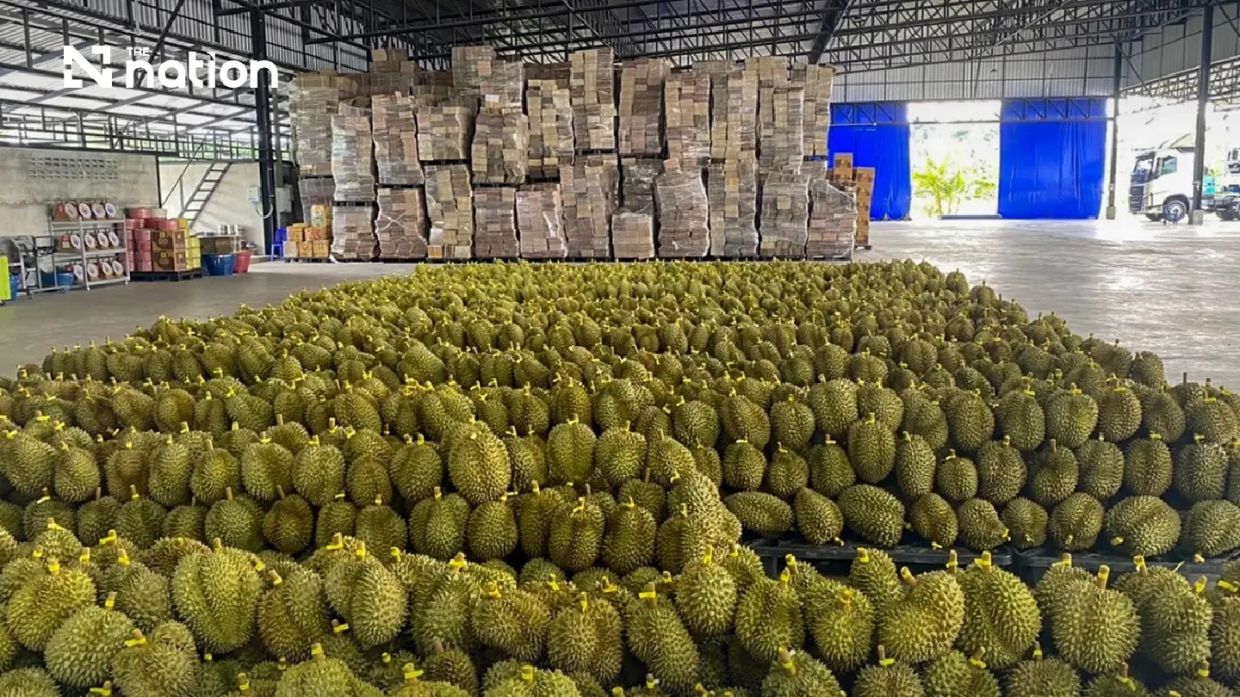
Thailand has reached a watershed moment in its durian trade with China, with fresh exports exceeding THB100 billion in value during the first half of 2026—a breakthrough built on systematic overhaul of quality management and enforcement of tougher standards across the entire supply chain. The shipment comprised over 870,000 tonnes transported in more than 53,600 containers, representing both a volume and value milestone that signals the country's strengthening grip on the world's most valuable durian market. This achievement comes as the government targets THB150 billion in full-year exports, positioning Thailand's premium fruit sector as a critical pillar of agricultural growth amid broader economic challenges facing Southeast Asia.
The breakthrough reflects a deliberate shift in how Thailand manages agricultural exports, moving away from reactive problem-solving towards a proactive, system-wide framework. Under the direction of Agriculture Minister Suriya Jungrungreangkit, who undertook a comprehensive review during his first 90 days in office, Thai authorities implemented the "Four Nos" protocol: zero immature fruit, zero worms, zero false origin claims, and zero contamination with Basic Yellow 2, a synthetic dye that had repeatedly triggered rejections by Chinese authorities. This standardised approach, integrated across government agencies and private operators, streamlined inspection procedures and accelerated logistics without compromising safety or quality assurance.
The importance of this structural reform cannot be overstated for Malaysian observers. Thailand's success in rebuilding buyer confidence demonstrates how rigorous supply chain governance can overcome past performance gaps and compete in increasingly stringent international markets. For Malaysian agricultural exporters in durian, cocoa, palm oil and other sectors, the Thai model offers a cautionary tale: maintaining quality standards and traceability systems is not merely compliance overhead but a competitive necessity that directly translates to market access and premium pricing. As regional trade intensifies and Chinese buyers become more selective, suppliers across Southeast Asia face similar pressures.
The Ministry of Agriculture and Cooperatives assigned the Department of Agriculture as the lead agency, coordinating closely with the National Bureau of Agricultural Commodity and Food Standards, provincial authorities, laboratories, customs agencies and Chinese regulatory counterparts. This multi-stakeholder approach represents institutional sophistication in managing complex cross-border agricultural flows. The integration of electronic phytosanitary certificates (e-Phyto) with traceability systems from farm to port created unprecedented transparency, enabling faster detection and resolution of issues before consignments reached destination.
Basic Yellow 2 contamination and cadmium residues emerged as critical problem areas that had shaken Chinese confidence in Thai supplies. By deploying science-based risk management tools and the four-layer PLUS screening measure targeting plant pests, Thai officials addressed root causes rather than symptoms. This preventive stance reduced reliance on post-shipment inspections and created operational efficiency that benefited both exporters and importing authorities. Faster clearances mean fresher fruit reaching Chinese retailers and consumers, strengthening Thailand's reputation for quality even as competitors jostle for market share.
The durian trade's recovery carries significance beyond the fruit itself. Thailand's dominance in fresh durian exports—commanding roughly two-thirds of global trade—makes this sector a bellwether for the country's broader agricultural competitiveness and government capacity to implement complex regulatory frameworks. If the Ministry can replicate this model for mango, pineapple, and rubber exports, the implications for Thailand's rural economy and farmer incomes are substantial. Minister Suriya explicitly framed this achievement as foundational work that stabilises farmer livelihoods, enhances operator competitiveness, and sustains Thailand's position as a world-class exporter.
For regional context, the expansion into the Chinese market underscores the centrality of Beijing's demand in shaping Southeast Asian agricultural production and export strategies. China's increasingly sophisticated import standards—driven by rising consumer awareness and tighter food safety regulations—are reshaping supply chains across the region. Thai authorities recognised that simply producing durian was no longer sufficient; producing durian that meets evolving Chinese specifications became the price of market access. This dynamic mirrors broader trends in electronics manufacturing, automotive components, and food processing where supply chain standards are dictated by the largest buyer.
The shift toward what Director-General Rapibhat Chandarasrivongs termed "Smart Regulation"—leveraging science, technology and risk management rather than heavy-handed inspections—reflects a modernisation of state capacity in agricultural governance. By using data linkages between production sources, packing facilities and testing labs to inform phytosanitary certificates, Thai authorities reduced administrative burden on smallholder farmers and exporters while paradoxically increasing oversight precision. This approach merits study by other Southeast Asian governments grappling with how to upgrade standards without stifling smallholder participation in export agriculture.
The THB100 billion first-half milestone also signals demand resilience in China despite broader trade tensions and economic headwinds affecting the region. Chinese consumers' appetite for premium imported fruit—particularly durian, which carries lifestyle and luxury associations—has remained robust. This demand provides crucial export revenue for Thailand and supports prices that incentivise quality investment by producers. However, this dependency on a single buyer market also introduces risk; any Chinese policy shift regarding agricultural imports or domestic production subsidies could rapidly reshape the sector's economics.
Looking forward, the government's full-year target of THB150 billion hinges on sustaining the quality standards achieved in the first half, expanding shipment volumes, and managing the seasonality of durian production. The peak season typically spans May to August, so second-half performance will prove whether first-half gains were anomalies or sustainable achievements. Moreover, as Thailand scales exports, maintaining consistent quality across thousands of small and medium producers becomes exponentially harder. The traceability systems and multi-agency coordination installed this year will face their true test during peak volumes.
For Malaysia, observing Thailand's durian export success carries practical implications. While Malaysia ranks among the top durian producers globally, its export volumes and market penetration lag Thailand's. The Thai experience suggests that achieving greater penetration in China requires not just production capability but credible, institutionalised quality assurance that reassures cautious importers. Malaysian agencies overseeing durian and other premium exports should consider whether current regulatory frameworks embody similar sophistication in traceability, transparency, and science-based risk management. As competition for Chinese market share intensifies, the jurisdictions that embed quality governance into their DNA, rather than imposing it episodically, will capture disproportionate market value.
Ultimately, Thailand's THB100 billion durian export achievement reflects a maturation of supply chain management that extends far beyond a single commodity. It demonstrates how government coordination, technology adoption, and commitment to international standards can transform agricultural sectors and sustain competitive advantage. Minister Suriya's framing of this success as laying foundations for a robust, transparent, traceable, and internationally accepted agricultural management system suggests the Thai government recognises durian exports as a model for broader sectoral upgrading. For Southeast Asian policymakers confronting similar challenges in food safety, trade compliance, and market access, Thailand's durian story offers both inspiration and a concrete blueprint for what institutional reform can achieve.

