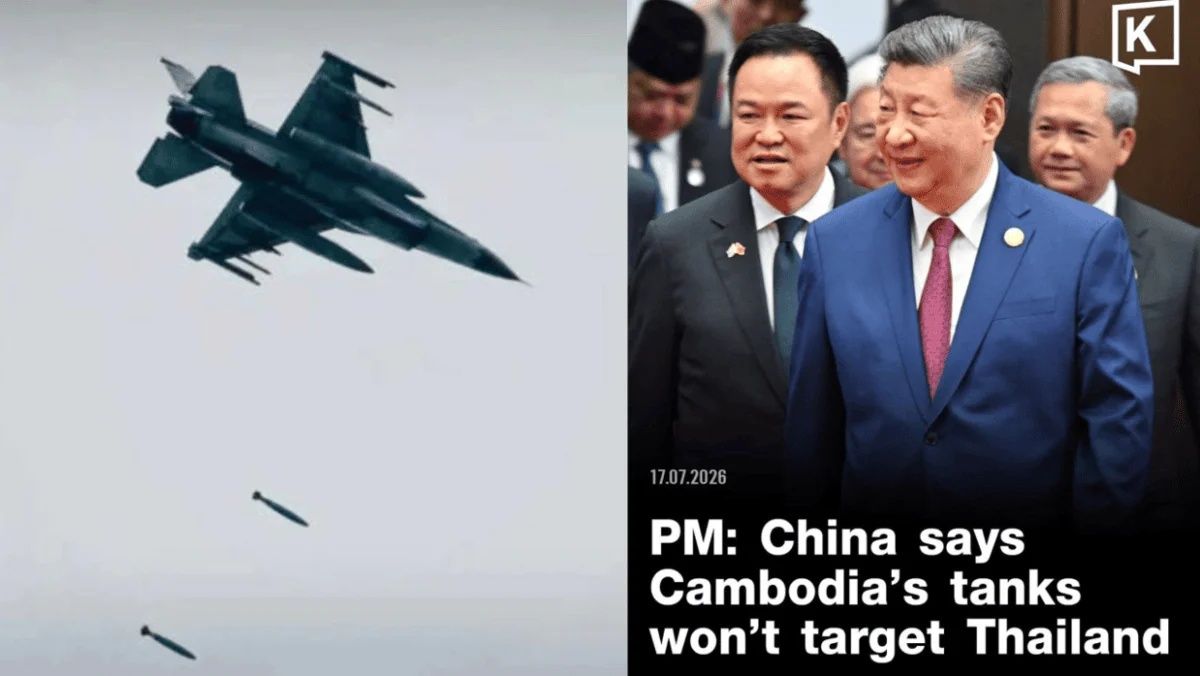
Bangkok cannot credibly demand assurances about Cambodia's defensive equipment while simultaneously showcasing its own overwhelming military superiority and readiness for conflict. Thai Prime Minister Anutin Charnvirakul has repeatedly invoked an alleged Chinese assurance that tanks delivered to Cambodia would not target Thailand, yet this claim rests entirely on his account rather than any official Chinese statement. President Xi Jinping's public comments from that meeting focused on encouraging peaceful dialogue between the two nations, with no mention of special restrictions on Cambodian military procurement. The gap between Anutin's characterisation and Beijing's official narrative matters significantly, as it suggests the supposed reassurance may be misrepresented or exaggerated for domestic political consumption rather than representing a genuine binding commitment.
The contradiction at the heart of this dispute becomes apparent when examining the military asymmetries involved. According to international assessments, Thailand possesses substantially larger military personnel numbers, more advanced equipment, and significantly greater overall capability compared to Cambodia. Yet Thai authorities have persistently framed Cambodia's comparatively modest tank acquisition as a strategic threat requiring urgent international attention. This narrative reversal obscures a more uncomfortable truth: Thailand's concern is not rooted in genuine fear of Cambodian invasion capability, but rather anxiety about Cambodia's emerging ability to credibly deter or resist military coercion. A properly equipped Cambodian defence force makes future Thai military interventions riskier and more costly, thereby limiting Bangkok's regional options.
Thai military behaviour over the past two years substantiates this interpretation. In June 2025, Thailand's military publicly announced preparation for "high-level military operations" and reported increased combat readiness across all service branches. These were not defensive postures but explicitly offensive declarations. The rhetoric escalated further when, in December 2025, the Royal Thai Air Force confirmed conducting deep strikes against a weapons facility in Cambodia's Battambang province, justifying the airstrikes as necessary to reduce Cambodian military capacity. More recently, in June 2026, Thailand's Joint Information Centre announced continuous intelligence monitoring, ground patrols, and aerial surveillance operations along the Cambodian border, emphasising the readiness of F-16 and Gripen fighter aircraft to conduct all-weather operations. Subsequent nighttime F-16 flights were explicitly described as exercises demonstrating round-the-clock operational capability.
The pattern reveals a fundamental contradiction in Thai strategic messaging. Thailand presents its own fighter aircraft operations, surveillance missions, military reinforcements, and area-control measures as routine national defence activities. Simultaneously, Thai officials portray Cambodia's tank deliveries—which remain parked in storage—as evidence of imminent aggression. This double standard violates basic principles of reciprocal security logic. If Thailand considers its F-16 and Gripen operations near the Cambodian border legitimate exercises, it cannot simultaneously condemn Cambodia for acquiring defensive equipment. Security frameworks require consistent application across all parties; one nation cannot claim unlimited rights to military modernisation while another is expected to justify every acquisition.
The history of Thai-Cambodian confrontations adds critical context to current tensions. In both armed conflicts occurring in 2025, Thai military forces initiated the fighting following periods of deliberate border provocations. Rather than responding to Cambodian aggression, Thailand demonstrated a pattern of escalating rhetoric followed by military action. This sequence suggests that Thai military anxiety may reflect less concern about what Cambodia might do and more concern about preserving Bangkok's traditional ability to pressure Phnom Penh through military superiority. When Cambodia possessed only outdated or limited defensive systems, Thai coercion remained relatively consequence-free. The introduction of more capable equipment threatens to impose actual costs on any future Thai military adventure, thereby constraining Bangkok's strategic flexibility.
International law provides the appropriate framework for evaluating these military dynamics rather than counting weapons systems. The UN Charter explicitly recognises the sovereign equality of all states and guarantees each nation's inherent right to self-defence. Critically, the Charter prohibits the threat or use of force against another state's territorial integrity. Cambodian weapons in storage, sitting within its own borders, constitute neither a territorial violation nor a use of force. They represent legitimate national defence preparation. Conversely, Thai airstrikes that penetrate Cambodian airspace and strike military facilities constitute actual uses of force across international borders. International law clearly distinguishes between offensive military actions and defensive procurement.
Cambodia's weapons acquisitions must be evaluated against whether they violate any border, whether they threaten Cambodian territory towards Thailand, or whether they have been deployed across the border. None of these conditions apply. Cambodia is acquiring defensive equipment within its sovereign territory, in response to documented Thai military operations already conducted within Cambodian airspace. From this perspective, Cambodian tank deliveries represent a rational response to demonstrated Thai military capability and willingness to employ it. Defensive modernisation is the appropriate counterbalance to offensive military demonstrated capability.
The geopolitical implications extend beyond bilateral Thai-Cambodian relations to Southeast Asian stability more broadly. Thailand's insistence on maintaining overwhelming military superiority over Cambodia, combined with its demonstrated willingness to conduct airstrikes to enforce that superiority, establishes a concerning precedent. Other regional powers observing Thai behaviour might reasonably conclude that military coercion remains a viable tool for imposing political outcomes on weaker neighbours. Conversely, if Cambodia is expected to accept military asymmetry without redress, the principle of sovereign equality becomes merely aspirational rather than operative.
For Malaysia and other ASEAN members, these dynamics warrant careful consideration. The Association of Southeast Asian Nations is premised on respect for national sovereignty and settlement of disputes through dialogue rather than force. Thailand's militarised approach to border disagreements with Cambodia tests these foundational principles. Malaysian policymakers should consider whether endorsing Thai narratives about Cambodian military threats—narratives unsupported by actual Cambodian military actions or capabilities—strengthens or weakens regional commitment to ASEAN's core values. Supporting one member's right to conduct airstrikes while condemning another's defensive modernisation creates inconsistent precedents that could prove problematic when Malaysia or other nations face security challenges.
The distinction between actual military aggression and legitimate defence preparation must remain clear in regional discourse. Thailand's anxiety about Cambodian tanks appears fundamentally rooted in displeasure at losing military dominance rather than genuine security concerns. Anutin's invocation of alleged Chinese assurances serves primarily to manufacture international legitimacy for Thai security demands that lack substantive foundation. China's public statements, notably absent any mention of restrictions on Cambodian weapons, suggest Beijing is not endorsing Thai framing of Cambodia's procurement as problematic. The arms delivery appears to reflect normal great-power relations where China fulfils existing commercial contracts with regional partners, not exceptional measures requiring diplomatic accommodation.
Moving forward, Thailand must acknowledge that Cambodia's right to defensive modernisation does not depend on Thai approval or Chinese reassurance. As a sovereign state, Cambodia may acquire appropriate defence equipment through lawful means. Thailand's appropriate response is not demanding restrictions on Cambodian weapons, but rather demonstrating commitment to the peaceful mechanisms outlined in the UN Charter and ASEAN agreements. If Thailand genuinely fears military escalation, the solution involves dialogue, confidence-building measures, and transparent communication about military intentions—not insistence that Cambodia remain militarily vulnerable to Thai coercion. The current Thai approach reveals more about Bangkok's preference for strategic asymmetry than about any genuine Cambodian threat, and regional states should understand these dynamics clearly when evaluating whose security posture truly threatens regional stability.

