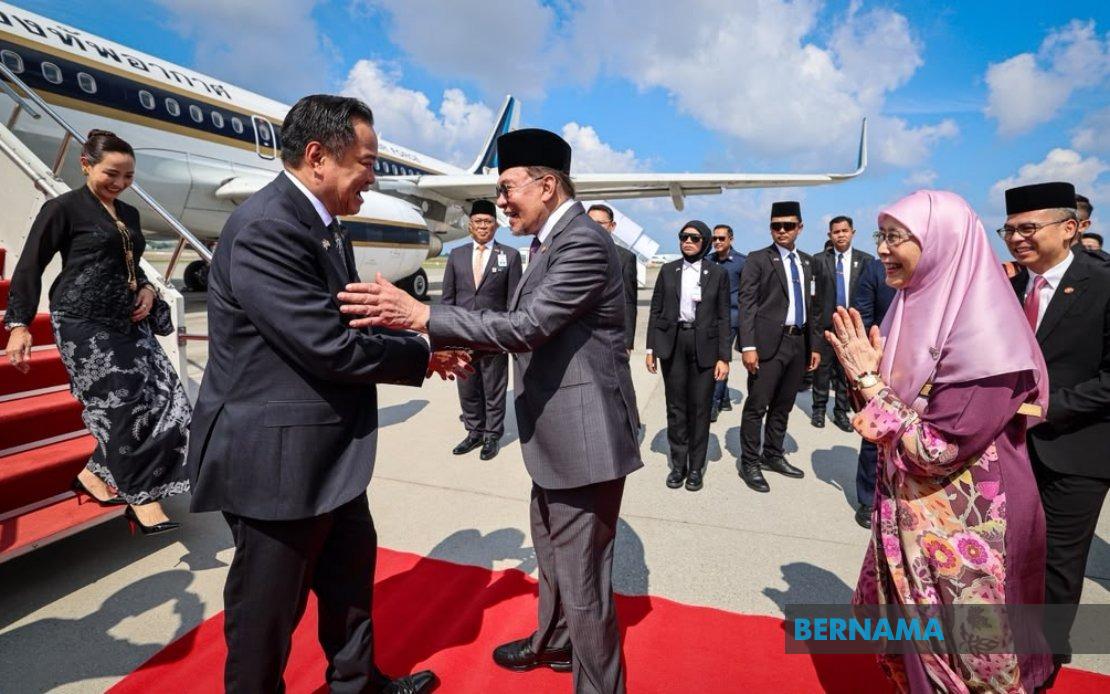
Thailand's Prime Minister Anutin Charnvirakul touched down at Kuala Lumpur International Airport on July 9 at 11.11 am, marking his first visit to Malaysia since resuming office in March 2026. The Thai leader, accompanied by his spouse Thananon Charnvirakul, arrived at the invitation of Prime Minister Datuk Seri Anwar Ibrahim, who received him personally at the Bunga Raya Complex. The formal reception underscored the significance both nations place on their relationship, with Anwar's wife Datuk Seri Dr Wan Azizah Wan Ismail and Communications Minister Datuk Fahmi Fadzil also present to greet the visiting delegation.
The ceremonial welcome reflected the diplomatic importance of the occasion, with a full honour guard comprising 34 personnel from the First Battalion of the Royal Ranger Regiment, led by Major Muhammad Nur Addeen Mustaza, formally receiving the Thai Prime Minister. National anthems of both countries were played in sequence, followed by introductions to Malaysia's Cabinet ministers and senior officials. These elaborate protocols signal a relationship that extends well beyond routine bilateral engagement, reflecting the strategic value Thailand holds within Malaysia's regional diplomacy and ASEAN framework.
For Thailand, this visit represents an opportunity to reinforce ties with a key neighbour at a time when regional stability and economic cooperation remain paramount concerns across Southeast Asia. Anutin's return to Malaysia as Prime Minister comes at a juncture when both nations face similar challenges in managing trade dynamics, border security, and agricultural productivity. The timing suggests deliberate coordination to address shared priorities and demonstrate continuity in their partnership despite domestic political transitions in both countries.
The centrepiece of the visit will be bilateral discussions at Perdana Putra, where the two leaders will assess progress in Malaysia-Thailand relations and chart direction for expanded cooperation. Beyond the formal talks, the leaders are expected to witness the signing of a memorandum of understanding focused on agricultural collaboration, an area where both nations possess complementary strengths and mutual development interests. This sector-specific agreement reflects recognition that agricultural partnership can drive tangible economic benefits for both populations.
Anwar will host a luncheon at Seri Perdana Complex honouring Anutin and his party, providing an informal setting for deeper engagement between the leaders and their respective delegations. Such hospitality serves multiple diplomatic functions, allowing relationship-building outside formal settings while demonstrating Malaysia's commitment to elevating the bilateral partnership. The gesture also affirms Anwar's personal investment in strengthening ties with Thailand's leadership.
The visit culminates on July 10 with a joint excursion to Bukit Kayu Hitam in Kedah, where both Prime Ministers will officiate the opening of a critical road infrastructure project linking the Immigration, Customs, Quarantine and Security Complex on the Malaysian side with Thailand's corresponding Customs, Immigration and Quarantine facility in Sadao. This infrastructure development carries substantial symbolic and practical importance, facilitating smoother cross-border movement of goods and people while reducing logistical bottlenecks that have historically complicated bilateral trade. The joint opening ceremony underscores shared commitment to regional integration and seamless border operations.
Economically, the relationship warrants priority attention given Thailand's prominent position in Malaysia's trade network. During 2025, Thailand ranked as Malaysia's sixth-largest trading partner globally and second among ASEAN member states, with total bilateral trade reaching RM118.57 billion, equivalent to US$27.73 billion. This substantial volume demonstrates the deep commercial interdependence between the economies, spanning multiple sectors from manufacturing and agriculture to services and investment flows.
Trade momentum has accelerated notably in the opening months of 2026, suggesting positive trajectory for the year ahead. From January through March 2026, bilateral trade totalled RM31.33 billion, representing US$7.90 billion, compared with RM27.35 billion or US$6.15 billion during the corresponding quarter in 2025. This year-on-year increase of roughly 14 percent in quarterly trade value indicates strengthening commercial ties and growing business confidence between Malaysian and Thai enterprises, likely driven by regional supply chain shifts and increased investment cooperation.
For Malaysian policymakers, Anutin's visit offers strategic opportunity to advance national interests in border management, agricultural trade, and regional stability. The infrastructure project in Kedah exemplifies how bilateral initiatives can generate tangible benefits for border communities while improving competitiveness of both nations in regional commerce. Enhanced agricultural cooperation through the MoU could enable Malaysian farmers to access Thai expertise and markets while supporting Thai agricultural interests in accessing Malaysian distribution networks and investment capital.
The timing of this official visit also reflects broader ASEAN dynamics, with Malaysia positioning itself as a constructive partner engaging major regional players in deepening cooperation frameworks. Thailand, as a fellow ASEAN member and significant economic power, represents a natural focus for diplomatic expansion. Through initiatives addressing agricultural collaboration and border infrastructure, Malaysia demonstrates commitment to practical regionalism that delivers concrete improvements to bilateral relations rather than rhetoric alone.
Looking forward, the outcomes of these discussions will likely shape Malaysia-Thailand engagement throughout 2026 and beyond. The agricultural MoU may serve as template for expanded sectoral cooperation, while the border infrastructure project sets foundation for further connectivity improvements. These elements combined position the bilateral relationship to weather global economic uncertainties while generating shared prosperity for both nations' citizens.

