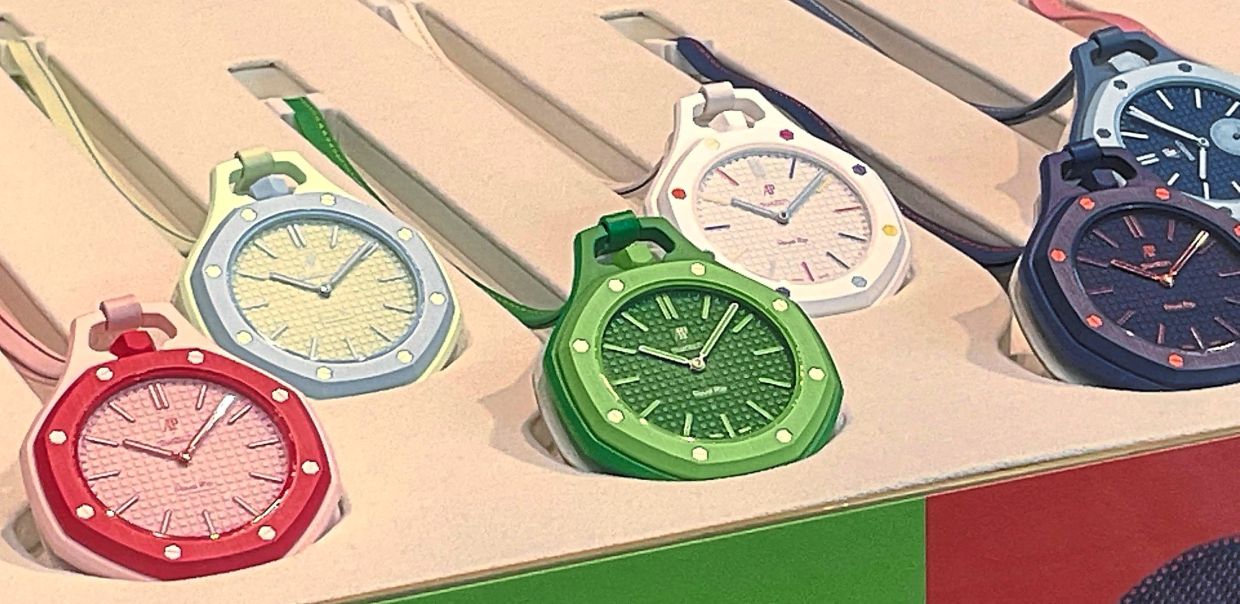
The global watch community experienced a seismic moment on May 16 when Swatch and Audemars Piguet unveiled Royal Pop, a collaboration that democratized one of haute horlogerie's most hallowed designs. The eight bioceramic pocket watches, priced under S$600 (RM1,800), adapted Gerald Genta's legendary Royal Oak silhouette into a playful format that immediately challenged conventional thinking about luxury brand partnerships and consumer desire.
Leading up to the announcement, both brands orchestrated a masterclass in engineered anticipation. Cryptic newspaper advertisements and social media hints promised something "iconic" and "unexpected" beginning weeks before the official reveal on May 12. This information vacuum proved irresistible to the watch community, which filled the void with feverish speculation, artificial intelligence mock-ups and endless forum discussions across Reddit, Instagram and dedicated horological platforms. The wall of secrecy—enforced through strict non-disclosure agreements and tightly compartmentalized teams—meant credible details remained locked away, further supercharging the collective imagination.
When Royal Pop finally materialized, it surprised nearly everyone. Instead of wristwatches, the collaboration presented pocket watches in two configurations: Lepine models with a crown at 12 o'clock, and Savonnette pieces featuring a crown at 3 o'clock paired with a small seconds subdial. Each watch borrowed the Royal Oak's most recognizable visual language—the distinctive octagonal bezel, the signature Petite Tapisserie dial pattern, and eight exposed hexagonal screws—but transplanted these elements into bioceramic cases with hand-wound SISTEM51 movements that emphasize minimalist mechanical elegance rather than haute horlogerie traditionalism.
This format distinction proved strategically crucial. Royal Pop was never positioned as an "affordable Royal Oak" alternative that might cannibalise Audemars Piguet's core wristwatch business. Entry-level Royal Oak timepieces command prices near S$30,000 (RM94,881), and a low-cost wristwatch bearing that name could have posed genuine existential threat to the brand's carefully maintained exclusivity. By reimagining the Royal Oak's design vocabulary through pocket watches—a nostalgic, niche category operating at the periphery of modern watchmaking—Audemars Piguet protected brand equity while granting itself creative freedom to play with its most iconic codes.
For Swatch, Royal Pop represents an evolutionary step from its tremendously successful 2022 MoonSwatch partnership with Omega. That collaboration demonstrated the magnetic power of pairing accessible mass-market appeal with prestigious luxury credibility. Queues formed across global cities, police deployed crowd control in multiple locations, and secondary market resellers rapidly flipped watches at substantial premiums. The lesson was clear: controlled scarcity, even at price points below S$400 (RM1,265), generates immense cultural buzz, commercial momentum and the kind of organic visibility that traditional advertising struggles to replicate.
Yet Royal Pop operates on a more ambitious scale than MoonSwatch, with implications extending beyond simple brand collaboration mechanics. Omega belongs to the Swatch Group corporate family, making MoonSwatch essentially an internal exercise in leveraging parent company assets. Audemars Piguet, conversely, remains fiercely independent. This structural difference transforms Royal Pop from another co-branded release into something far more significant: a clear signal that Swatch aspires to function as a cultural platform through which elite luxury houses can broaden their reach and contemporaneity without compromising their core product sanctity.
Pat Law, founder of Singapore-based social marketing agency Goodstuph, articulates the symbiotic dynamics at play. "Luxury today transcends mere ownership," Law observes. "It increasingly encompasses proximity—the sense of touching something greater." For Swatch, the partnership delivers immediate cultural elevation; a playful plastic watch instantaneously inherits decades of horological craftsmanship, Swiss heritage, and the kind of snobbery associated with haute horlogerie. For Audemars Piguet, the calculus proves equally compelling. The brand gains mass-market relevance without requiring product line dilution, positioning itself in the consciousness of young consumers who would never venture into an AP boutique while they're still years away from affording entry prices.
Yet luxury industry scholarship raises legitimate cautions about overextending democratization strategies. While such initiatives reliably drive short-term sales spikes and cultural currency, research suggests that excessive brand access—particularly when a brand's visual identity becomes ubiquitous—can progressively erode the exclusivity mechanisms that underpinned the original prestige. The pocket watch format provides some insulation from this risk, given the category's inherent niche positioning compared to wristwatches. Still, Audemars Piguet must carefully calibrate future collaborations, ensuring that playing with its design vocabulary never transforms into the perception that the brand is desperately grasping for relevance.
The Royal Pop phenomenon also reveals evolving consumer psychology around luxury consumption in Southeast Asia and globally. Younger buyers increasingly measure luxury not through ownership alone but through cultural narrative, storytelling, and the ability to participate in meaningful moments—even transient ones. The hours-long queues that accompany Royal Pop releases reflect this shift. Consumers demonstrate willingness to invest time and effort for experiences that feel momentous, regardless of whether the product itself carries official scarcity designations. This presents both opportunity and risk for heritage brands: the chance to remain contemporary and accessible, tempered by the possibility that demystification breeds contempt.
Looking forward, Royal Pop will likely inspire competitors to explore similar partnerships. Independent luxury houses may reconsider their stance toward accessible collaborations if the Swatch model proves sustainable and brand-protective. The pocket watch format offers particular potential for future iterations, given its aesthetic distinctness from modern daily wear. However, the collaboration's long-term success will ultimately depend on Audemars Piguet and Swatch resisting the temptation to oversaturate the market. Scarcity—whether real or engineered—remains the lifeblood of luxury desirability. Once perception shifts from "difficult to obtain" toward "deliberately limited to maintain hype," the magic typically dissolves. For now, Royal Pop stands as a sophisticated bet that luxury's future involves collaboration, accessibility, and playfulness, provided the brand's essential DNA remains inviolate.