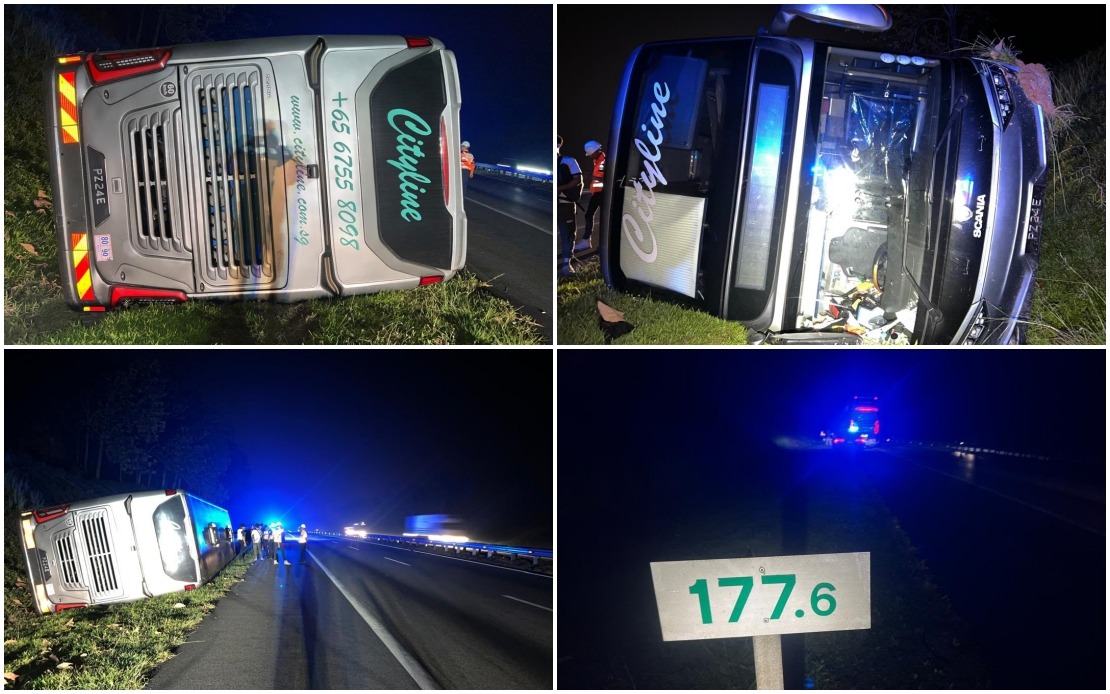
A tour bus journey from Singapore to Kuala Lumpur ended in an accident on the North-South Expressway when the vehicle veered off the roadway and overturned at Kilometre 177.6 in the Jasin district this morning. Police responded to reports of the incident at approximately 5 am, finding three passengers requiring medical attention following the crash. The injured comprised a 59-year-old Malaysian tour guide, a 62-year-old visitor from Singapore, and a 42-year-old British national, all of whom sustained injuries to their heads and legs.
According to Jasin district police chief Supt Lee Robert, the circumstances leading to the accident were relatively straightforward. The bus, which was transporting 12 people including its driver and tour guide, encountered slower traffic ahead on the expressway. In attempting to prevent a collision with a lorry that had reduced speed, the bus driver made an evasive manoeuvre that sent the vehicle off the left side of the roadway. The rapid loss of control resulted in the bus overturning, incapacitating three of its passengers.
This incident highlights ongoing concerns about safety on Malaysia's major expressway corridors, particularly during early morning hours when visibility may be compromised and driver fatigue can play a factor. Tour buses operating cross-border routes between Singapore and Malaysia represent a significant portion of regional tourism traffic, with hundreds of such journeys undertaken weekly along the North-South Expressway. The accident raises questions about driver alertness protocols and the effectiveness of defensive driving measures when encountering unexpected changes in traffic flow.
The North-South Expressway remains one of Southeast Asia's busiest toll highways, linking Malaysia's southern and northern regions through high-speed traffic lanes designed for efficient long-distance travel. Incidents involving large passenger vehicles on this route carry particular weight given the concentrated passenger load and the complex dynamics of emergency response on expressway segments. The Jasin location, positioned within Melaka state's commercial corridor, experiences regular commercial and tourist traffic throughout the day and night.
All three injured passengers were transported to Jasin Hospital where they received treatment for their injuries. The nature and severity of their head and leg injuries were not immediately detailed in official reports, though their hospitalisation suggests injuries beyond minor classification. The mixed nationality composition of the injured parties—one Malaysian national, one Singaporean, and one British national—underscores the international character of cross-border tourism flowing through this corridor.
The investigation into the accident's precise cause remains ongoing, with police gathering evidence and witness statements to determine whether contributory factors beyond the immediate lane-changing manoeuvre played a role. Questions persist about the spacing between vehicles, visibility conditions, and whether the lorry ahead issued adequate warning signals before reducing speed. Understanding these details becomes crucial for establishing whether additional safety measures or infrastructure improvements might be warranted on this expressway section.
Tour operators running scheduled services between Singapore and Malaysia depend on the North-South Expressway for reliable transit times and passenger safety. This accident carries implications for operational procedures, including driver rest requirements, vehicle maintenance standards, and emergency communication protocols. Companies managing cross-border tours face increasing pressure to demonstrate robust safety records as insurance premiums and reputational concerns mount following incidents involving their fleets.
The location of the accident at Kilometre 177.6 places it within the expressway's central corridor, a segment regularly traversed by hundreds of heavy vehicles daily alongside private transportation. Traffic management along this stretch typically involves coordinated monitoring by highway authorities, toll operators, and enforcement agencies. Whether adequate traffic flow communication systems are functioning effectively at the point where this incident occurred remains a question for further investigation.
For Malaysian authorities overseeing expressway safety, this incident adds to an ongoing dataset regarding vehicle accidents involving tour buses and commercial transport operators. Patterns emerging from such incidents can inform policy adjustments, enforcement priorities, and infrastructure modifications aimed at reducing future occurrences. The regional dimension of cross-border tourism means that accidents affecting foreign nationals carry diplomatic and economic considerations alongside public safety concerns.
The immediate response by Jasin Hospital and local police appears to have followed standard accident protocols, with rapid patient transfer and information gathering. However, the broader context of tourism safety on Malaysian expressways suggests a need for continued emphasis on driver training, vehicle standards compliance, and perhaps enhanced monitoring systems along high-risk sections. As Malaysia continues to position itself as a regional tourism hub, maintaining strong safety records for cross-border travel becomes increasingly important for visitor confidence and economic sustainability.

