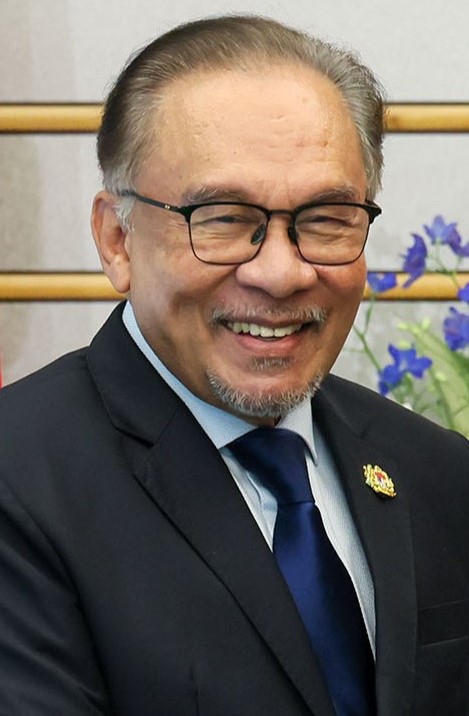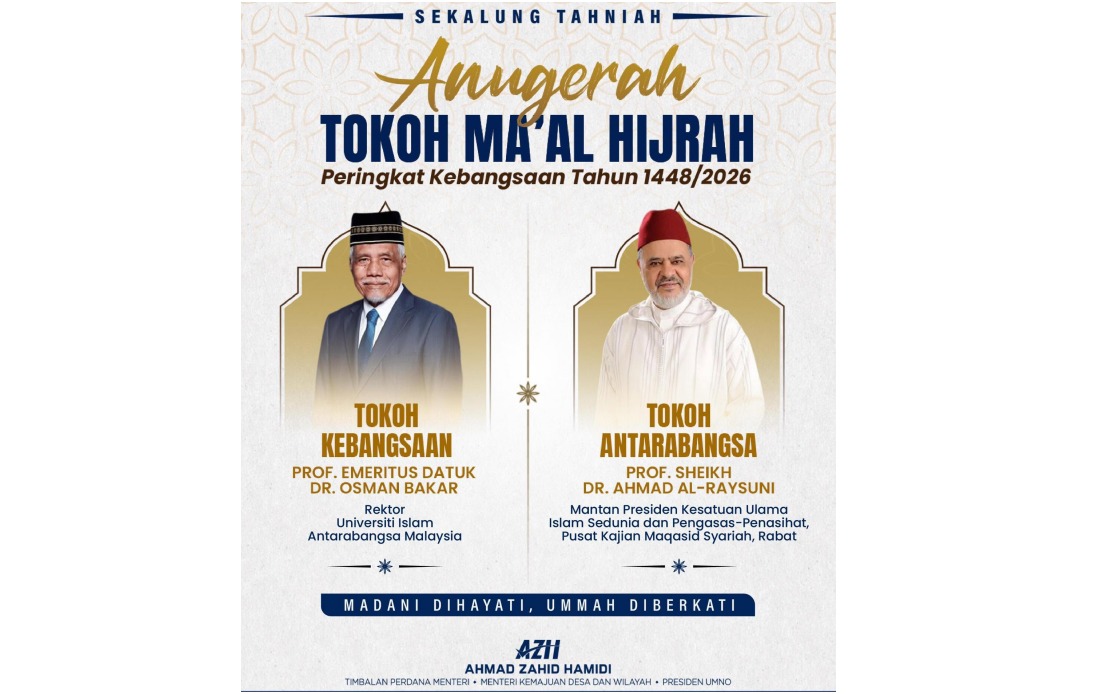
Deputy Prime Minister Datuk Seri Dr Ahmad Zahid Hamidi has called on Malaysia's Muslim population to find inspiration in the achievements of the Tokoh Maal Hijrah award recipients, whose recognition underscores the importance of intellectual advancement and spiritual leadership within the Islamic community. Speaking at the national-level Maal Hijrah celebration held at Masjid Putra in Putrajaya, Ahmad Zahid emphasised that the honours bestowed upon this year's recipients should serve as a catalyst for broader engagement with Islamic values and community service across the country.
Among those recognised in this year's ceremony were Prof Emeritus Datuk Dr Osman Bakar, who received the prestigious National Tokoh Maal Hijrah Award, and Prof Sheikh Dr Ahmad Al-Raysuni, an accomplished Islamic jurisprudence scholar from Morocco, who earned the International Tokoh Maal Hijrah Award. The Sultan of Perak, Sultan Nazrin Shah, presented the awards at the Putrajaya event, honouring the recipients with trophies, certificates of appreciation, and cash prizes that acknowledge their scholarly contributions to Islamic thought and community advancement.
In his remarks, Ahmad Zahid highlighted the broader significance of recognising individuals who have dedicated themselves to empowering the Muslim community through knowledge dissemination and the reinforcement of Islamic principles. He stressed that the contributions made by award recipients extend beyond academic achievement to encompass the elevation of intellectual standards within Islamic circles and the propagation of values that foster wisdom, compassion, and societal benefit. These qualities, he suggested, form the foundation upon which a more enlightened and cohesive Muslim community can be built.
The Deputy Prime Minister explicitly encouraged all Muslims in Malaysia to channel the inspiration drawn from these award recipients into concrete action. His call resonated beyond mere celebratory remarks, framing the awards as benchmarks for personal and communal aspiration. Ahmad Zahid urged the Muslim population to persist in the pursuit of knowledge across all disciplines, to engage meaningfully in serving their local communities, and to contribute substantively to the development of the broader Islamic ummah while simultaneously strengthening their contributions to the nation and the advancement of Islamic civilisation itself.
Deputy Prime Minister Datuk Seri Fadillah Yusof echoed similar sentiments, extending the significance of the awards beyond the Muslim community to encompass all Malaysians. Fadillah contended that the recognition principle embedded in the Tokoh Maal Hijrah awards—honouring those who make meaningful contributions to collective progress—should resonate with citizens of all backgrounds and faiths. He positioned the awards within a broader national narrative of service and dedication to the country's development, suggesting that the values they represent are universally applicable to Malaysia's multiethnic and multireligious society.
Central to Fadillah's interpretation of the award ceremony was his engagement with the historical and spiritual dimensions of Maal Hijrah itself. Rather than treating the hijrah of Prophet Muhammad as merely a historical milestone relegated to textbooks, Fadillah reframed it as an enduring philosophical framework that continues to impart crucial lessons to contemporary communities. He identified sacrifice, unity, resilience, and unwavering determination as the core principles embedded within the hijrah narrative—qualities that he argued remain profoundly relevant to the challenges and opportunities facing modern Malaysia.
Fadillah's broader vision connected these classical Islamic principles to the practical requirements of contemporary nation-building. He articulated a conception of societal progress that deliberately integrates moral and spiritual foundations with material development, explicitly referencing the aspiration toward a progressive, prosperous, and values-based society and nation. This formulation suggests an understanding that economic advancement and technological progress, divorced from ethical moorings and spiritual consciousness, risk producing hollow achievements that fail to address the deeper needs of human communities.
The Deputy Prime Minister's call for collective action emphasised the need to strengthen social cohesion, deepen religious faith and practice, and multiply virtuous deeds in service of both the Islamic ummah and the Malaysian nation. This dual emphasis reflects the balancing act required of Malaysia's political leadership in serving a substantial Muslim-majority population while maintaining the delicate equilibrium necessary in a pluralistic democracy. By framing the awards and their underlying values as applicable to national development broadly, Fadillah sought to universalise the message while maintaining its grounding in Islamic tradition.
For Malaysian readers and observers of the region's Islamic affairs, the Tokoh Maal Hijrah Awards represent an important recognition mechanism within the Islamic world. The inclusion of an international awardee from Morocco signals Malaysia's ongoing engagement with broader Islamic scholarly networks and its role as a platform for celebrating Islamic intellectual achievement beyond national boundaries. This international dimension reflects Malaysia's positioning as a significant player in contemporary Islamic thought and practice, extending its influence across the Muslim-majority world.
The ceremony at Masjid Putra, one of Malaysia's most symbolically significant religious structures, provided an appropriate venue for articulating these themes of Islamic leadership and community responsibility. The presence of Sultan Nazrin Shah as the conferrer of awards lent constitutional and ceremonial weight to the proceedings, underscoring the integration of religious values within Malaysia's framework of constitutional monarchy and Islamic governance. This institutional embedding of the awards within formal state structures demonstrates the organised approach Malaysia has adopted toward recognising and promoting Islamic intellectual and spiritual leadership.
As Malaysia continues to navigate the complex terrain of balancing modernisation with Islamic values, and national development with religious commitment, the messages conveyed by Ahmad Zahid and Fadillah through the Tokoh Maal Hijrah Awards ceremony offer important guidance to the Muslim community. The emphasis on knowledge-seeking, community service, and ethical contribution suggests a vision of Islamic leadership that transcends purely religious domains to encompass broader civic and national responsibilities. This comprehensive understanding of Islamic engagement positions faith not as a constraint on progress but as a motivating force directing development toward genuinely human ends.