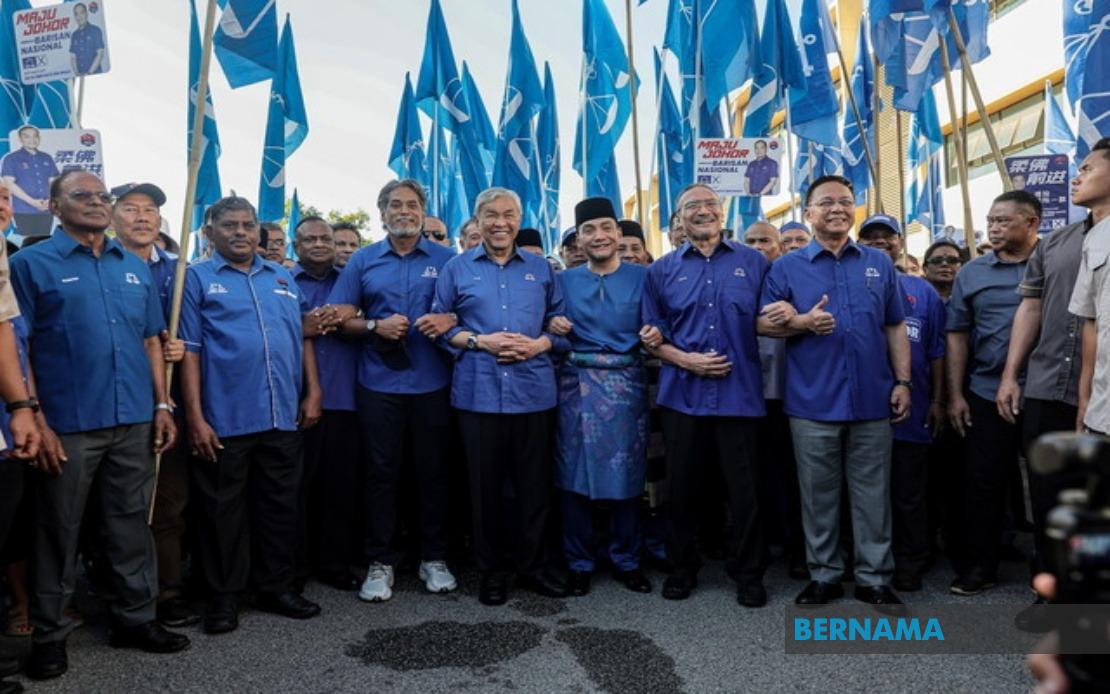
Johor's ruling coalition threw its considerable weight behind the re-election bid of state Barisan Nasional chairman Datuk Onn Hafiz Ghazi on Wednesday, as the incumbent Machap assemblyman formally submitted his nomination at the Simpang Renggam District Council's nomination centre. The 9.10 am filing drew a constellation of UMNO heavyweights, underscoring party leadership's determination to secure the seat and project strength as the 16th Johor state election enters its decisive phase. The public show of unity carried particular significance given the competitive nature of electoral contests in the state and the symbolic importance of consolidating support among UMNO's grassroots.
Onn Hafiz's nomination journey was accompanied by UMNO president Datuk Seri Dr Ahmad Zahid Hamidi and Sembrong MP Datuk Seri Hishammuddin Tun Hussein, two of the party's most prominent figures with deep roots in federal politics. Their presence at the Muafakat Hall underscored the centrality of Machap to the party's broader state strategy and the confidence hierarchy places in the incumbent's viability. Khairy Jamaluddin, the former minister whose political profile extends across multiple portfolios and generational appeal, rounded out the senior delegation, reflecting a deliberate effort to project both establishment credentials and contemporary political relevance.
Former Johor Menteri Besar Datuk Seri Hasni Mohammad's attendance added another institutional layer, connecting current leadership to the state's administrative heritage and creating visual continuity across different phases of BN governance. Such carefully orchestrated appearances are rarely coincidental in Malaysian politics; they serve to reassure the party base, signal hierarchy's priorities to observers, and create photographic and broadcast moments that reinforce messaging around organizational discipline and electoral confidence. The gathering essentially transformed a routine administrative filing into a political event designed for wider consumption.
The nomination centre's surroundings reflected the heightened political energy accompanying the election campaign period. Supporters materialised in neighbouring areas wearing party colours and displaying banners and flags, creating the visual spectacle that characterizes electoral mobilization in Malaysia. This grassroots presence, while individually voluntary, occurs within frameworks established by party machinery, creating an impression of organic enthusiasm that simultaneously reflects organizational capacity to turn out supporters. The juxtaposition of formal nomination procedures with informal street-level campaigning demonstrates how electoral systems operate across multiple registers simultaneously.
Machap's significance within Johor's political geography extends beyond single-seat considerations. The constituency represents a stronghold within the state's UMNO-dominated landscape, and controlling such seats remains fundamental to coalition ambitions regardless of broader electoral dynamics. Onn Hafiz's incumbent status traditionally confers advantages in terms of local government infrastructure familiarity, established community networks, and administrative resources—advantages that become especially valuable in competitive environments where margins can be narrow.
The ceremonial nature of nomination submission, while procedurally straightforward, carries weightier implications for how parties manage internal expectations and project external confidence. UMNO's dispatch of such senior figures to this particular filing suggests organizational calculations about which contests warrant escalated resource commitment and symbolic backing. The pattern demonstrates how routine administrative processes become opportunities for political theatre in Malaysia's electoral calendar, where media coverage and public visibility translate into campaign momentum.
Onn Hafiz's position as Johor BN chairman places him at the intersection of state-level coalition management and UMNO's broader peninsular strategy. His re-election directly impacts the coalition's legislative arithmetic in the state assembly and signals broader health of the ruling establishment within Johor. The state's economic significance, demographic weight, and historical importance to UMNO ensure that electoral outcomes here receive disproportionate attention from federal party structures, explaining the heavy participation of national-level figures in what might elsewhere be treated as routine constituency-level activity.
The gathering also reflected evolving patterns within UMNO's leadership. Ahmad Zahid's presence as party president emphasizes commitment to the state election outcome, while Hishammuddin's participation as a sitting federal MP demonstrates how senators and national legislators involve themselves in state-level contests to maintain relevance across different political layers. Khairy's attendance, meanwhile, connects the event to broader generational conversations within the party about succession dynamics and the integration of younger voices into institutional hierarchies. These multiple legitimacy sources create a formidable backing that speaks to organizational seriousness rather than casual support.
The nomination period itself represents a compressed window where campaign intensity accelerates markedly. Once papers are formally submitted and candidates confirmed, political activity concentrates into a final push aimed at swaying undecided voters and maximizing turnout among supporter bases. Onn Hafiz's formal entry into the race, accompanied by such prominent backing, signals that Machap will receive sustained attention from coalition machinery and that party structures have allocated meaningful resources to his defence. The coming weeks will test whether such elite-level support translates into electoral performance, or whether ground-level dynamics produce different outcomes than hierarchy's projection of confidence suggests.

