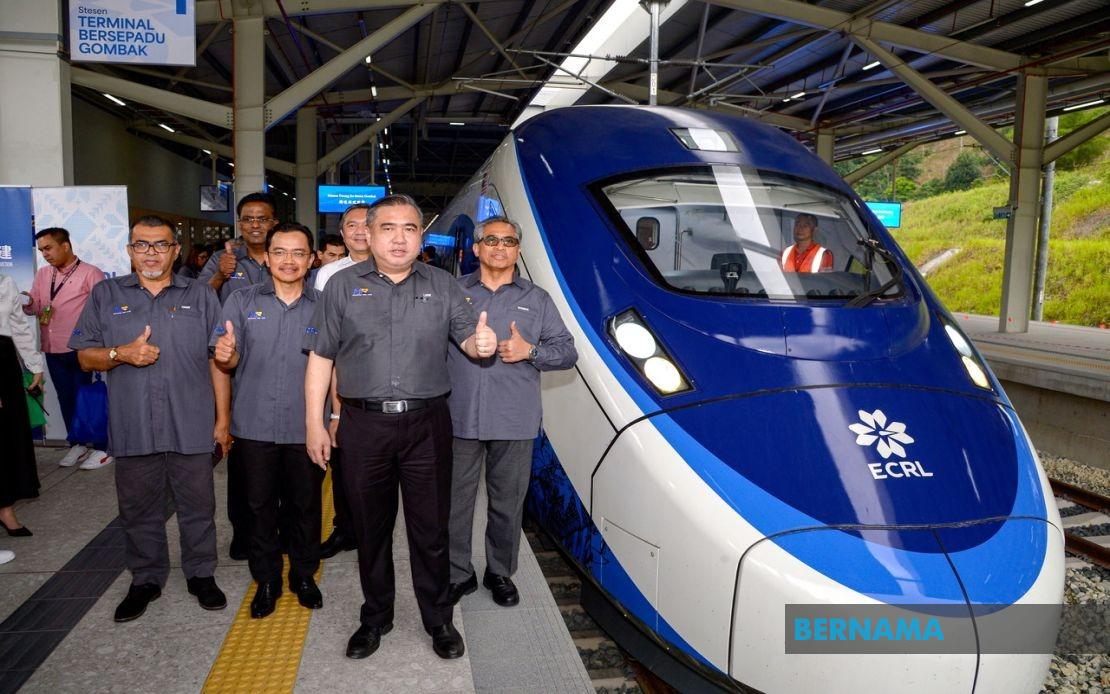
Malaysia's ambitious East Coast Rail Link (ECRL) project has entered a critical phase as Transport Minister Anthony Loke Siew Fook unveiled plans to commence Phase 1 operations between Kota Bharu and Gombak by December this year, a significant acceleration from the originally planned January 2027 start date. The announcement was made during the formal launch of the Comprehensive Inspection Train and the beginning of System Integration Testing (SIT) and Fault-Free Run (FFR) trials at the Gombak Integrated Terminal Station, marking a pivotal moment in Malaysia's long-awaited rail connectivity initiative.
The proposed acceleration reflects confidence in the construction and testing progress to date, with the project achieving an overall completion rate of 95.08 per cent for Phase 1 as of July. However, Loke emphasised that any expedited timeline remains conditional on the seamless execution of rigorous testing and commissioning procedures, with safety remaining the absolute priority throughout the process. The minister acknowledged that Malaysia Rail Link Sdn Bhd (MRL) and main contractor China Communications Construction Company Ltd (CCCC) would need to coordinate closely to maintain momentum without cutting corners on critical safety protocols.
The acceleration strategy hinges on the Land Public Transport Agency (APAD) streamlining its role in testing and certification processes. Typically, this stage requires two to three months of careful evaluation, but officials are exploring methods to compress this timeline without bypassing essential safety checks. Loke explained that the initial confidence in accelerating the schedule stems from comprehensive factory testing already completed in China before the trains arrived in Malaysia, providing a foundation of quality assurance that justifies exploring faster local deployment.
System Integration Testing, which commenced this month, represents the first critical phase of local trials. This process will systematically verify the functionality and compatibility of all major systems integrated into the ECRL infrastructure, including complex electrical and signalling networks that are fundamental to safe railway operations. Following successful SIT completion, the Fault-Free Run phase is anticipated to begin in September, during which the first train set and E-Locomotive will traverse the entire 8,000-kilometre track length under APAD supervision to validate operational performance under real-world conditions, albeit without passenger loads.
The FFR stage is particularly significant for Malaysia's rail development, as it represents the final validation phase before commercial service commencement. During this extended trial period, engineers and safety inspectors will meticulously monitor train performance across the full corridor, documenting behaviour across varying terrain, weather conditions, and operational scenarios. This data collection is essential for confirming that operational safety standards and reliability metrics align with domestic regulations and international benchmarks, ensuring that when services finally commence, they do so with documented evidence of readiness.
Loke's repeated reassurances about safety underscored the political sensitivity surrounding the ECRL project, which has faced scrutiny regarding costs, timelines, and technical capacity. The minister's candid observation that officials are "more afraid than you" if there is a risk suggested acknowledgment of public concerns about rushing a megaproject of this scale. By emphasising that every testing phase must be completed and formally approved before the next phase begins, he attempted to balance the government's desire for rapid project delivery with recognition that a rail catastrophe would far outweigh any benefits from early opening.
Beyond Phase 1, the ECRL development maintains a structured expansion plan that will progressively extend rail connectivity across the peninsula. Phase 2, connecting Gombak to Port Klang, is scheduled for completion by December 2027 with operations commencing in January 2028. This phased approach allows for operational experience and technical learning from Phase 1 to be incorporated into subsequent stages, potentially improving efficiency and reliability across the extended network.
The ECRL represents a transformative infrastructure investment for Malaysia, particularly for Kelantan and northern Selangor, regions that have historically faced geographical isolation from major transportation corridors. The rail link promises to facilitate goods movement, reduce road congestion, and enhance tourism accessibility to East Coast destinations. For the wider Southeast Asian context, the ECRL contributes to regional integration goals by strengthening logistics connectivity within Malaysia and potentially linking to neighbouring countries' rail networks as part of broader regional economic corridors.
The presence of senior government officials at the Gombak terminal event, including Chief Secretary Tan Sri Shamsul Azri Abu Bakar and Chinese Ambassador Ouyang Yujing, reflected the project's significance to Malaysia-China bilateral relations. The ECRL remains one of the most visible infrastructure collaborations between the two nations, with CCCC's role as primary contractor underscoring China's technical involvement in Malaysia's transport modernisation. The ambassador's attendance symbolised continued commitment to the project despite evolving geopolitical considerations affecting Chinese infrastructure investments in Southeast Asia.
For Malaysian commuters and businesses, the potential December launch would represent tangible progress after years of anticipation. The Kota Bharu-Gombak corridor would provide the first operational segment of modern mass rail infrastructure connecting Kelantan's capital to Selangor's commercial heartland, with frequencies and efficiency levels that current road-based alternatives cannot match. The eight-month acceleration, if achieved, would validate the government's ability to execute complex infrastructure projects within revised timelines, potentially building confidence for future transport initiatives.
The testing protocols now underway will determine whether the December target proves realistic or whether additional time becomes necessary. International experience with similar rail projects suggests that achieving such an acceleration requires flawless execution across multiple technical domains simultaneously. The upcoming months will be decisive in establishing whether the ECRL can transition from a construction project into operational service, finally delivering on promises made to Malaysian travellers and freight operators.

