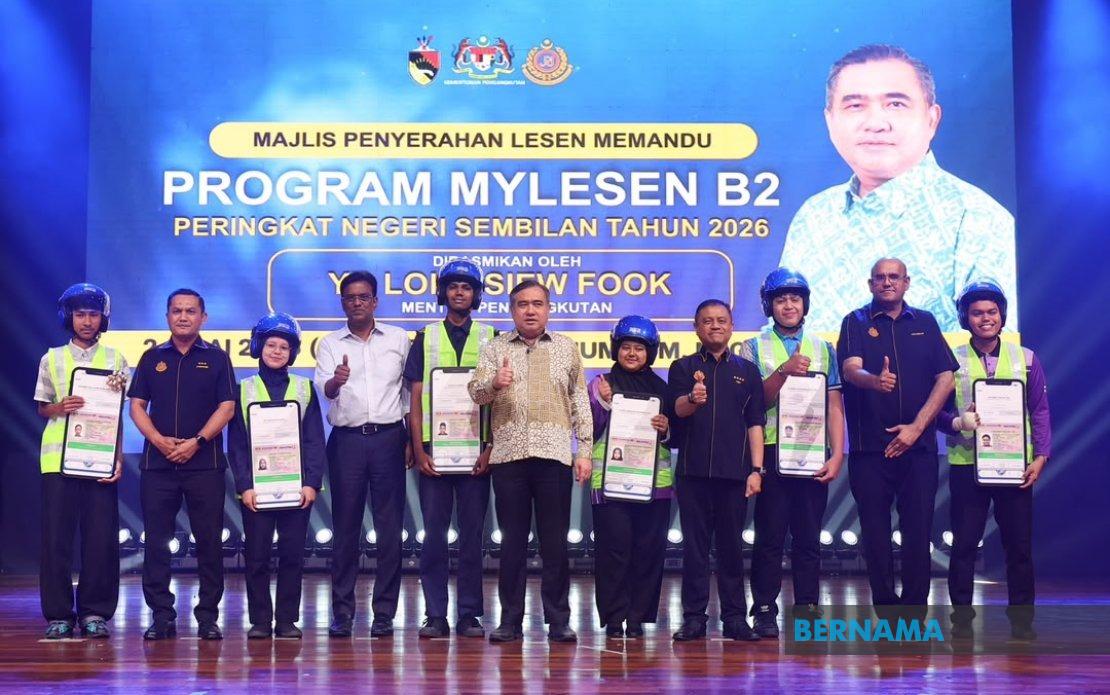
Transport Minister Anthony Loke has issued a firm reminder to young Malaysians receiving motorcycle licences under the government's MyLesen B2 Programme, stressing that their newly acquired permits carry significant legal and safety obligations rather than serving as an endorsement for dangerous riding behaviour. Speaking at a licence presentation ceremony in Seremban on July 2, Loke made clear that the free credentials must be exercised with maturity and strict adherence to traffic regulations, particularly over weekends when youth gathering and street racing incidents traditionally spike.
The minister's cautionary message arrives against the backdrop of deeply troubling road safety statistics that underscore the urgency of cultivating responsible motorcycling culture among younger riders. According to Loke's remarks, approximately 60 per cent of annual road fatalities recorded across Malaysia involve motorcyclists and pillion passengers, with a disproportionate concentration among individuals below 30 years of age. This demographic skew reveals a persistent pattern of risk-taking behaviour among the nation's youth and points to a critical gap between licence possession and genuine road safety competency.
The MyLesen B2 Programme itself represents a substantial government investment in expanding legal access to motorcycle mobility among disadvantaged populations. Loke disclosed that the initiative has already benefited more than 100,000 recipients nationwide since its launch in 2023, functioning as a pathway to employment, educational advancement, and improved socio-economic circumstances through legally sanctioned transportation access. The programme's expansion into Negeri Sembilan exemplifies this scaling effort, with quota allocations nearly doubling from 1,000 participants last year to 2,300 this year.
Within the Negeri Sembilan cohort specifically, implementation has progressed substantially through the structured certification pipeline. As of the announcement date, 1,979 participants had obtained their Learner's Driving Licences, the foundational credential, whilst 1,879 had advanced further by completing mandatory training modules and successfully passing competency assessments required for the Probationary Driving Licence. This graduation rate demonstrates reasonable programme efficacy in moving candidates through systematic skill-building stages before independent road operation.
However, Loke's warnings suggest that formal licensing credentials alone prove insufficient to guarantee safe riding practices among younger operators. The minister specifically targeted illegal street racing and unsanctioned speed competitions as particularly egregious violations warranting escalated enforcement and criminal penalties. His reference to these activities reflects the broader Southeast Asian phenomenon of motorcycle culture becoming entangled with youth rebellion and organised illegal street competition networks that pose dangers extending beyond individual riders to innocent bystanders and public order.
The government has responded legislatively to this challenge through the Road Transport (Amendment) Bill 2026, which the Dewan Rakyat has already passed. This legislation significantly strengthens penalties for those apprehended engaging in illegal racing or speed testing across all vehicle categories, transforming offences from administrative violations into criminal matters potentially carrying imprisonment alongside substantial fines. Such legislative recalibration reflects recognition that traditional enforcement mechanisms have proven inadequate for deterring determined youth participants in illegal street racing subcultures.
Loke's emphasis on helmet compliance represents another critical dimension of the road safety messaging, specifically requiring all riders and pillion passengers to wear only SIRIM-certified headgear. This standardised certification requirement addresses the widespread problem of counterfeit or substandard protective equipment circulating in informal markets across Malaysia, often falsely marketed as legitimate safety gear. The minister's explicit specification of SIRIM certification suggests previous regulatory slack or consumer confusion regarding helmet authenticity, pointing to lingering implementation challenges in enforcement and consumer education.
The presence of high-level officials at the Seremban presentation, including Transport Ministry Secretary-General Datuk Seri Jana Santhiran Muniyan, Road Transport Department Director-General Datuk Aedy Fadly Ramli, and various deputy leadership, underscores the political significance attached to youth motorcycle safety initiatives. This administrative visibility signals that road safety has ascended to priority status within transport sector governance, reflecting perhaps accumulated pressure from road safety advocacy groups, bereaved families, and accumulating social costs of youth motorcycle fatalities.
For Malaysian readers and policymakers, Loke's intervention highlights tensions inherent in democratising mobility access whilst simultaneously constraining dangerous behaviour patterns among younger users. Expanding affordable licence availability serves legitimate equity and economic objectives, yet simultaneously requires parallel investment in safety culture development, enhanced enforcement capacity, and targeted youth education campaigns addressing social drivers of reckless riding behaviour. The MyLesen B2 Programme's success ultimately depends less on licensing volume achievements than on whether participants genuinely internalise road safety values and comply consistently with traffic regulations.
Regionally, Malaysia's experience with youth motorcycle safety challenges mirrors difficulties faced across Southeast Asia, where motorcycles constitute the dominant transportation mode for lower-income populations and younger demographic segments. Countries including Thailand, Vietnam, and Indonesia have grappled with similar combinations of expanding motorcycle ownership, cultural associations between riding and masculine identity performance, and resistance to safety regulation compliance among youth communities. Malaysia's legislative and enforcement responses may offer instructive models for regional counterparts confronting analogous challenges.
Looking forward, the effectiveness of initiatives like MyLesen B2 will require sustained commitment beyond ceremonial licence presentations. Genuine progress demands complementary investments in motorcycle safety education integration within school curricula, workplace safety campaigns targeting young riders, parental engagement programmes, and community-based mentoring by experienced riders emphasising responsible behaviours. Without such ecosystem-wide support, legislative amendments and licensing expansions risk remaining merely symbolic policy gestures rather than catalysing meaningful behavioural transformation among younger road users whose daily choices ultimately determine whether road safety statistics improve or continue their tragic trajectories.

