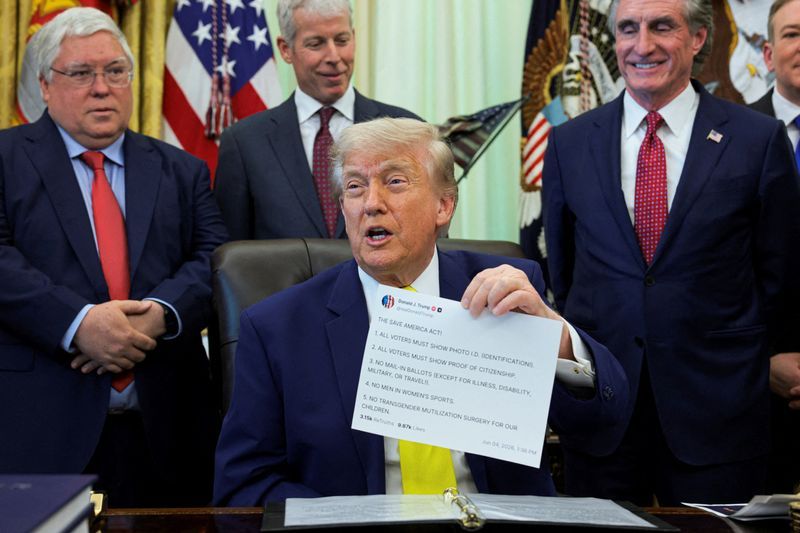
A legal battle over exclusive access to presidential communications has erupted in Manhattan, with media watchdog organisations challenging a subscription service that grants wealthy clients early viewing rights to posts from the U.S. president on his Truth Social platform. The Intercept and the Freedom of the Press Foundation filed suit against the arrangement on Wednesday, arguing that Truth API—a feed operated by Trump Media & Technology Group—represents a troubling blending of commercial interests with government communications that should be publicly available to all citizens simultaneously.
The Truth API service, which commenced operations on August 1, permits subscribers paying as much as $100,000 monthly to access posts from ten prominent Truth Social accounts approximately ninety seconds before they become available to the general public. This brief but commercially valuable window includes messages from the president himself, Vice President JD Vance, Health and Human Services Secretary Robert F. Kennedy Jr., FBI Director Kash Patel, and official White House accounts. The timing of the service's launch followed a pointed warning from Democratic Senators Elizabeth Warren of Massachusetts and Adam Schiff of California, who had urged the Securities and Exchange Commission to examine whether such an arrangement compromised financial market integrity while benefiting Wall Street insiders and the president personally.
The lawsuit targets what plaintiffs characterise as a fundamentally corrupting arrangement that violates constitutional principles. Their complaint contends that citizens possess an inherent right to receive official government announcements simultaneously, regardless of their financial capacity. The plaintiffs argue further that no legitimate governmental purpose justifies President Trump's direct financial benefit from the subscription model, given his substantial ownership stake in Trump Media. Analysis of posts during the president's second term revealed that between 9,000 and 11,000 Truth Social messages and reposts were never accompanied by formal White House statements, suggesting the platform serves as his primary channel for material disclosures rather than as supplementary communications infrastructure.
The financial dimensions of this arrangement warrant careful scrutiny for investors and market participants across Asia-Pacific regions. The president holds a 41.3 per cent stake in Trump Media valued at approximately $950 million through his revocable trust, with his eldest son serving as a trust overseer and company director. Any service generating revenue tied to the president's personal communications creates structural incentives that could influence what he chooses to disclose and when. History demonstrates that unconfirmed remarks about tariffs, international relations, and trade policy emanating from Truth Social have previously triggered measurable movements in equities, commodities, and currency markets—making information asymmetries potentially profitable for those with millisecond advantages.
Trump Media's interim Chief Executive Kevin McGurn attempted to minimise the service's significance during a recent earnings presentation, describing the advantage as merely fractional—subscribers receive news only marginally faster than others. This characterisation sits uneasily alongside the premium pricing structure, which would scarcely justify such expenditure if the temporal advantage proved negligible. The defendant company has responded to the lawsuit by emphasising that countless other news outlets and subscription platforms already redistribute Trump's communications, positioning the controversy as selective weaponisation by left-leaning activists seeking to censor the president.
The constitutional dimensions of this case present novel questions about digital-age government transparency. The First Amendment traditionally contemplates that citizens enjoy equal access to official government information; the subscription model appears to invert this principle, creating graduated access tiers based on wealth. Courts have not previously adjudicated whether such arrangements violate foundational transparency doctrines. For Southeast Asian observers, this case illustrates how questions of platform governance and information equity increasingly transcend national boundaries, as global markets react instantaneously to communications originating from American political figures.
The regulatory landscape surrounding this dispute remains somewhat ambiguous. The Securities and Exchange Commission's three current commissioners are Republicans, potentially affecting whether enforcement actions materialise. The White House declined to provide immediate comment when approached for reaction. Notably, Trump Media itself does not appear as a defendant in the suit; rather, individual White House officials face the legal challenge, a distinction suggesting plaintiffs' strategy emphasises the impropriety of government officials participating in a commercial scheme.
Regional implications deserve attention as well. Emerging market investors in Malaysia, Singapore, Thailand, and Indonesia maintain substantial exposure to American equities and currency markets. Information asymmetries affecting U.S. asset pricing propagate rapidly throughout global financial systems. Should Truth API operate unimpeded, sophisticated hedge funds and institutional investors with $100,000 to commit would gain measurable advantages in executing trades ahead of broader market reactions—advantages unavailable to retail investors across Southeast Asia. This dynamic reinforces existing inequality in market access while benefiting only the wealthiest participants.
The complaint explicitly seeks to prohibit the White House from posting official government announcements exclusively through Truth Social whilst the paid-access system remains operational. This request suggests plaintiffs recognise the distinction between Trump's personal platform and legitimate government communications channels. The underlying tension reflects broader questions about whether a sitting president should maintain direct control over a private social media company simultaneously used for official announcements. Malaysian readers familiar with governance standards in this region may note the heightened scrutiny placed on conflicts of interest and the separation between personal commercial interests and government responsibilities.
The litigation's trajectory will likely prove instructive for global observers monitoring the evolution of digital-age governance norms. If American courts reject the arrangement, it would establish important precedent limiting presidents' ability to monetise government communications. Conversely, if Truth API withstands legal challenge, it would signal acceptance of a concerning new model where access to material policy announcements becomes purchasable rather than universally available. The outcome carries implications extending well beyond American borders, potentially influencing how other democracies regulate the intersection of political communications and commercial platforms.

