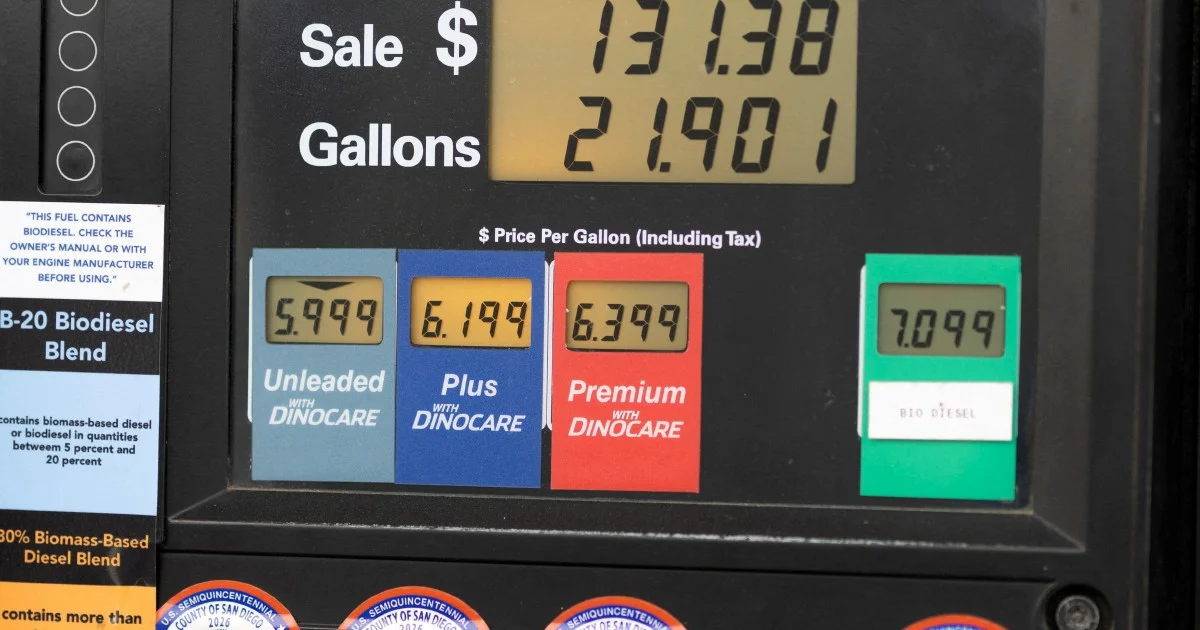
President Donald Trump announced on Wednesday that he has directed authorities to examine the pricing practices of major petroleum corporations, reflecting mounting pressure over fuel costs that remain stubbornly elevated despite his administration's stated commitment to energy affordability. The move comes as Trump faces increasing criticism regarding how geopolitical tensions in the Middle East are translating into higher prices for American consumers at the pump.
The investigation signals Trump's concern that oil majors may not be responding adequately to market conditions or that other factors beyond global supply constraints are keeping gasoline prices elevated. The President's directive essentially challenges the industry to explain why retail fuel prices have not fallen more substantially, even as crude oil markets have experienced fluctuations. This reflects a broader political calculation: energy affordability remains a potent issue for voters, particularly those in suburban and rural areas where driving distances are greater and fuel budgets constitute a larger household expense.
Trump's decision to initiate this probe also addresses a fundamental tension in U.S. energy policy. The administration has sought to expand domestic oil production through deregulation and lease sales, yet global market dynamics—including Middle East geopolitical risks—continue to exert upward pressure on prices. By investigating oil companies, Trump attempts to deflect responsibility for price movements beyond his direct control while simultaneously demonstrating action to concerned constituencies.
The Middle East conflict has created genuine supply-side concerns within global energy markets. Regional instability raises questions about potential disruptions to critical petroleum flows through key strategic chokepoints, particularly the Strait of Hormuz. These geopolitical uncertainties create risk premiums embedded in crude prices, which eventually flow through to consumers regardless of what any single government can do through domestic policy alone.
For Malaysian readers and regional observers, Trump's investigation carries broader implications. Southeast Asia remains acutely vulnerable to petroleum price volatility given the region's heavy reliance on imported energy. Higher global crude prices directly impact fuel costs across Malaysia, Indonesia, Singapore, Thailand, and the Philippines, affecting everything from transportation to the cost of electricity generation. The region's economies, still recovering from post-pandemic disruptions, have limited buffer capacity for sustained energy cost inflation.
The investigation also reflects Trump's tendency toward using executive action and regulatory scrutiny as political tools to address popular grievances. Whether such investigations ultimately yield meaningful policy outcomes or serve primarily as political theater remains an open question. Nevertheless, they signal to the energy industry that Washington intends closer scrutiny of business practices and pricing strategies—a message that reverberates through international capital markets where these companies operate.
Oil companies may argue that their pricing reflects actual costs, including crude acquisition expenses, refining margins, distribution logistics, and retail operations. They contend that margins in downstream operations (refining and retail) are often compressed precisely because those segments face intense competition. Crude prices themselves are set by global markets where American oil firms are price-takers rather than price-setters, though major producers do influence supply volumes.
The political economy underlying Trump's move deserves scrutiny. In American electoral politics, energy prices function as a direct, visible measure of economic well-being for millions of voters. Unlike abstract measures of GDP growth or employment statistics, gasoline prices appear on digital signs at every service station, confronting consumers multiple times weekly. This visibility makes energy costs particularly salient during election cycles, explaining why sitting presidents frequently face pressure regarding fuel prices regardless of actual causative factors.
Regional energy security takes on added significance as this situation unfolds. Malaysia, as a petroleum producer itself with substantial downstream operations through Petronas, understands the complex dynamics of global energy markets. The country has simultaneously positioned itself as an energy exporter and negotiated with neighbors regarding shared resources. Southeast Asian governments maintain careful balances between supporting their own citizens' cost-of-living concerns and encouraging investment in hydrocarbon extraction and processing.
The investigation's scope and duration remain unclear. Whether it will examine price coordination, speculation in futures markets, refinery utilization rates, or export policies cannot yet be determined. Different investigative angles would yield markedly different conclusions about industry behavior. A narrow investigation focused on collusion would require evidence of coordinated pricing, which is difficult to prove in markets where numerous participants respond to common underlying factors.
For investors and companies operating in the energy sector, Trump's directive introduces regulatory uncertainty. Major oil corporations have international portfolios and shareholder bases; investigations into their U.S. operations could influence their strategic investment decisions, potentially affecting exploration and production commitments both domestically and in partners' territories. This uncertainty factor may ultimately complicate rather than resolve energy market dynamics.
The broader challenge Trump confronts mirrors difficulties faced by governments worldwide: balancing desire for affordable energy with market realities, geopolitical constraints, and the interests of domestic energy producers. Southeast Asian nations face similar pressures, often complicated by energy poverty affecting rural populations and the need to maintain economic competitiveness in energy-intensive manufacturing sectors.

