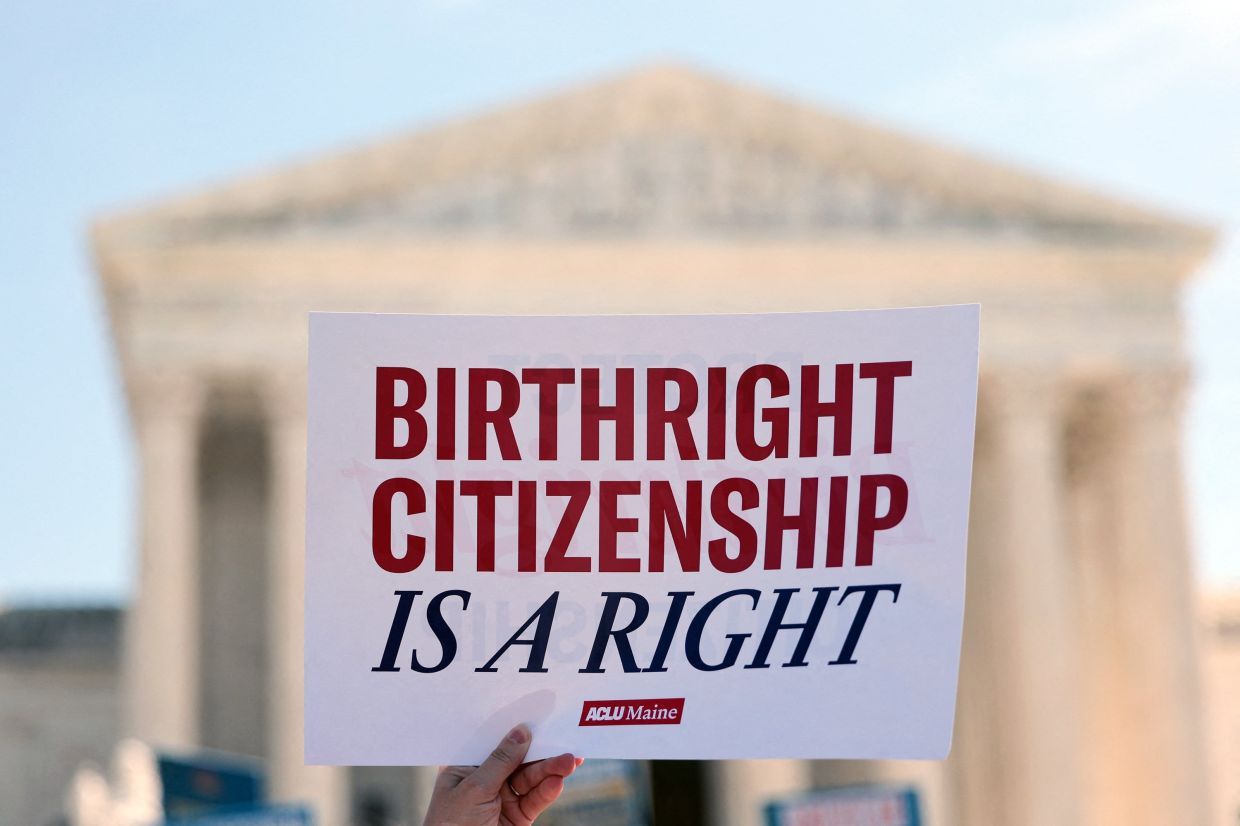
When the United States Supreme Court declined to back President Donald Trump's effort to restrict birthright citizenship, the administration quickly recalibrated its strategy. Rather than accepting defeat, Trump turned his focus to an alternative approach, and his messaging took a notably pointed turn toward China. In a sarcastic social media post, Trump congratulated President Xi and China on what he framed as their "massive Birthright Citizenship WIN," a move that signalled where his renewed campaign would concentrate its energy.
The shift from constitutional challenge to enforcement action occurred rapidly. Within hours of Trump's post, the Department of Justice issued guidance to federal prosecutors directing them to prioritise investigations into so-called "birth tourism" schemes. Days later, US House Speaker Mike Johnson confirmed that lawmakers were developing legislation to address women who travel to the United States specifically to give birth. This cascade of actions demonstrated a coordinated pivot from judicial to executive and legislative avenues, all centred on combating what the administration characterises as a systemic immigration abuse.
Central to this reframing is an assertion that China and Chinese citizens represent the primary threat to the integrity of American citizenship. Trump's messaging has repeatedly invoked China, claiming that "foreign adversaries like the Chinese Communist Party" are exploiting the system. In a March post, he explicitly contrasted what he portrayed as wealthy Chinese parents buying citizenship for their children with the historical purpose of birthright citizenship. This rhetorical strategy serves multiple purposes: it mobilises nationalist sentiment, distinguishes between types of immigration, and provides cover for enforcement actions by framing them as defence against foreign manipulation rather than restriction of immigration itself.
Yet the factual foundation for this expansive focus on China appears far more modest than administration rhetoric suggests. No comprehensive federal dataset exists that directly measures how many women enter the United States primarily to give birth, and the available statistics tell a markedly different story from what administration officials have presented. According to the National Centre for Health Statistics, in 2023 there were just 113 births recorded to non-US resident mothers from China out of 3.7 million total births in the country. This represents a minuscule proportion, and the trend has actually declined over time, with 267 such births recorded in 2018. These figures suggest that birth tourism from China, if it exists at all at the scale officials describe, represents an exceptionally rare phenomenon.
The Trump administration's Justice Department has nonetheless committed to pursuing such cases aggressively. The department characterised organised birth tourism schemes as fraudulent exploitation of the immigration system, arguing that thousands of foreigners enter under false pretences to secure citizenship for their children. Colin McDonald, assistant attorney general overseeing fraud enforcement, pledged to "zealously protect the sanctity of United States citizenship" through investigations and prosecutions. The department has cited specific cases, including a 2020 case involving fugitive Chao "Edwin" Chen, who operated what the administration claims was a substantial birth tourism business advertising a 100-person team based in China and claiming to have served more than 500 cases.
What constitutes "birth tourism" itself involves legal complexity that extends beyond simply giving birth while visiting. Giving birth in the United States is not inherently illegal, and prosecutions have typically relied on allegations of visa fraud, conspiracy, money laundering, or other offences involving claims that travellers concealed their actual intentions and that businesses assisted in these deceptions. This reliance on fraud charges rather than birth-related offences means that enforcement depends on proving intent and deception, a substantially higher bar than simply documenting births to foreign visitors. Immigration lawyers have raised concerns about the implications of shifting enforcement priorities toward pregnant travellers, noting that the routine targeting of such women based on suspected intent creates a chilling effect regardless of whether charges are ultimately filed.
The congressional embrace of this enforcement direction reflects broader Republican concern about immigration and sovereignty, though the framing has evolved markedly from Trump's original executive order. When Trump initially directed federal agencies to deny citizenship documents to children born in the US to undocumented parents or those on temporary visas, the policy faced immediate legal challenges that ultimately reached the Supreme Court. Rather than mounting another constitutional challenge after losing that case, congressional allies have adopted the birth tourism framing. Republican Congressman Chip Roy articulated this perspective, warning that foreign adversaries including China leverage birth tourism to gain influence within American borders and that Congress must restore integrity to the immigration system.
However, the geographic scope of birth tourism allegations extends well beyond China. Countries including Turkey, Russia, and Mexico have similarly faced accusations of participating in such schemes, a fact that complicates the administration's singular focus on China. This broader context suggests that while birth tourism may constitute a legitimate immigration concern, the rhetorical elevation of China as the primary threat reflects geopolitical considerations as much as evidence-based policy concerns. The selective emphasis on Chinese birth tourism, despite comparable or larger numbers from other nations, indicates that the administration's approach serves strategic messaging purposes.
Trump has also made demonstrably false claims about American exceptionalism in birthright citizenship policy. He asserted that the United States is "the only Country in the World STUPID enough to allow 'birthright' citizenship," a claim contradicted by analysis from the Pew Research Centre, which found that thirty-two other countries maintain birthright citizenship laws substantially similar to those of the United States, including Canada and Mexico, America's immediate neighbours. This factual inaccuracy, repeated on social media where it reaches millions, frames the issue as uniquely American foolishness rather than a widespread international practice.
The scale claims made by administration supporters have drawn particular scrutiny from experts. Government Accountability Institute president Peter Schweizer claimed during a congressional hearing that approximately one million US citizens are being raised in China today due to birth tourism, an assertion that independent legal scholars have characterised as "wildly inflated." Peter Spiro, an American legal expert, told the South China Morning Post that the most honest assessment is that birth tourism has "risen over the last few decades to become a non-trivial phenomenon," but acknowledged the absence of reliable data supporting much larger claims.
Statistics from the Northern Mariana Islands, frequently cited as a birth tourism hotspot, further underscore the data mismatch. The territory recorded only 581 births in 2023, with just two born to foreign-resident mothers. In 2018, the territory saw 1,262 births total, though the data does not specify the national origins of foreign residents giving birth or account for potential misrepresentation of residence. The absence of granular statistics on the nationality composition of births in these locations means that much of the policy debate proceeds without the detailed empirical foundation that typically underpins immigration enforcement decisions.
For Malaysian and Southeast Asian observers, this American policy shift carries implications beyond the United States. The Trump administration's approach demonstrates how geopolitical competition can reshape immigration enforcement rhetoric and priorities, with birth tourism serving as a vehicle for broader concerns about Chinese influence. The emphasis on enforcement over constitutional reform suggests that when judicial avenues close, administrations may pursue alternative pathways through prosecutorial discretion and legislation. Additionally, the reliance on fraud charges rather than explicit restrictions on births to foreigners reflects how immigration control can be exercised through prosecutorial mechanisms even when direct prohibitions face legal barriers. As regional governments navigate their own immigration policies and bilateral relationships with the United States and China, the mechanisms of American enforcement may offer instructive lessons in both policy design and the risks of allowing strategic messaging to outpace empirical evidence.

