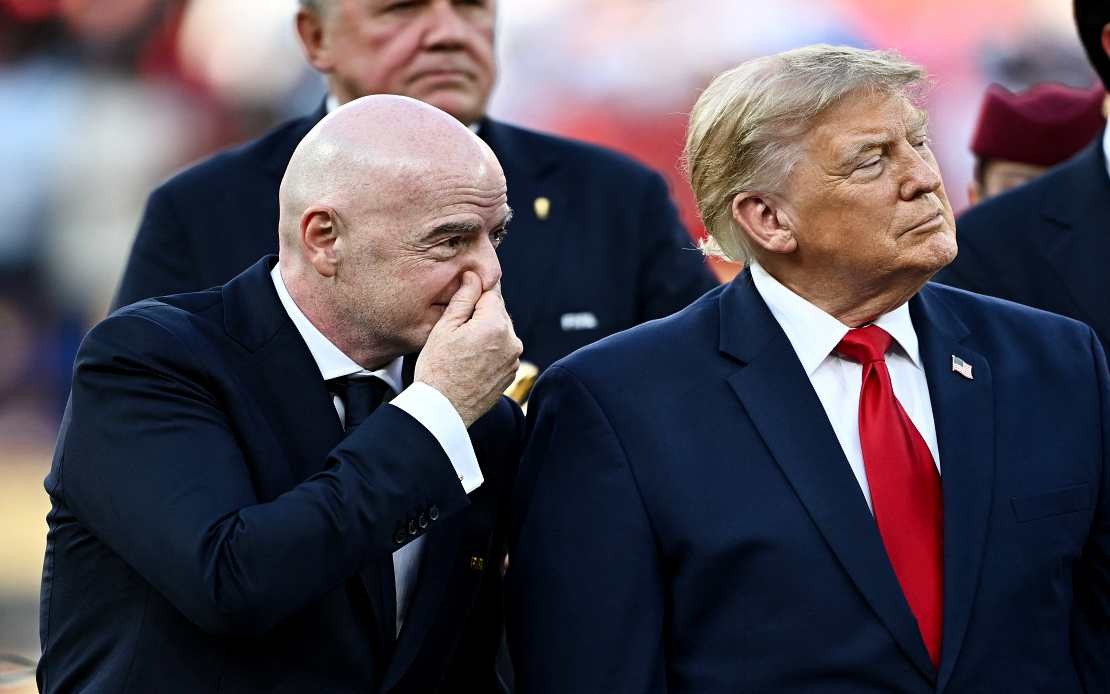
United States President Donald Trump has emerged as an unexpected champion of FIFA President Gianni Infantino's embattled leadership, offering a public endorsement at a moment when the world football governing body faces mounting pressure from its own regional confederations. Trump's statement, posted on Truth Social, praised Infantino as fantastic and credited him with delivering the most successful World Cup in history, making the defence particularly notable given the brewing institutional crisis at FIFA.
The support from Washington comes as three continental football bodies—the Union of European Football Associations (UEFA), the Asian Football Confederation (AFC), and the Confederation of North, Central American and Caribbean Football (CONCACAF)—have jointly released an open letter signalling their loss of confidence in Infantino's stewardship. Rather than seeking his removal outright, these organisations have called for an independent investigation into the circumstances surrounding a proposed sale of FIFA's commercial rights, a move that suggests deep institutional concerns about governance and transparency at the highest levels of international football.
The controversy centres on a commercial initiative that would have fundamentally reshaped how FIFA monetises its most valuable assets. In July, FIFA announced plans to raise US$4.2 billion by transferring approximately 20 per cent of shares in a newly created entity to private investors. This vehicle, initially dubbed the FIFA Forward Enterprise, would have assumed control of the organisation's media and commercial rights, including the highly lucrative broadcasting and sponsorship arrangements surrounding the World Cup tournaments. For context, the World Cup represents the single most valuable property in global sports, with rights sold in multi-billion dollar tranches across different territories and time periods.
Murky questions about the investment structure have fuelled regional concerns. Media reports circulated suggesting that Joshua Kushner's foundation—the brother of Jared Kushner, Trump's son-in-law—could be positioned to acquire a significant stake in this arrangement. While such connections alone do not necessarily indicate impropriety, they raised legitimate questions within the football community about whether FIFA's commercial modernisation was being pursued through proper channels with adequate oversight. The potential for perceived conflicts of interest appears to have catalysed the unusual alliance between UEFA, AFC, and CONCACAF.
UEFA took the most aggressive posture, announcing that all its member associations would boycott FIFA competitions if the proposal remained unchanged. This represented an extraordinary escalation in football politics, as UEFA represents the European clubs and national teams that generate substantial revenue and global viewership for FIFA tournaments. A genuine boycott would have posed existential risks to FIFA's financial model and international standing. The threat clearly registered with FIFA's leadership, which recognised that maintaining the support of Europe's football authorities was non-negotiable.
Infantino's response evolved in phases. Initially, he convened an emergency meeting of FIFA's top leadership in early August where he received reassurances of support from key figures within the organisation. However, rather than defending the commercial initiative, he offered an apology for mistakes made in how the FIFA Forward Enterprise was developed and presented. His acknowledgement of missteps suggested recognition that the consultation process and governance frameworks had fallen short of what major confederations expected from global sports governance.
Ultimately, Infantino and FIFA announced a complete withdrawal of the proposed commercial rights sale. This represented a significant reversal and effectively handed a victory to the confederations that had mobilised against the initiative. The decision to abandon the plan entirely, rather than simply revising it, underscored how toxic the proposal had become within football's institutional landscape and how little confidence the regional bodies had in the original framework.
Trump's intervention into this dispute adds an unexpected geopolitical dimension to what might otherwise appear as a purely internal football governance matter. By characterising Infantino as irreplaceable and warning that FIFA would never again achieve equivalent success without him, Trump positioned himself as defending the FIFA president against what could be interpreted as a coordinated challenge to his authority. The timing and tone of the statement suggest Trump views Infantino's continued leadership as important to American interests, whether through commercial arrangements, World Cup hosting considerations, or broader diplomatic alignments.
For Malaysian and Southeast Asian readers, this controversy illuminates several important dynamics. First, it demonstrates how commercial pressures are reshaping global sports governance, with private capital seeking greater stakes in traditionally association-controlled institutions. Second, it shows that when regional confederations unite around governance concerns, they possess sufficient collective leverage to challenge even sitting leaders. The AFC's participation in the united front against the FIFA proposal signals that Asian football bodies are increasingly willing to coordinate with European counterparts on institutional matters affecting the sport's governance.
Third, the episode reveals how national political leaders occasionally intervene in international sports matters, particularly when commercial or diplomatic interests align. Trump's public defence of Infantino, while framed in terms of football success, also reflects American interests in maintaining relationships with FIFA leadership and potentially influence over future World Cup hosting arrangements and commercial partnerships.
The resolution of this crisis leaves Infantino's position stabilised, at least in the immediate term, but with diminished authority and facing ongoing scrutiny from major confederations. The confederations achieved their immediate objective—blocking the commercial rights sale—without requiring Infantino's resignation, suggesting they recognised the value of institutional continuity even while demanding reform in his decision-making processes. As FIFA moves forward, the episode will likely produce new governance requirements, enhanced transparency mechanisms, and possibly revised consultation procedures before major commercial initiatives can be pursued, particularly those involving private equity investments in football's crown jewels.

