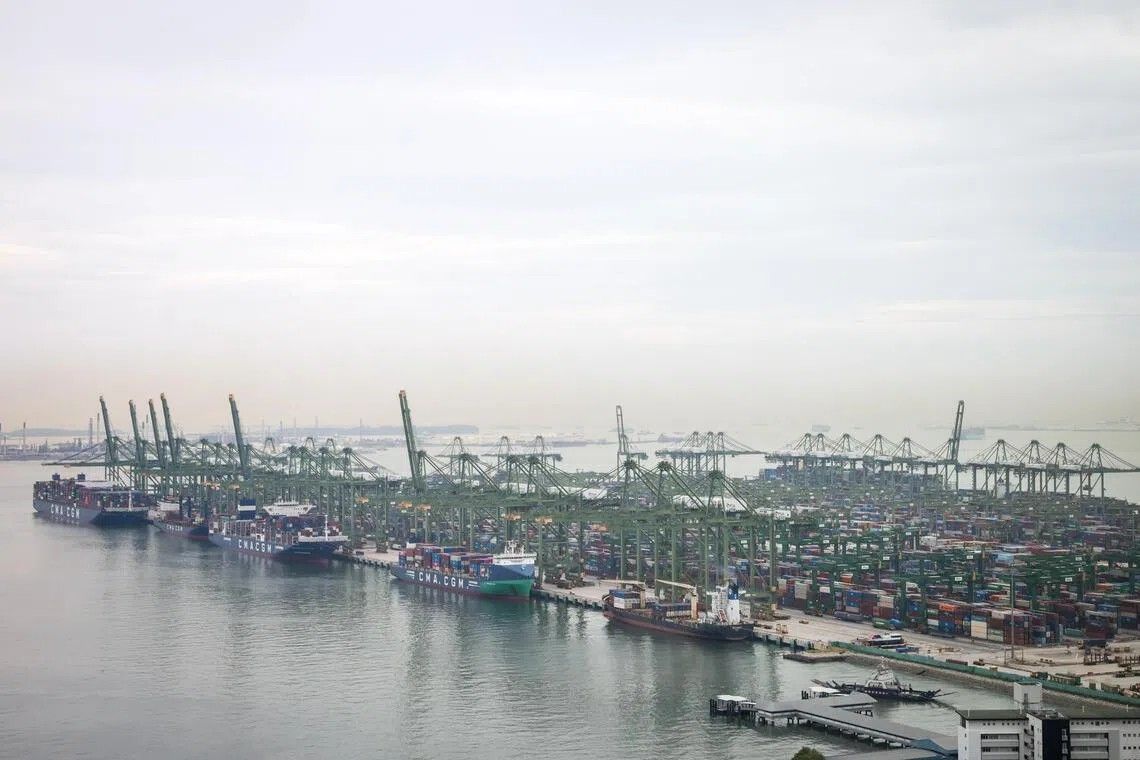
Singapore's exporters face a fresh wave of US trade restrictions as President Donald Trump imposes a 12.5 per cent tariff on approximately one-third of the city-state's domestic shipments to America, effective from July 24. The tariff marks a significant escalation in Washington's protectionist stance and reflects the administration's determination to establish new legal foundations for broader trade barriers after an earlier tariff framework collapsed under judicial scrutiny.
The Office of the US Trade Representative initiated the investigation in March, concluding by July that Singapore and 44 other economies had failed to adequately adopt or enforce prohibitions against goods manufactured using forced labour. US Trade Representative Jamieson Greer framed the measure as ensuring that trading partners match America's nearly century-old commitment to banning forced-labour imports. This characterisation provided the administration with what it believed to be more defensible legal grounds than its previous reciprocal tariff approach, which the US Supreme Court invalidated in February 2026 by striking down the statute underpinning that policy.
The tariff structure reveals strategic differentiation among trading partners. Forty-five economies, including Singapore, Japan, Switzerland and South Korea, face the maximum 12.5 per cent rate. A second tier of approximately ten nations deemed to have adequate forced-labour restrictions, including Mexico, Britain, Canada and India, will pay 10 per cent duties. However, Japan, Switzerland and South Korea receive slightly more favourable treatment insofar as their tariffs comply with existing bilateral or regional trade agreements with the United States. This tiered approach suggests the administration calibrated its response to both geopolitical relationships and legal vulnerability to challenge.
Singapore's government immediately pushed back against the characterisation, with the Ministry of Trade and Industry rejecting any suggestion of complicity in forced-labour practices and emphasising the republic's existing enforcement framework. Foreign Minister Vivian Balakrishnan raised the matter with US Secretary of State Marco Rubio during bilateral discussions at the Asean Foreign Ministers' Meeting in Manila on July 23, signalling diplomatic engagement even as the tariff took effect. The ministry framed the issue as fundamentally transnational, requiring international cooperation rather than unilateral penalties, and noted that addressing forced labour across complex, multi-tiered global supply chains remained most effective when tackled at source rather than through import restrictions.
Certain product categories secured exemptions from the new tariff, providing some relief to Singapore's manufacturing base. Goods already subject to Trump's earlier Section 232 sector-specific tariffs—including primary metals such as steel, aluminium and copper, plus strategic products like automobiles and wood—remain excluded. Energy products, pharmaceuticals, specific electronics, aerospace components, semiconductors and metals used in currency and bullion also escape the new duty. The White House memorandum further exempted items covered by the United States-Mexico-Canada Agreement and goods already subject to fertiliser tariffs, suggesting the administration sought to avoid compounding duties that might trigger broader economic disruption.
The new tariff replaced a 10 per cent global levy imposed under Section 122 that expired earlier in the week, allowing the administration to claim continuity whilst shifting legal foundations. Experts believe the Trump administration selected Section 301 of the Trade Act of 1974 as its statutory basis because the law imposes no expiration date and permits open-ended percentage caps, characteristics that strengthen resistance to judicial challenge. Historically, measures imposed under Section 301 have proven more durable in courtrooms than the reciprocal tariff framework that fell. However, legal scholars acknowledge that applying Section 301—originally designed to address unfair trade practices by specific countries—to blanket dozens of nations on forced-labour grounds stretches the statute's original congressional intent, virtually guaranteeing litigation.
Singapore faces additional uncertainty from an ongoing Section 301 investigation into structural excess capacity and production across manufacturing sectors, which involves Singapore alongside fifteen other economies. The Office of the US Trade Representative launched this parallel probe but has not yet released findings, and Greer acknowledged in a recent Bloomberg Television interview that the investigation proceeded more slowly than the forced-labour inquiry because officials sought to ensure legal compliance. The potential for layered duties—forcing Singapore's exporters to navigate both the current 12.5 per cent tariff and possible future obligations from the excess-capacity findings—compounds the strategic difficulty facing manufacturers.
Lennon Tan, president of the Singapore Manufacturing Federation, acknowledged that whilst his members rejected the forced-labour characterisation as inconsistent with their standards, the practical impact remained substantial. The federation announced plans to survey affected exporters, particularly those with significant American market exposure, to quantify the damage and channel industry concerns to government. Tan urged manufacturers to pursue market diversification, strengthen supply chain resilience and capitalise on Singapore's extensive network of free trade agreements and the broader region's economic growth to reduce dependency on the American market.
The tariff's introduction reflects a broader Trump administration strategy to reconstruct protectionist authority following the February court decision that upended previous policy. By shifting from reciprocal tariffs to forced-labour justifications, the administration attempted to navigate legal constraints whilst maintaining its protectionist agenda. This approach carries implications extending beyond Singapore to the entire Southeast Asian region, which relies substantially on US market access and functions as a critical node in global supply chains. The precedent established through the forced-labour investigation may embolden similar actions against other trading partners accused of inadequate labour protections, potentially reshaping regional trade dynamics and forcing manufacturers across Asean to reassess their American market strategies.

