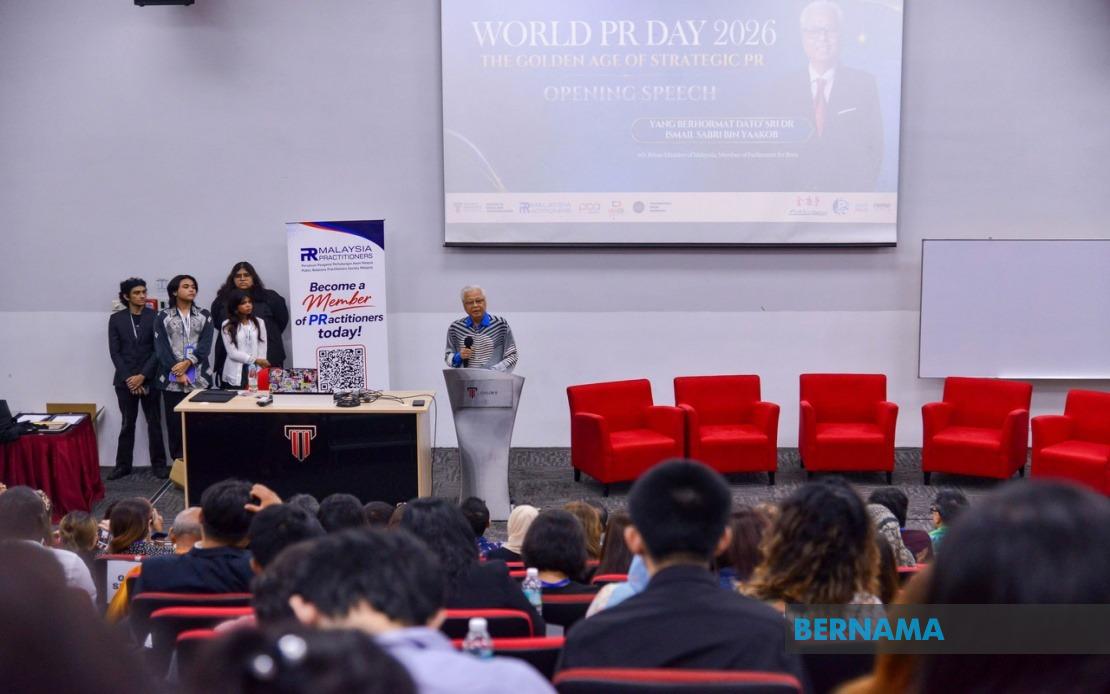
Facing an audience at Taylor's University in Subang Jaya, former Prime Minister Datuk Seri Dr Ismail Sabri Yaakob articulated a vision of contemporary leadership that extends far beyond traditional performance metrics. The competitive landscape of the modern era, he contended, transcends the purely economic rivalries that defined the previous century. Instead, organisations and governments now operate within what he termed a "trust competition"—a contest won not through superior products or profits alone, but through the credibility and transparency demonstrated in every communication.
The distinction Ismail Sabri drew between 20th and 21st century imperatives carries significant implications for Malaysian institutions navigating rapid digital transformation. Where previous generations of leaders could rely on hierarchical communication structures and limited media channels, contemporary administrators must engage in constant dialogue across fragmented digital platforms. This shift fundamentally alters how organisations measure success, pushing them beyond quarterly reports and achievement announcements toward comprehensive reputation management strategies that encompass both triumph and adversity.
The former prime minister's reflections on his tenure during the COVID-19 crisis illustrated this principle through concrete example. When Malaysia grappled with evolving public health protocols, Ismail Sabri found himself before journalists daily, tasked with explaining modifications to standard operating procedures that directly affected millions of citizens. The pressure to communicate with precision during that period was immense—confusion bred by unclear messaging could undermine public compliance and endanger lives. This crucible experience crystallised his conviction that communication transcends mere information delivery, functioning instead as a foundational pillar supporting institutional credibility.
During the pandemic response, Ismail Sabri recognised that citizens needed more than directives; they required comprehensible explanations grounded in transparent reasoning. This understanding echoes across Southeast Asia, where governments continue grappling with public health communication challenges and the erosion of institutional trust. Malaysian organisations, whether governmental or corporate, face similar imperatives to demonstrate that decisions emerge from rational assessment rather than arbitrary authority. The pandemic revealed how quickly populations could turn sceptical when communication appeared evasive or contradictory—a lesson with enduring relevance as new crises inevitably emerge.
The evolution of public relations practice itself reflects broader institutional transformation, according to Ismail Sabri's assessment. Practitioners no longer function as mere conduits transmitting predetermined messages; they have assumed roles as strategic architects shaping organisational narratives and safeguarding reputations through proactive stakeholder engagement. This elevation reflects recognition that in hyperconnected societies, reputation operates as a tangible asset capable of influencing market performance, regulatory outcomes, and political legitimacy. Malaysian PR professionals navigating this expanded remit must possess both traditional communication skills and sophisticated understanding of digital ecosystems where narratives propagate at unprecedented velocity.
The proliferation of artificial intelligence capabilities presents opportunities and hazards in equal measure, Ismail Sabri cautioned. PR practitioners equipped with AI-driven sentiment analysis tools can detect emerging public concerns before they crystallise into reputational crises, adjusting messaging with responsive precision. However, technological sophistication divorced from ethical grounding creates new vulnerabilities. The same artificial intelligence systems that enable rapid sentiment analysis can generate convincing fabrications—deepfakes, synthetic media, algorithmically-amplified disinformation—that corrode the information environment itself.
Information integrity now represents a foundational prerequisite for trust formation, yet the digital landscape increasingly obscures distinctions between authentic content and sophisticated deceptions. Malaysian citizens, like populations globally, confront overwhelming information volumes that make verification laborious and critical evaluation demanding. When deepfake technology enables creation of convincing false videos, when algorithmic amplification can propagate falsehoods faster than fact-checking can address them, and when coordinated disinformation campaigns deliberately exploit social divisions, the very concept of shared factual reality becomes contested. This environment demands that PR professionals position themselves as custodians of informational integrity rather than merely propagandists for organisational interests.
Recognising these challenges, Ismail Sabri voiced support for Malaysia's proposed AI Governance Bill, positioning regulation as essential infrastructure for digital-era communication ethics. Such legislative frameworks attempt to establish boundaries preventing AI misuse while enabling beneficial applications—a delicate calibration requiring collaboration between technologists, communicators, policymakers, and civil society representatives. For Malaysian institutions, compliance with emerging AI governance standards will become as fundamental as financial audits, embedding ethical accountability into technological deployment from inception rather than retrofitting constraints after problems materialise.
The intersection of technological capability and ethical responsibility defines the professional landscape confronting Malaysia's PR sector. Practitioners increasingly function as bridges between human values and machine-driven systems, required to articulate where automation enhances communication and where human judgment proves irreplaceable. This mediation role gains urgency as artificial intelligence systems make consequential decisions affecting public perception, resource allocation, and institutional credibility. Malaysian PR leaders must develop frameworks enabling organisations to harness AI's analytical power while maintaining the human authenticity and contextual sensitivity that generate genuine trust.
Ismail Sabri's emphasis on integrity as the foundation for trust-building communication resonates particularly strongly across Southeast Asia, where rapid digitalisation has sometimes outpaced institutional capacity for ethical adaptation. The region encompasses nations grappling with significant trust deficits in governance, corporate sectors, and media institutions—contexts where communication grounded in transparency and consistency offers genuine competitive advantage. Organisations demonstrating commitment to integrity across digital and physical channels differentiate themselves not through superior messaging techniques but through demonstrated alignment between stated values and institutional behaviour.
For Malaysian communications professionals launching careers in this transformed landscape, Ismail Sabri's message emphasises that technical proficiency alone proves insufficient. Mastering social media platforms, data analytics, and digital campaign mechanics matters considerably, yet these capabilities amplify impact of underlying integrity—or expose fundamental dishonesty more efficiently than ever before. The most resilient organisations moving forward will employ communications professionals who view integrity not as constraint limiting creative expression, but as cornerstone enabling authentic stakeholder relationships capable of surviving inevitable crises and controversies.
The World PR Day 2026 celebration at which Ismail Sabri shared these observations provided Malaysia's communications community opportunity to reflect on evolving professional responsibilities. As artificial intelligence becomes integral to communications practice, as digital platforms fragment audiences and complicate message control, and as information abundance paradoxically produces citizen confusion, the profession's value proposition increasingly centres on ethical guidance and trust facilitation. This represents genuine evolution from mid-20th century models where PR practitioners primarily managed information flow. Contemporary practitioners function as institutional conscience-keepers, responsible for ensuring that organisations maintain alignment between aspirational narratives and operational reality.

