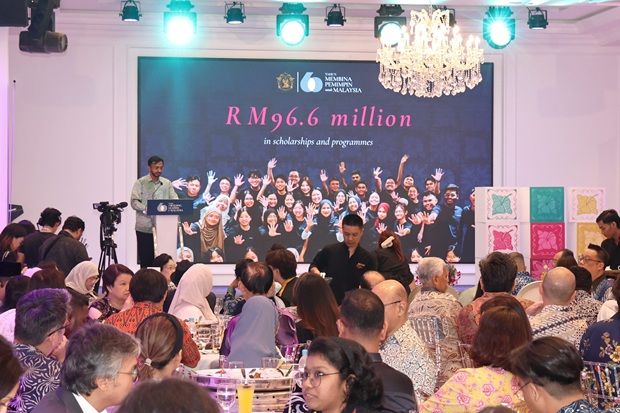
The Tunku Abdul Rahman Foundation reached a significant milestone this month as it commemorated six decades of championing educational opportunity across Malaysia. The celebration took place on August 13 at Bangunan Sultan Abdul Samad, drawing together government officials, alumni, and supporters to reflect on the institution's enduring contribution to nation-building through human capital development. Since its formal establishment in 1966, YTAR has become one of the nation's most respected scholarship providers, embodying a commitment to identifying and nurturing talent regardless of socioeconomic background.
The foundation's origins reveal an instructive chapter in Malaysian civic history. What began as a grassroots initiative to honour Malaysia's first Prime Minister, Tunku Abdul Rahman Putra al-Haj, evolved into a nationally-scaled institution through the efforts of ordinary Malaysians. The founding campaign, initiated by Utusan Melayu on Tunku's birthday, raised more than M$60,170.20 through crowdfunding—a sum equivalent to approximately RM380,000 in contemporary terms. This unprecedented public demonstration of support impressed policymakers sufficiently that Education Minister Tan Sri Mohamed Khir Johari proposed establishing YTAR as a formal national institution, transforming a community-led endeavour into a statutory body through the Tunku Abdul Rahman Foundation Fund Act 1966.
The timing of YTAR's establishment reflected national imperatives of the post-independence period. Malaysia faced an acute shortage of highly-educated professionals capable of managing a complex, modernising economy. By enabling talented Malaysian youth to access higher education abroad and subsequently return to contribute their expertise, YTAR directly served the nation's development agenda. The foundation recognised that investing in human capital was not merely altruistic but fundamental to Malaysia's competitive positioning in an increasingly complex regional and global landscape. This calculation proved prescient: many early recipients of YTAR support would go on to occupy leadership positions in government, academia, healthcare, and business.
Over its six-decade history, YTAR's operational scope has expanded considerably beyond its original mandate. The foundation has channelled RM96.6 million towards supporting over 12,000 Malaysian youths through scholarships, loans, financial assistance, and increasingly sophisticated employability programmes designed to equip graduates with skills demanded by modern employers. National Unity Minister Datuk Aaron Ago Dagang, speaking at the 60th-anniversary ceremony, emphasised that YTAR's evolution reflects changing understandings of how educational institutions can best serve national development. The foundation now functions not merely as a scholarship provider but as a comprehensive talent-identification and development platform, working to identify promising individuals early and nurture their potential systematically.
The role of corporate Malaysia in supporting such initiatives remains underdeveloped according to official assessments. Aaron Ago specifically appealed to businesses to integrate education and talent development into their corporate social responsibility strategies, partnering with established foundations like YTAR to multiply the reach and impact of scholarship programmes. Given Malaysia's competitive pressures in attracting and retaining top talent in an increasingly globalised knowledge economy, such corporate engagement could prove mutually beneficial, enabling businesses to access pipeline talent while contributing meaningfully to national human capital development.
The foundation's chief executive officer, Kularetnam Vijayakumar, stressed that YTAR's longevity derives from its identity as a custodial institution rather than the project of any individual. The foundation represents the collective commitment of multiple generations of Malaysians who have served as trustees, supporters, and beneficiaries. This characterisation carries particular significance in a region where personality-driven institutions frequently falter when their founders depart. By deliberately cultivating institutional culture that transcends individual leadership, YTAR has achieved the rarer feat of demonstrating that nation-building endeavours can outlast their architects when grounded in compelling collective purpose. The enduring belief in education's transformative power—the original conviction that inspired Malaysian citizens to contribute to the founding fund in 1964—remains the foundation's animating principle.
Tunku Abdul Rahman's own pronouncements on education continue to guide the institution's philosophy. The late Prime Minister articulated in 1964 that Malaysia's present and future depended substantially on developing its youth, a conviction that shaped institutional priorities throughout the foundation's history. Datin Sri Sharifah Menyalara Syed Hussein, Tunku's granddaughter and YTAR chairperson, elaborated that her grandfather conceived education not narrowly as academic achievement but as the development of character and purpose enabling young people to locate their meaningful place in society. Over the past six decades, YTAR has progressively evolved from providing financial aid and study loans to adopting a more comprehensive approach that supplies capital, opportunities, skills training, and values formation to high-potential deserving youth.
The foundation honoured two of its earliest recipients whose trajectories illuminate YTAR's impact across different professional domains. Dr Zakaria Ali emerged as a pioneering figure in Malaysian fine arts, establishing himself as painter, writer, educator, and academic leader whose contributions have shaped the nation's cultural intellectual tradition. His pathway to the YTAR scholarship demonstrates the unpredictability of opportunity: an American instructor from Texas, impressed by Zakaria's potential while he worked as a processing assistant, undertook the remarkable step of corresponding with the King, education minister, and prime minister on his behalf. When those efforts culminated in a scholarship award, Zakaria recognised the convergence of chance, individual effort, and institutional support that would define his subsequent contributions to Malaysian society.
Similarly, Ch'ng Kim See received her YTAR scholarship in 1967 at a moment of acute financial crisis during her university studies. Having exhausted other scholarship applications without success, the unexpected award proved transformative for both her family circumstances and her personal trajectory. Ch'ng subsequently became one of Southeast Asia's most prominent librarians, establishing regional leadership in South-East Asian history and library and information science. Her recognition of the scholarship's providential timing shaped her subsequent life philosophy: she consciously sought opportunities to pay forward assistance to others, understanding her own transformation as generating obligations to support emerging talent. Such narratives, multiplied across thousands of beneficiaries, constitute YTAR's most significant legacy.
The alumni cohort of Tunku Scholars has dispersed across every dimension of Malaysia's institutional landscape. Educators, civil servants, lawyers, doctors, and frontline leaders across multiple sectors all trace their access to transformative educational opportunity partly to YTAR's investment. This diversity of professional outcome suggests the foundation's success in identifying talent across varied socioeconomic and geographic backgrounds rather than concentrating support on already-privileged populations. The unifying thread binding this dispersed alumni network is the shared conviction that education represents the optimal investment in Malaysia's future and that individual transformation through learning constitutes the foundation for collective national development.
Looking forward, YTAR announced expansion of its recognition and recruitment mechanisms. The 2026 Pingat Tunku Award nominations process, opening August 31 to September 30, represents a significant structural shift: for the first time, self-nomination has been opened to graduates of both public and private higher education institutions nationwide. This democratisation of the nomination process potentially widens the pool of recognisable achievement and may identify deserving individuals previously overlooked by institutional gatekeepers. Such methodological evolution reflects YTAR's ongoing commitment to refining its talent-identification mechanisms and ensuring that potential remains the primary criterion rather than social networks or institutional affiliation.
As Malaysia confronts intensifying regional competition for talent and expertise, YTAR's model of systematic educational investment gains renewed relevance. The foundation demonstrates that sustained institutional commitment to human capital development, grounded in clear philosophical principles and implemented through professionally managed systems, generates compounding returns across decades. The 12,000 young Malaysians supported thus far represent not merely historical recipients but continuing networks capable of identifying and mentoring subsequent generations of talent. In this sense, YTAR's most significant achievement may be establishing the institutional template and cultural belief system that enables educational opportunity to function as genuine accelerant for national development rather than as peripheral charitable activity. The foundation's six-decade trajectory suggests that such patient, systematic investment in youth remains among the highest-return national priorities available to policymakers and corporate leaders alike.

