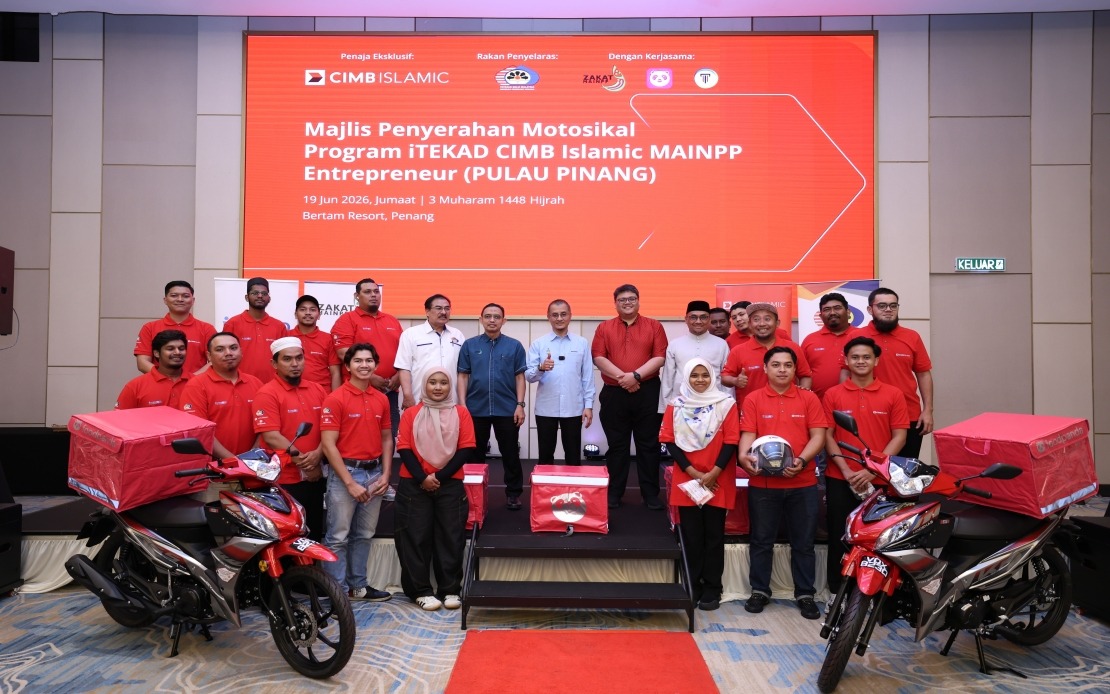
A milestone in poverty alleviation efforts in Penang was marked recently when twenty carefully selected participants received motorcycles as part of the iTEKAD CIMB Islamic-MAINPP Entrepreneur programme. The distribution, which took place at Bertam Resort in Kepala Batas, represents a carefully calibrated intervention designed to provide productive assets alongside comprehensive support services to members of the asnaf, or disadvantaged Muslim communities eligible for zakat assistance.
The initiative reflects an increasingly sophisticated approach to using zakat funds in Malaysia, moving beyond direct cash assistance to catalyse sustainable economic participation. Penang Deputy Chief Minister I Datuk Dr Mohamad Abdul Hamid, who presided over the handover ceremony and serves as president of the Penang Islamic Religious Council (MAINPP), underscored that effective asnaf development demands more than isolated charitable acts. Instead, the programme exemplifies how coordinated effort between financial institutions, religious authorities, government bodies and private enterprises can create pathways out of poverty that address root causes rather than merely symptoms.
The financial architecture underpinning this intervention demonstrates creative partnership between public and private resources. A RM400,000 seed fund was established through matching contributions, with CIMB Islamic Bank Berhad channelling RM200,000 from its Wakalah Zakat fund and Bank Negara Malaysia contributing an identical amount. This structure ensures that private sector zakat reserves and central bank resources work in tandem, a model that could have broader applicability across Malaysia's various state Islamic councils as they seek to modernise their social welfare delivery mechanisms.
The programme's rigour in participant selection distinguishes it from more permissive distribution models. From an initial pool of 151 applicants, all hopefuls were subjected to intensive evaluation including formal interviews and a residential Entrepreneurship Camp conducted from May 31 to June 3, 2026. This bootcamp approach, likely drawing on expertise from the Malaysian Youth Foundation (YBM), emphasizes that asset provision must be paired with human capital development. The filtering mechanism ensures that motorcycles go to individuals demonstrating genuine entrepreneurial inclination and foundational business capacity rather than being distributed indiscriminately.
Beyond the motorcycle itself, successful participants received delivery equipment and critically, structured training in financial management, workplace discipline and entrepreneurial fundamentals. The involvement of foodpanda Malaysia as an implementation partner suggests that these graduates will likely plug into the platform economy as delivery personnel, a sector offering flexible, accessible entry points for individuals previously excluded from formal employment. This alignment with existing gig economy infrastructure increases the practical viability of the assistance, as participants gain not merely tools but immediate pathways to monetise them.
The programme's integration with the Penang Islamic Religious Development Agenda 2030 (APAI2030) signals that such initiatives are no longer ad-hoc charity but rather become woven into longer-term institutional frameworks for ummah advancement. By situating entrepreneur support within broader agendas spanning education, family welfare, youth engagement and economic participation, Penang is constructing a more holistic vision of religious governance that extends well beyond ritual and spirituality into tangible material improvement of community welfare.
For Malaysian policymakers observing from other states, the iTEKAD model offers several transferable lessons. First, it demonstrates how zakat, often conceived narrowly as direct poverty relief, can function as venture capital for economic participation. Second, it shows that meaningful outcomes require substantial upfront investment in screening and training rather than minimal bureaucracy. Third, the explicit integration of private sector players—banks, technology platforms, training foundations—suggests that religious authorities cannot effectively modernise social welfare in isolation but must cultivate institutional ecosystems involving multiple stakeholders.
The emphasis by Deputy Chief Minister Mohamad on moving beyond temporary measures towards catalytic transformation speaks to a recognition that sustainable poverty reduction requires psychological and structural shifts, not merely consumption smoothing. By positioning the motorcycle and training as starting points for ongoing support and mentorship rather than concluding acts of charity, the programme acknowledges that transition into stable self-employment often requires sustained encouragement beyond initial asset transfer.
Within the Southeast Asian context, such initiatives merit attention as models for how Islamic financial and social governance can be operationalised beyond theoretical frameworks. Many Muslim-majority nations in the region grapple with directing zakat resources towards maximum development impact while maintaining spiritual integrity. The iTEKAD approach—combining professional evaluation, skills development, linkages to established platforms and ongoing support—may resonate with policymakers seeking efficiency without sacrificing compassion.
The selection of motorcycle-based delivery as the income generation vehicle is strategically astute for the Malaysian context. Urban and semi-urban areas across Penang and beyond face persistent demand for logistics support, and the gig economy has created legitimate earning opportunities for individuals with minimal capital. Motorcycles remain an efficient asset for this work, with reasonable fuel costs and maintenance requirements compared to alternatives. The partnership with foodpanda specifically signals that graduates have pre-established demand channels rather than needing to create customer bases from scratch.
Looking forward, the success of this cohort will likely determine whether iTEKAD expands to other states or scales up participation numbers in Penang itself. Key metrics to monitor would include income stability among programme alumni twelve and twenty-four months post-graduation, retention rates in delivery work or related self-employment, and evidence of participants moving towards business ownership or advancement rather than remaining perpetual platform workers. Such longitudinal data would validate whether the intensive bootcamp and mentorship investment truly produces durable economic mobility or merely shuffles individuals between categories of precarity.
The programme ultimately illustrates a maturation in how Malaysian society conceptualises religious obligation and social responsibility. Rather than viewing zakat as discharge of individual duty through transaction-like exchanges, this approach treats accumulated religious wealth as institutional capital for systematic community transformation. Whether this model achieves its ambitious aims of breaking poverty cycles will depend not just on initial resource allocation but on sustained commitment to participant support through the inevitable challenges of early entrepreneurship.

