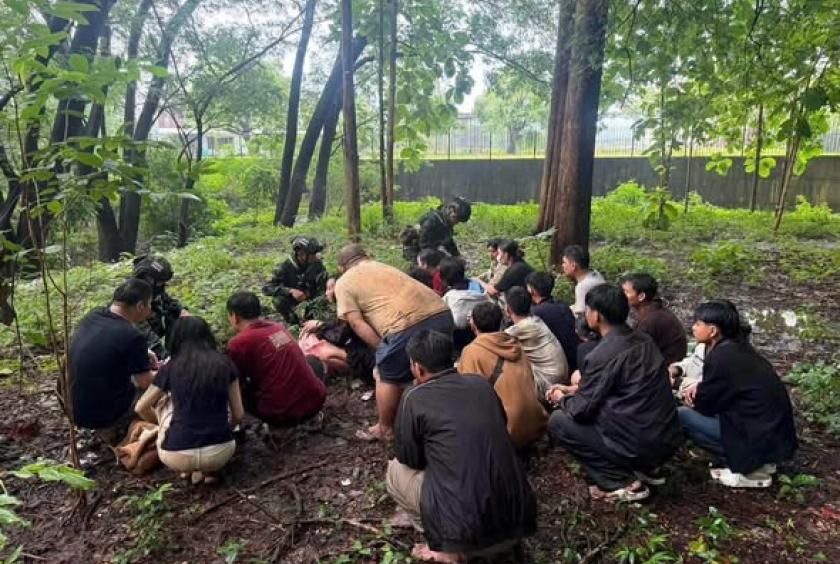
Thai security forces have arrested 20 Myanmar nationals accused of illegally crossing into Thailand through Mae Sot district in Tak province, marking another instance of unauthorized border movement in a region experiencing escalating cross-border migration pressures. The detentions occurred on July 24 when personnel from the Ratchamanu Task Force, operating under Thailand's 3rd Army Region command, intercepted the group during routine security patrols designed to intercept unauthorized border activities.
The operation unfolded in Tha Sai Luat subdistrict, where soldiers discovered the migrants sheltering in woodland adjacent to the Mae Moei City shopping complex in Village No. 2. The hidden location suggests the individuals were attempting to evade detection, raising questions about organized smuggling networks that facilitate such crossings. Initial screening by authorities revealed that none of the detainees possessed valid travel documents, passports, or recognized identification, establishing a presumption of illegal entry under Thai immigration statutes.
The detained group consisted of 11 male and nine female Myanmar nationals, reflecting patterns of family-unit and mixed-gender migration flows characteristic of broader displacement movements from Myanmar. Since the military coup in February 2021, Myanmar has experienced deepening civil strife, economic deterioration, and humanitarian crises that have displaced hundreds of thousands of people seeking refuge in neighboring countries. Thailand, sharing a 2,400-kilometre border with Myanmar, remains a primary destination for those fleeing instability, though Bangkok maintains restrictive immigration policies that classify most entries as illegal.
Mae Sot, a border town in Tak province, has long served as a critical crossroads for migration and trade between the two nations. The district's porous frontier, characterized by difficult terrain and limited surveillance infrastructure in remote areas, creates persistent vulnerabilities that smuggling networks exploit systematically. Thai authorities have intensified patrols in response to mounting unauthorized crossings, deploying task forces specifically tasked with detecting and apprehending migrants attempting clandestine entry.
The Ratchamanu Task Force represents Thailand's military-coordinated approach to border security, integrating intelligence gathering with ground operations across sensitive frontier zones. Such deployments underscore Thailand's security concerns regarding unregulated population movements, though human rights organizations have raised concerns about the treatment of detainees and the limited access to legal representation afforded to migrants. The military's lead role in immigration enforcement, rather than civilian police agencies, reflects Bangkok's classification of border security as a national defense matter.
Following apprehension, the 20 detainees were transferred to the Mae Sot Immigration Office in Tak province, where they face processing under Thailand's Immigration Act and related statutes governing unlawful entry. This process typically involves documentation, background investigations, and hearings that determine penalties ranging from fines to deportation. Myanmar nationals detained for illegal entry generally receive deportation orders, though implementation faces complications given Myanmar's ongoing political instability and limited diplomatic coordination between Bangkok and Naypyidaw.
The incident exemplifies challenges confronting Thai border management at a moment of heightened regional instability. Myanmar's civil conflict has created a cascading humanitarian emergency, with fighting between military forces and armed resistance groups displacing civilians across multiple states. Thailand, already hosting approximately 600,000 registered Myanmar refugees and millions of migrant workers, faces mounting pressure from spontaneous migration flows that bypass official channels. Unauthorized crossings strain resources, create security concerns, and expose vulnerable migrants to exploitation and trafficking networks.
For Malaysia and the broader Southeast Asian region, the Mae Sot situation underscores interconnected migration dynamics reshaping the subcontinent. Thailand functions as both a destination and transit country, with migrants from Myanmar attempting onward movement toward Malaysia, Indonesia, and Singapore in pursuit of economic opportunity or further refuge. The arrest of 20 individuals in a single operation, while routine for Thai authorities, reflects systematic patterns that multiply across the border daily. Malaysia's own experience with Myanmar migrants and Rohingya populations demonstrates how displacement in one nation generates consequences throughout the region's migration corridors.
Thailand's enforcement response, while consistent with immigration law, occurs against a backdrop of limited humanitarian accommodation and restricted legal pathways for asylum seekers. International humanitarian organizations have criticized Bangkok's treatment of unauthorized migrants, contending that criminalization approaches fail to address underlying drivers of forced displacement. Alternately, Thai policymakers argue that robust enforcement prevents exploitation by smuggling syndicates and maintains border sovereignty amid unprecedented population pressures.
The detainees now face an uncertain administrative process that may culminate in forced return to Myanmar, a country where political repression, economic collapse, and armed conflict persist. The returnee experience remains precarious, with many individuals facing security risks or destitution upon repatriation. Such outcomes raise difficult questions about the responsibility of receiving states toward vulnerable migrants, questions increasingly urgent as Myanmar's crisis deepens and regional displacement accelerates.

