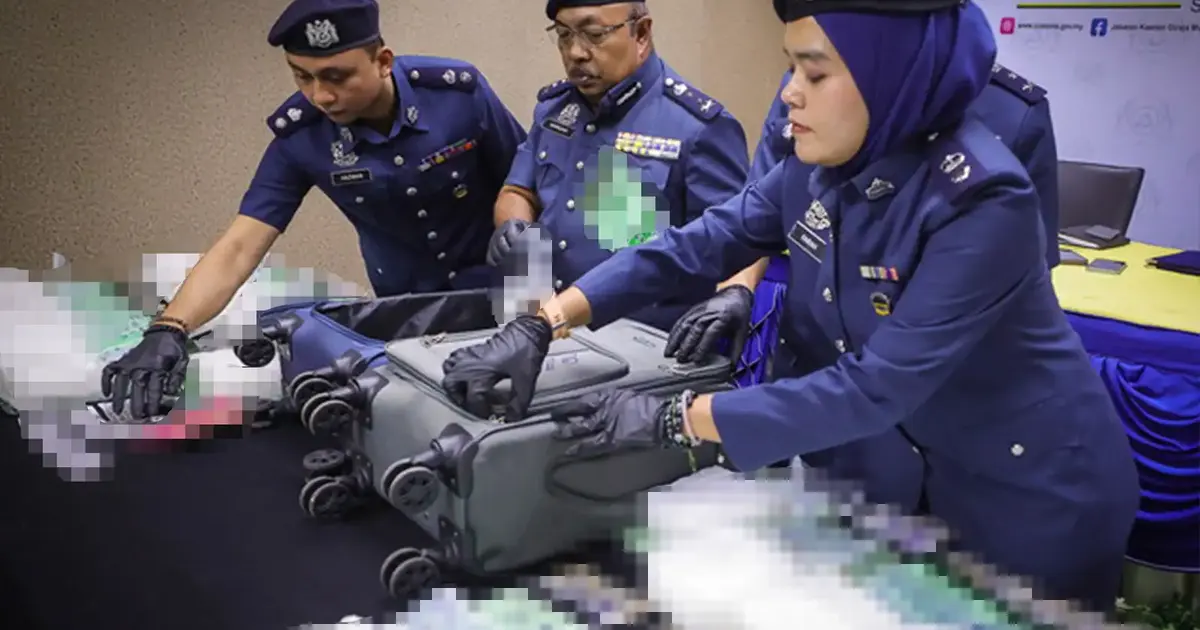
Law enforcement authorities in Sarawak have successfully intercepted a major drug-smuggling attempt at Kuching International Airport, resulting in the arrest of two men who arrived on a flight originating from Johor Bahru on July 9. The coordinated operation represents a significant success for regional drug enforcement agencies in combating the organised trafficking of narcotics through Malaysian transport hubs.
The two detainees were apprehended during routine screening procedures at the airport's arrival terminal after disembarking from their domestic flight. Initial investigations indicate that the pair had been transporting a substantial consignment of illicit substances, with the total estimated street value of the seizure reaching RM1.32 million. The nature and classification of the drugs involved have not been disclosed in official statements, though the substantial monetary valuation suggests involvement of high-potency narcotics commonly targeted by trafficking networks operating in Southeast Asia.
Kuching International Airport, serving as the primary commercial aviation gateway to Sarawak, has become an increasingly critical checkpoint in Malaysia's counternarcotics strategy. The facility processes thousands of passengers daily on both domestic and international routes, making it a vulnerable point for smuggling operations. The successful interdiction demonstrates enhanced vigilance among airport security personnel and coordinated intelligence efforts between federal and state-level enforcement bodies.
The timing of this operation reflects broader patterns observed by narcotics enforcement agencies across the region. Drug trafficking syndicates frequently utilise domestic flight routes as intermediate legs in larger supply chains, particularly when transporting contraband between major Malaysian states. The Johor Bahru–Kuching corridor has previously featured in narcotics investigations, as criminal networks exploit the perceived lower scrutiny of domestic services compared to international borders.
This arrest comes amid intensified efforts by the Royal Malaysia Police and the Ministry of Home Affairs to dismantle trafficking operations feeding the growing demand for illicit substances in East Malaysia. Sarawak has become an increasingly significant market for narcotics consumption, driven by population growth and economic development in urban centres such as Kuching and Miri. Law enforcement agencies have identified the need for enhanced interdiction at transport nodes to stem the flow of contraband into the state.
The successful interception at Kuching airport underscores the effectiveness of passenger profiling techniques and advanced scanning technologies now deployed at major Malaysian aviation facilities. These systems enable authorities to identify suspicious travel patterns, undeclared baggage anomalies, and behavioural indicators suggestive of smuggling activity. Intelligence sharing between airport security operators and narcotics task forces has proven instrumental in elevating detection rates over recent years.
For Malaysian travellers and legitimate businesses operating through Kuching airport, the operation reinforces the stringent security protocols that remain necessary to maintain aviation safety and customs integrity. The facility continues to balance efficient passenger throughput with rigorous contraband detection, a challenge faced by regional airports handling both substantial tourist traffic and cargo operations. Authorities remain committed to preventing the airport from becoming a distribution point for illicit substances destined for local consumption.
The detention of the two suspects initiates formal investigation procedures under relevant sections of Malaysia's dangerous drugs legislation. Both detainees remain in custody pending charges before the Kuching Magistrate's Court, where sentencing guidelines reflect the serious criminal status accorded to trafficking offences. Conviction on narcotics charges carries substantial prison sentences and mandatory fines, particularly where quantities and valuations suggest intent to distribute rather than personal consumption.
This case illustrates the ongoing challenge faced by Southeast Asian governments in combating transnational drug trafficking networks that exploit porous supply routes and utilise commercial transport infrastructure for contraband movement. Malaysia's strategic location within regional trafficking corridors means that domestic airports, seaports, and land borders remain priority enforcement zones. Continued investment in detection technology, personnel training, and interagency coordination will be essential to sustaining operational success against increasingly sophisticated smuggling operations.
Beyond the immediate criminal proceedings, the operation highlights the importance of sustained public awareness campaigns regarding the severe legal consequences of drug trafficking. Malaysian legislation treats smuggling activities as among the most serious criminal offences, reflecting the broader regional commitment to protecting communities from narcotics-related harm. The arrest at Kuching airport serves as a stark reminder of law enforcement capacity to identify and prosecute trafficking operations, regardless of the sophistication employed by criminal organisations.

