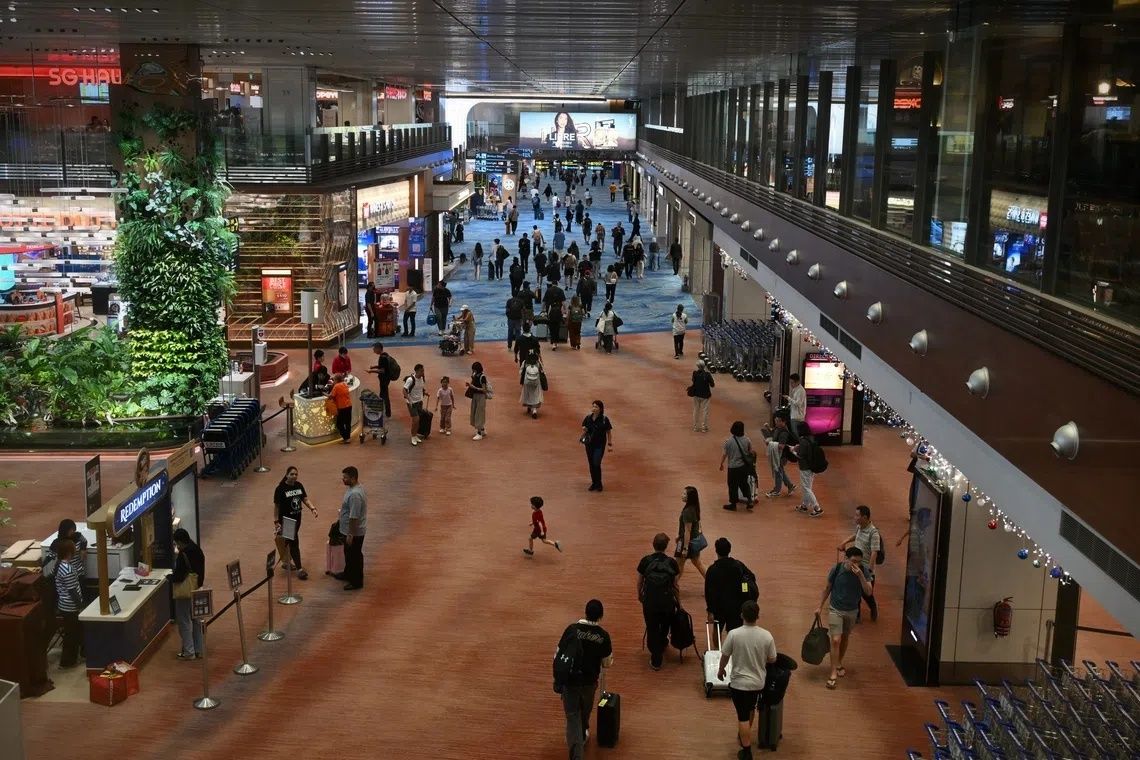
Singapore's police force has apprehended two foreign nationals in connection with separate theft cases at Changi Airport, with one suspect evading capture for more than eight months before being intercepted during a subsequent transit through the facility. The 37-year-old Australian man and a 50-year-old American man are scheduled to appear in court on August 17 to face charges related to their respective incidents, marking a significant success for airport security operations that increasingly rely on advanced surveillance technology to track offenders across international travel hubs.
The incident involving the Australian suspect dates back to November 19, 2025, when a retail employee at a perfume outlet in the transit area of Changi Airport Terminal 2 discovered two boxes of fragrance products missing from a display shelf. Upon reviewing closed-circuit television footage, authorities identified the man removing the items valued at approximately $430 at 4.50 pm without proceeding to make any payment. His departure from Singapore occurred before police could establish a solid identification, allowing him to temporarily evade accountability for the brazen daytime theft.
The breakthrough in the Australian's case came unexpectedly when he returned to Changi Airport on August 4 in a transit capacity, more than eight months after the original offense. This interval between the initial theft and subsequent arrest underscores how international airport security protocols now enable authorities to track and identify suspects even after considerable time has elapsed, particularly when repeat travelers pass through major regional hubs like Singapore's principal aviation gateway.
The American suspect's apprehension involved a more immediate response from airport authorities. Police received notification of a theft at approximately 1.25 am on August 5 after a retail assistant at a perfume store in the transit area of Changi Airport Terminal 1 observed a missing box of fragrance valued at over $310. Security footage documented the American man appropriating the item around 12.40 am and departing without payment, but crucially, law enforcement officers managed to intercept him before he could board his departing flight.
Further investigation through extended CCTV review revealed that the American's criminal activity extended beyond this single incident. Authorities uncovered evidence that he had also stolen a second perfume box valued at approximately $170 and a fragrance tester bottle worth more than $230 from two additional retail locations within the airport's transit zones. The cumulative value of all items recovered from the American suspect exceeded $717, highlighting the scale of coordinated retail theft that can occur within the confined environment of an international airport's commercial areas.
The recovery of all stolen merchandise in the American's case demonstrates the effectiveness of rapid police response and the ability of airport retailers to preserve evidence through their surveillance infrastructure. The contrast between the two cases—one involving an eight-month investigative timeline and another resolved within hours—illustrates how airport security capabilities have evolved to manage both immediate threats and historical offenses through data analysis and intelligence sharing.
Theft in a dwelling, the applicable charge in both matters, represents a serious criminal offense under Singapore law carrying potential sentences of up to seven years imprisonment, monetary fines, or both. This classification reflects authorities' commitment to treating airport retail theft with the same gravity as residential burglary, acknowledging that transit zones constitute enclosed commercial spaces deserving equivalent legal protection. The severity of potential penalties signals to prospective offenders that such crimes will not be treated as minor infractions.
Associate Commissioner of Police M. Malathi issued a formal statement on August 16 emphasizing that Singapore's police service maintains an uncompromising stance toward shop theft across all venues, including high-traffic international facilities. He articulated that modern surveillance technology and its deployment by retailers have fundamentally transformed the detection landscape, making it progressively more difficult for offenders to act with impunity. His remarks carried particular significance for travelers and international criminals who might assume that airport anonymity provides protection from identification and prosecution.
Crucially, the police commissioner's statement addressed the temporal dimension of modern investigation, noting that initial detection evasion no longer guarantees ultimate escape from accountability. Even when offenders depart successfully, subsequent investigations leveraging CCTV data, facial recognition capabilities, and international airport coordination systems can lead to eventual identification and arrest. This message has profound implications for individuals considering transit through major regional airports, as Singapore's approach increasingly reflects standards adopted across developed aviation hubs worldwide.
The airport police unit operating at Changi has signaled its commitment to maintaining collaborative relationships with retail stakeholders and security partners to prevent and discourage shop theft. This ecosystem approach recognizes that no single entity—whether police, retailers, or airport management—can independently eliminate theft from such complex environments. Instead, coordinated intelligence sharing, real-time communication protocols, and unified investigative frameworks create the conditions under which criminal opportunities diminish substantially.
For Malaysian and Southeast Asian travelers and businesses, these arrests carry practical implications. Changi Airport's enhanced security posture and demonstrated capacity to pursue international suspects across extended timeframes serves as a deterrent to opportunistic theft. Additionally, the cases illustrate how comprehensive CCTV coverage in transit zones creates a permanent evidentiary record that transcends borders and time, making it progressively riskier for individuals to engage in retail theft at major regional hubs. Retailers operating across Southeast Asian airports may view Changi's approach as a model for their own loss-prevention strategies and stakeholder collaboration frameworks.

