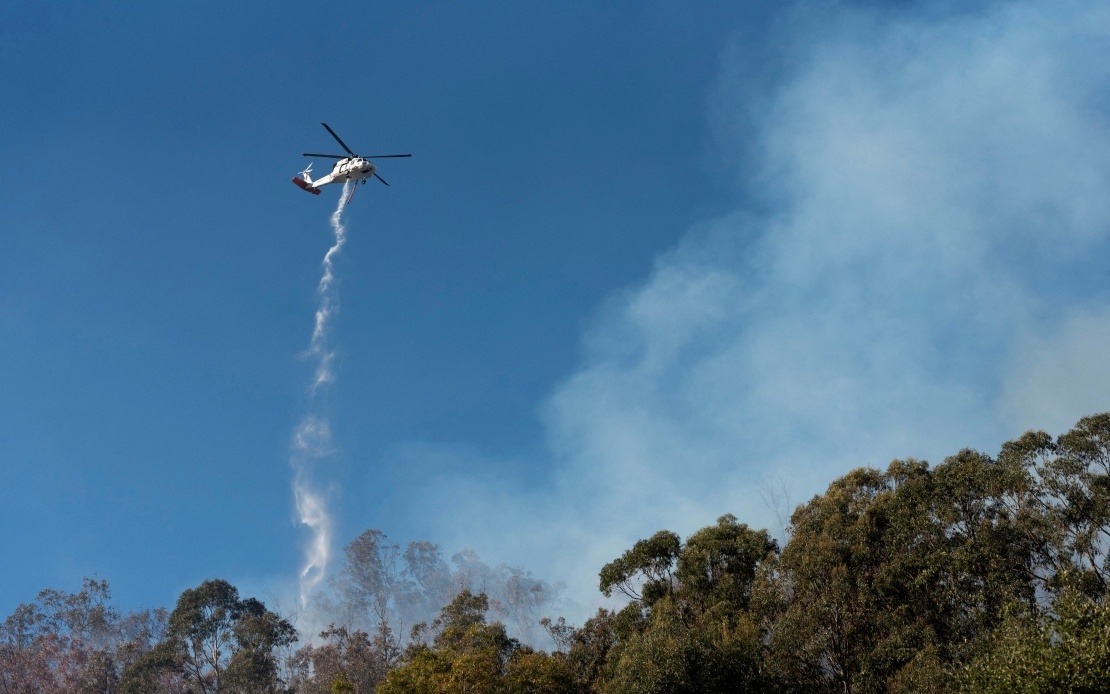
A helicopter supporting firefighting efforts in central Utah crashed on Friday, resulting in the deaths of its pilot and one crew member, according to authorities who announced the incident over the weekend. The accident occurred during active wildfire suppression operations on the Widemouth 2 Fire, which has emerged as one of Utah's most significant fire events in 2024. The National Interagency Fire Centre confirmed that the aircraft, operating under contract with the US Forest Service, went down near Richfield at approximately 10 am local time, though the identities of the two fatalities have not yet been made public.
The National Transportation Safety Board has assumed investigative authority over the crash, examining preliminary information that suggests the Sikorsky S-64 encountered unknown circumstances while conducting fire suppression activities over difficult terrain. This type of helicopter is widely used in large-scale wildfire operations across North America due to its ability to carry substantial water loads for aerial drops. The crash site's remote location and the active fire conditions in the surrounding area have complicated initial access by emergency personnel, raising significant concerns about the safety of recovery and investigation teams attempting to reach the wreckage.
The terrain itself presented immediate challenges to rescue operations, with fire activity around the crash location creating additional hazards that delayed crews' ability to approach the site safely. Officials reported that the impact of the helicopter actually ignited fresh fires in the vicinity, which further hindered access and multiplied the dangers facing first responders. This cascading effect—where the crash itself created new fire dangers—demonstrates the complex and interconnected hazards that emerge when accidents occur in active wildfire zones.
Utah Governor Spencer Cox issued a statement acknowledging the tragedy while emphasising the inherent dangers of wildland firefighting. Cox characterised wildfire suppression as among the world's most perilous occupations, noting that those engaged in this work willingly accept extraordinary risks to protect communities and natural resources. He requested that the public allow investigators and emergency personnel adequate time and space to conduct their operations, recognising the sensitive and ongoing nature of both the crash investigation and the broader firefighting response.
The Widemouth 2 Fire originated on July 27 after lightning ignited vegetation across the Fishlake National Forest near Kanosh, a rural community in Utah's central region. The initial spark found ideal conditions for rapid expansion: timber and brush had dried considerably, ambient temperatures remained elevated, and unpredictable wind patterns accelerated the fire's spread across the landscape. These environmental factors—characteristic of late summer wildfire seasons throughout the western United States—transformed what might have been a contained lightning strike into a major conflagration affecting vast areas.
The fire's expansion prompted mandatory evacuations in surrounding communities and resulted in substantial property damage, with at least six structures destroyed by the advancing flames. Such evacuations create their own humanitarian challenges, displacing residents and straining local emergency management resources even before accounting for the direct losses inflicted by the fire itself. The ripple effects of large wildfires extend far beyond the immediate burn zone, affecting air quality across multiple states and creating economic disruptions through lost agricultural production, timber resources, and tourism revenue.
As of the latest assessment, the Widemouth 2 Fire had consumed more than 114,000 acres, equivalent to approximately 461 square kilometres of forest, grassland, and mixed vegetation. This scale places the fire among Utah's most destructive in recent years, though it remains contained to only 24 percent of its perimeter according to Utah Fire Info, the interagency coordination centre tracking active wildfires across the state. The gap between current containment levels and full suppression suggests that firefighting operations will continue intensively for weeks, assuming weather conditions remain favourable.
The loss of these two firefighting personnel underscores persistent vulnerabilities in aerial wildfire suppression operations, despite technological advances and safety protocols. Helicopter operations during active fires involve inherent risks that cannot be entirely eliminated—pilots must fly in challenging terrain, often in smoke-reduced visibility, while supporting crews coordinate complex manoeuvres to deliver water or fire retardant. Equipment failures, unexpected wind shear, or disorientation in smoky conditions can develop rapidly, leaving little margin for recovery.
For Malaysian and regional readers, this incident reflects broader patterns affecting firefighting operations across numerous countries that manage large forest areas. Southeast Asia faces increasingly intense dry seasons, particularly during El Niño years, which have historically triggered massive transboundary haze episodes affecting multiple nations. The challenges demonstrated in Utah—terrain access, coordination between multiple agencies, the balance between aggressive suppression efforts and responder safety—directly parallel those confronting fire management authorities throughout the region, from Indonesia's vast peat forests to Malaysia's own fire-prone zones during peak burning seasons.
The investigation into the helicopter crash will likely yield valuable safety lessons applicable across the global wildfire management community. Understanding what circumstances led to the accident—whether mechanical failure, pilot error, wind conditions, or some combination of factors—can inform training protocols and operational procedures for similar aerial firefighting missions elsewhere. Such knowledge transfer between jurisdictions strengthens overall safety standards and potentially prevents similar tragedies in other regions currently battling or preparing for wildfire seasons ahead.

