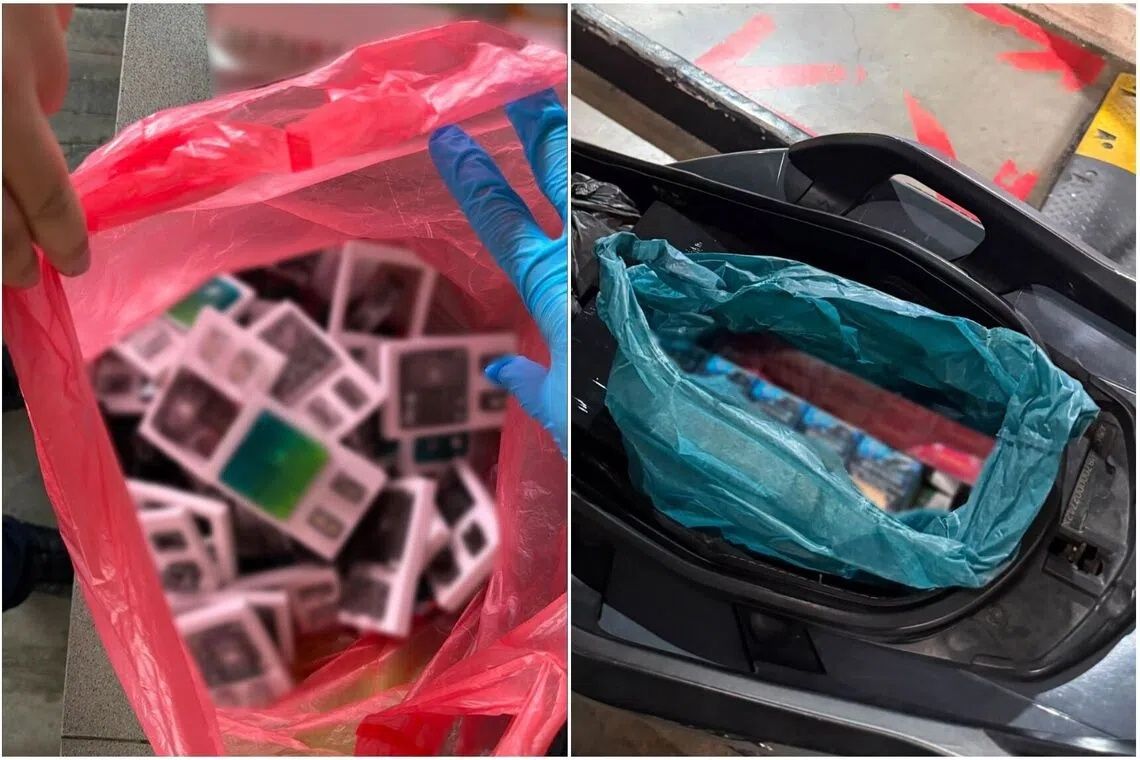
Singapore's Immigration and Checkpoints Authority has arrested two motorcyclists for attempting to smuggle substantial quantities of duty-unpaid cigarettes and illegal vaping devices into the city-state through the Woodlands Checkpoint, highlighting ongoing border security challenges at one of Southeast Asia's busiest crossing points.
The separate incidents, which occurred on Aug 3 and Aug 4, resulted in the detention of a 46-year-old Malaysian national and a 51-year-old Singaporean resident. Authorities announced the arrests on Thursday (Aug 13) following completion of initial investigations at the checkpoint, which processes thousands of vehicles daily crossing between Malaysia and Singapore.
In the first incident on Aug 3, ICA officers conducting enhanced screening procedures on a Malaysia-registered motorcycle discovered an extensive cache of contraband concealed within the vehicle's storage compartment. Officers uncovered more than 30 packets of cigarettes without proper duty stamps, alongside over 60 vaping devices and related accessories. The systematic concealment method suggests deliberate smuggling operations rather than personal possession, raising concerns about organized trafficking networks operating across the causeway.
The following day's apprehension yielded similar findings, demonstrating a pattern of cross-border smuggling activity. Officers inspecting a Singapore-registered motorcycle recovered 25 full cartons and 30 individual packets of duty-unpaid cigarettes, along with more than 60 vapes. The contraband had been distributed across multiple hiding locations within the motorcycle, including under the seat and in the storage box, indicating knowledge of checkpoint procedures and inspection patterns.
The scale of these seizures underscores a persistent challenge for Singapore's authorities, who must balance efficient border processing with rigorous enforcement. Motorcycles and smaller vehicles present particular vulnerabilities due to their relative ease of modification and the volume of cross-border traffic, particularly among commuters and traders who regularly traverse the Johor Bahru-Singapore route. For Malaysian residents with legitimate business in Singapore, these enforcement actions risk creating additional delays during already congested peak periods.
Both suspects and the seized items have been referred to Singapore Customs and the Health Sciences Authority for comprehensive investigation and prosecution preparation. This multi-agency approach reflects the serious nature of the offences, involving both revenue fraud through excise duty evasion and health regulation violations. The involvement of both Malaysian and Singaporean nationals suggests that smuggling operations may operate across community lines, complicating enforcement efforts that typically focus on outbound Malaysian smugglers.
Singapore's statutory penalties for duty-unpaid cigarette offences carry considerable severity, reflecting the government's zero-tolerance approach to excise evasion. Conviction can result in fines reaching 40 times the evaded duty and tax amount, imprisonment up to six years, or both sanctions combined. Additionally, any vehicles utilized in smuggling operations face automatic forfeiture, representing a substantial financial deterrent beyond criminal penalties.
The regulatory framework surrounding vapes carries even harsher penalties, as Singapore maintains one of the world's strictest vaping prohibitions. End users face maximum fines of $10,000 for possession or use, while retailers encounter potential penalties of $200,000 and six years imprisonment. Smugglers specifically face $300,000 fines and up to nine years jail time, reflecting classification of vape smuggling as a serious criminal enterprise rather than a minor customs violation.
Foreign nationals, including Malaysian citizens, convicted of vape-related offences face additional immigration consequences beyond criminal sanctions. Repeat offenders may experience pass revocation and permanent re-entry bans, effectively barring them from future entry to Singapore. This extraterritorial consequence particularly impacts Malaysian cross-border workers, traders, and frequent visitors whose livelihoods depend on regular Singapore access.
These arrests occur within a broader context of Singapore-Malaysia border management complexities. The Woodlands Checkpoint processes approximately 300,000 vehicles weekly, making comprehensive inspection challenging despite advanced screening technologies. Smuggling operations persistently adapt to enforcement patterns, with traffickers employing increasingly sophisticated concealment methods and utilizing various vehicle types and crossing times to evade detection.
For Malaysian stakeholders, the incidents highlight escalating enforcement intensity at the causeway. Legitimate traders and commuters should anticipate potential delays from enhanced screening procedures, while those engaged in grey-market cigarette and vape trading face mounting legal and financial exposure. The seizure quantities suggest organized operations rather than individual transactions, indicating that enforcement focus extends beyond petty smuggling to network-level disruption.
The cases also reflect diverging regulatory philosophies between the two nations regarding tobacco and vaping products. Malaysia permits vaping products with appropriate licensing, creating regulatory arbitrage opportunities that smugglers exploit. This differential regulatory environment will likely continue generating cross-border traffic unless Malaysia and Singapore achieve greater policy alignment on tobacco and nicotine product controls.
Authorities on both sides of the causeway continue strengthening coordination mechanisms to disrupt supply chains. The arrests demonstrate that Singapore's checkpoint enforcement remains operationally effective despite the volume of traffic, though the persistence of smuggling attempts suggests that penalties, however severe, have not completely deterred determined traffickers.

