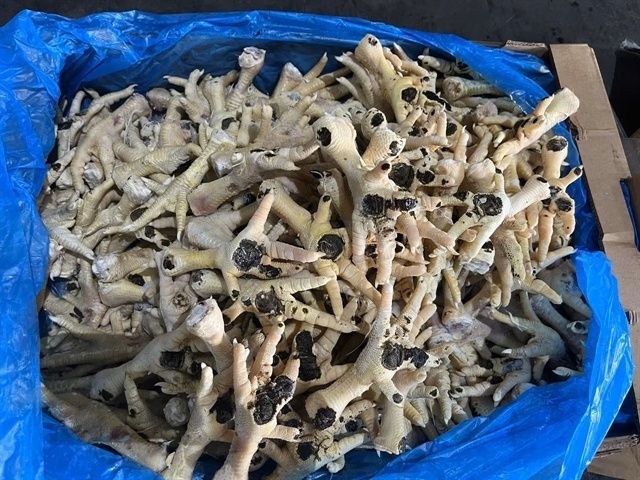
Vietnamese police in Hanoi have brought charges against two businesswomen for orchestrating an elaborate smuggling operation involving hundreds of containers of frozen chicken feet sourced from countries experiencing active poultry diseases. The scheme, which unfolded between 2023 and 2026, represents one of the region's more unusual food contraband cases and raises serious questions about supply chain oversight in Southeast Asia's food sector.
The two accused are Nguyen Thi To Loan, 47, who managed ABF Food Import-Export JSC based in Ninh Binh Province, and Trang Tuyet Ngoc, 45, who held the position of assistant department head at An Binh Group. Police confirmed that both suspects have admitted to all allegations levelled against them, providing investigators with crucial details about how the operation functioned across multiple provinces and involved numerous downstream distributors.
The investigation uncovered a deliberate flouting of Vietnam's biosecurity regulations designed to protect domestic poultry stocks and consumers. Chicken feet shipments from nations with documented poultry disease outbreaks legally can only enter Vietnam for processing and immediate re-export, not for domestic consumption. This restriction exists precisely to prevent contaminated products from entering the food supply. Yet between 2023 and 2026, ABF Food Import-Export imported 339 containers of frozen chicken feet while falsely declaring them on customs documentation as goods destined solely for processing and re-export operations.
Loan, who retained operational control of the scheme, reportedly instructed Ngoc to redirect the incoming shipments to the domestic market rather than pursuing legitimate re-export channels. The scale of diversion was substantial: investigators determined that more than 10,000 metric tonnes of frozen chicken feet reached food-service businesses throughout Hanoi, Cao Bang, Ninh Binh, Quang Ninh and several other provinces across northern and central Vietnam. This geographic spread suggests the product entered numerous restaurants, institutional food operations and possibly retail chains before reaching consumers.
From a financial perspective, the operation generated approximately VNĐ347 billion, equivalent to US$13 million, in unreported sales. Equally significant, no import duties were paid on any of the 339 containers, representing additional revenue loss to the state. The scale suggests this was not a minor infraction but a systematic effort to circumvent both health protocols and customs obligations.
When Hanoi police conducted raids on cold-storage facilities associated with the operation, they recovered evidence of the scheme's true dimensions. At the An Viet 2 freezer facility located in Hanoi's Quang Minh Industrial Zone, officers discovered over 1,000 metric tonnes of frozen chicken feet in storage. Alarmingly, approximately 260 metric tonnes of this stockpile had already exceeded its expiration date and exhibited visible mold growth and foul odours—yet appeared to be prepared for further distribution to customers, suggesting the operation was willing to sell deteriorated products to unwitting buyers.
A second enforcement action at the THL cold-storage warehouse in Lang Son Province in northern Vietnam yielded an additional 1,030 metric tonnes of frozen chicken feet. The combined recovery of more than 2,000 metric tonnes from just two facilities indicates that substantially larger quantities had already moved through the supply chain and reached their final destinations before police intervention. This timeline raises troubling questions about how long the contaminated product may have circulated in Vietnam's food system.
The implications for consumer safety extend well beyond Vietnam's borders, carrying particular relevance for Malaysia and other Southeast Asian nations. Poultry disease outbreaks in one country can rapidly spread regionally through trade networks, and the discovery that products from affected nations were being diverted from legitimate channels and distributed domestically suggests weaknesses in biosecurity enforcement that could enable similar violations across the region. Malaysia's own food import authorities may need to heighten scrutiny of similar high-volume frozen poultry shipments.
Both suspects now face charges under Article 188 of Vietnam's 2015 Penal Code, which covers smuggling offences. The charges carry potential imprisonment and substantial fines. However, police have indicated that their investigation remains ongoing as they work to identify other individuals and organizations that may have participated in the broader network. This suggests the operation likely extended beyond just these two principals, possibly involving customs officials, warehouse operators, transportation companies and downstream distributors who knowingly participated in or benefited from the illegal scheme.
The case underscores vulnerabilities in supply chain governance that exist across Southeast Asia. Frozen poultry products, which travel in high volumes and depend on continuous cold storage, present particular challenges for regulators. The ability to reroute shipments from export to domestic sale requires complicity at multiple checkpoints—including customs clearance, warehouse management and distribution logistics—suggesting systemic corruption may have enabled the operation to function for several years relatively undetected.
For Malaysian businesses importing poultry products from Vietnam or elsewhere in the region, the case serves as a cautionary reminder about verification of source countries and health certifications. Companies purchasing from unfamiliar suppliers should conduct enhanced due diligence, particularly for products originating in nations with known disease issues. The discovery that products bearing signs of spoilage were still being prepared for distribution also highlights the risks of purchasing from informal or poorly documented supply chains.
As investigations continue in Hanoi, authorities will likely examine whether organized crime syndicates or corrupt government officials facilitated the scheme, potentially uncovering broader vulnerabilities in Vietnam's food import system. The scale of the operation and its apparent smooth functioning for years suggest institutional failures that extend beyond the two charged individuals, with implications for how seriously biosecurity enforcement is pursued across the region.

