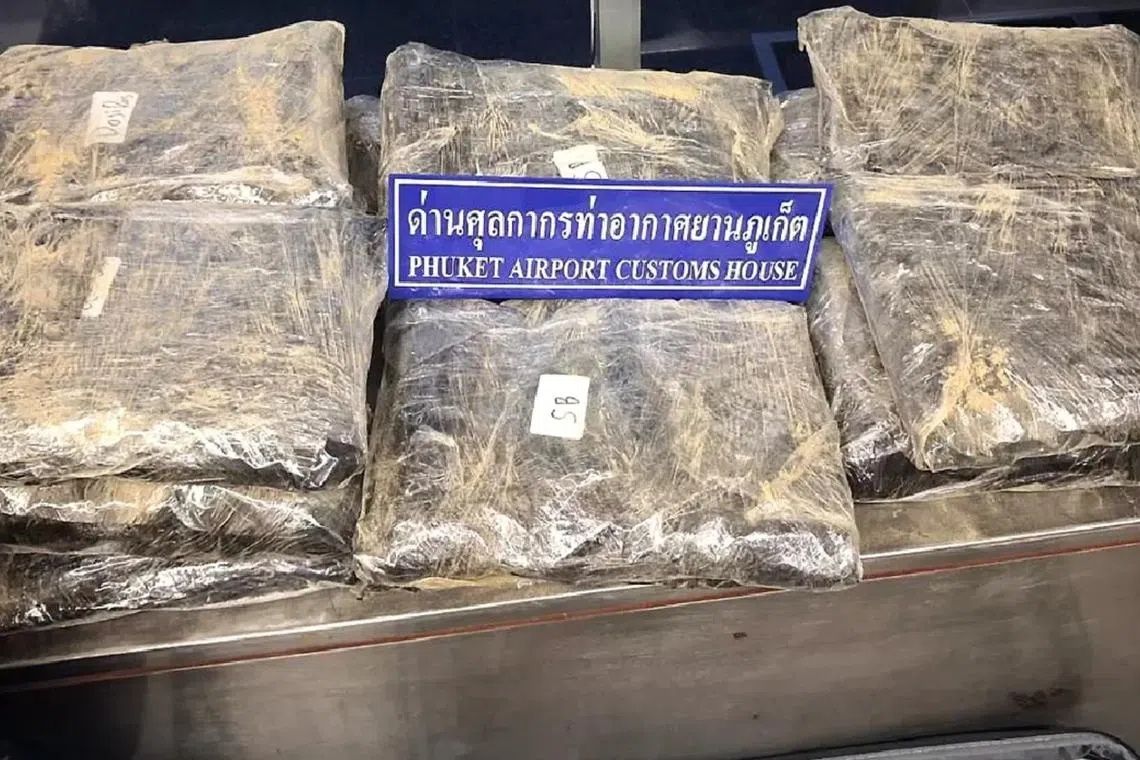
Customs officers at Phuket International Airport have arrested two women following the discovery of more than 32 kilograms of cannabis flowers concealed in their checked luggage, marking another significant smuggling attempt intercepted at Thailand's busy travel hub. The arrests unfolded on Thursday at the airport's international departures terminal, with officers from Phuket Airport Customs House and Sakhu Police Station jointly executing the inspections that led to the seizures and subsequent charges against both suspects.
The first apprehension occurred in the morning when customs officials inspecting outbound passenger baggage opened a black Pierre Cardin suitcase belonging to 18-year-old Filipino national Levannah Chelsea Guzman. Inside the case, officers discovered fourteen individual vacuum-sealed packages containing cannabis flowers, with the total weight of the confiscated material and packaging reaching 14.5 kilograms. Upon interrogation, Guzman confirmed ownership of the suitcase and its entire contents, providing authorities with a clear admission that would form the basis of subsequent legal charges.
The second arrest came several hours later when inspectors became suspicious of a green Swish Navy wheeled suitcase during the afternoon luggage screening process. The suitcase, which belonged to Thai national Penpitcha Phutsiang, contained sixteen vacuum-sealed packages of cannabis flowers totalling 17.6 kilograms. Like her counterpart arrested earlier in the day, Phutsiang acknowledged that both the luggage and all seized items were her property, streamlining the evidentiary requirements for prosecutors building cases against both defendants.
Both women now face multiple charges under Thai law, demonstrating the comprehensive legal framework authorities employ to prosecute trafficking offences. They stand accused of attempting to export controlled goods without completing mandatory customs procedures, a violation of the Customs Act BE 2560 enacted in 2017. Additionally, prosecutors have initiated charges under the Narcotics Code, bringing the cases under the more stringent penalties typically reserved for drug-related offences. The charges have been further expanded to include violations of the Protection and Promotion of Traditional Thai Medicine Wisdom Act BE 2542 from 1999, and the Public Health Ministry's notification concerning controlled herbs related to cannabis that was issued in 2025, reflecting Thailand's evolving regulatory approach to cannabis regulation.
The coordinated bust at Phuket International Airport reflects broader enforcement priorities across Southeast Asia's transportation hubs, where customs agencies have substantially increased scrutiny of outbound passenger luggage. Thailand, as a major transit point for international travel, has become increasingly vigilant in intercepting narcotics smuggling attempts that exploit the high volume of daily passenger traffic. The arrests at Phuket underscore how sophisticated inspection protocols can effectively disrupt trafficking networks attempting to move contraband through conventional travel channels rather than relying on maritime or overland routes.
These intercepts occur within Thailand's complex regulatory environment surrounding cannabis, where the substance occupies an ambiguous legal status. While Thailand has permitted certain medical and research applications of cannabis through specific legislative channels, exportation of cannabis flowers outside official frameworks remains strictly prohibited. The Public Health Ministry's 2025 notification establishing controlled herb classifications indicates ongoing governmental recalibration of cannabis policy, yet such developments have not extended to permit recreational or unregulated commercial exportation. This regulatory uncertainty can inadvertently create opportunities for smuggling attempts by individuals who may underestimate enforcement severity or misunderstand applicable restrictions.
For Malaysian readers and Southeast Asian observers, the Phuket arrests carry significant implications regarding regional drug enforcement coordination and the persistent vulnerabilities within international travel infrastructure. Malaysia's own customs and narcotics agencies face comparable challenges at Kuala Lumpur International Airport and other major gateways, where the combination of high passenger volumes and limited inspection capacity creates systematic risks. The successful interdiction at Phuket demonstrates that enhanced screening protocols, whether involving advanced detection equipment or intensified manual inspection procedures, can yield substantial results when properly resourced and implemented consistently.
The timing and nature of these arrests also reflect evolving patterns in regional drug trafficking, where traditional narcotics routes and methods coexist with emerging attempts to exploit changing legal landscapes. As individual Southeast Asian nations adopt divergent approaches to cannabis regulation—ranging from complete prohibition to controlled medical frameworks—border enforcement becomes increasingly complicated. Smugglers may perceive opportunities in jurisdictional gaps or attempt to exploit transitional periods when regulations are being revised, as may have occurred with the 2025 Thai health ministry notification.
Authorities throughout the region have responded to such challenges by intensifying luggage inspections of departing passengers, a labour-intensive but demonstrably effective strategy. The Phuket airport's commitment to rigorous screening of international departures reflects recognition that airports represent critical chokepoints where trafficking networks remain vulnerable to interdiction. The sustained enforcement emphasis, according to official statements, aims to disrupt smuggling operations before contraband reaches international markets and to establish clear deterrence messaging to potential traffickers considering airport routes.
The implications for travellers between Malaysia and Thailand, and throughout Southeast Asia more broadly, centre on the serious consequences accompanying narcotics transportation across borders. Both women now face protracted legal proceedings under multiple statutory regimes, with potential imprisonment and substantial fines representing probable outcomes. These outcomes serve as practical reminders that international travel, while enabling legitimate commerce and tourism, remains subject to rigorous law enforcement scrutiny regarding prohibited substances, and that customs violations and drug trafficking charges carry consequences significantly exceeding typical travel inconveniences.
Governmental coordination between Phuket's customs authorities and local police in executing the arrests highlights institutional approaches to drug interdiction that may serve as models for enhanced cross-agency cooperation throughout Southeast Asia. As drug trafficking networks grow more sophisticated in response to enforcement pressures, security agencies must correspondingly develop integrated operational frameworks combining customs expertise, police investigative capabilities, and intelligence analysis. The successful prosecution of cases originating from such coordinated efforts depends upon maintaining consistent enforcement momentum and ensuring that legislative frameworks remain responsive to emerging trafficking methodologies.

