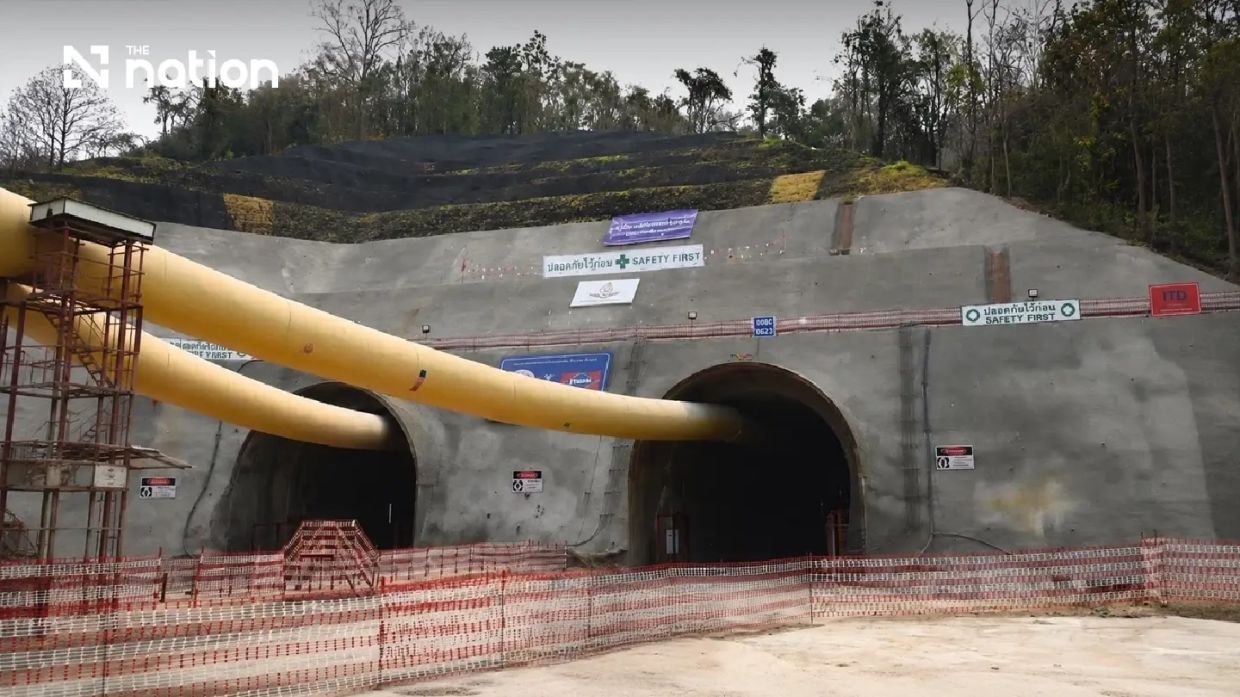
A major construction accident unfolded at the Doi Luang railway tunnel in Chiang Rai on Saturday evening when scaffolding collapsed, killing two workers and leaving seven others with injuries ranging from serious to minor. The incident occurred while construction crews were engaged in installing waterproofing systems deep within the tunnel, which forms part of Thailand's ambitious Den Chai-Chiang Rai-Chiang Khong railway line development. Rescue teams and emergency responders moved swiftly to the scene, transporting all casualties to hospital facilities in the area.
According to Deputy Transport Minister Siripong Angkasakulkiat, the accident was reported at 8.35pm local time. Based on preliminary investigations, the immediate cause appears to have stemmed from rocks dislodging from the tunnel wall and falling onto workers below as they were carrying out their assigned tasks. Earlier accounts had suggested the problem might have involved collapse of shotcrete work—a sprayed concrete technique commonly used in tunnel construction—but subsequent examination pointed more specifically toward the rock fall hypothesis. Officials cautioned, however, that the investigation remained ongoing and a comprehensive assessment of contributing factors was still being conducted.
The immediate aftermath of the collapse saw a well-coordinated emergency response. The accident site was secured and cordoned off to prevent further risk to personnel, and the project's dedicated safety unit assumed operational control of the location. Deputy Minister Siripong reassured observers that circumstances at the tunnel had been stabilised and that continuous monitoring would continue while engineers and safety specialists completed their detailed examination of what went wrong. The State Railway of Thailand's Special Projects and Construction Department mobilised resources to conduct a thorough inspection of the scene and surrounding work areas.
The Doi Luang tunnel represents a critical component of Thailand's broader railway expansion strategy in the northern region. Located in Chiang Saen district, the tunnel extends 3.4 kilometres in length and has already been fully bored through—meaning the collapse occurred during the finishing phases of interior work rather than during the main excavation phase. This stage of construction typically involves installing support systems, waterproofing membranes, and internal infrastructure that will eventually serve the operational railway.
The tunnel forms part of Contract 3 within the larger Chiang Rai-Chiang Khong section of the railway line, a massive infrastructure undertaking valued at THB19.385 billion. This particular contract encompasses extensive construction responsibilities: laying both at-grade and elevated track systems across approximately 87 kilometres, establishing three full stations and three smaller halts, constructing the Doi Luang tunnel itself, and installing comprehensive signalling and telecommunications infrastructure. The scope demonstrates the complex nature of modern rail projects in challenging terrain.
The contractor consortium responsible for delivery is CKST-DC3 Joint Venture, a partnership between three major regional construction firms: CH. Karnchang Public Company Limited, a Thai construction heavyweight; Sino-Thai Engineering & Construction Public Company Limited, representing Chinese-Thai cooperation; and Chiangmai Construction Co., Ltd. Such joint ventures are common in large-scale infrastructure projects across Southeast Asia, allowing companies to combine expertise, share financial risk, and manage substantial workloads.
For Malaysia and other regional observers, this incident underscores persistent safety challenges in large-scale construction projects across Southeast Asia. Despite regulatory frameworks and contractual safety requirements, accidents continue to occur at tunnelling and infrastructure sites throughout the region. The conditions encountered in tunnel work—confined spaces, geological unpredictability, and physically demanding labour—create inherent hazards that require constant vigilance and investment in safety protocols.
The tragedy also highlights broader questions about worker welfare in cross-border construction ventures. When international joint ventures operate across multiple countries, ensuring consistent safety standards and worker protection can become complex. Questions naturally arise about training adequacy, supervision intensity, equipment maintenance, and whether all consortium members maintained aligned safety cultures and practices.
Thailand's railway development programme, which includes the Den Chai-Chiang Rai-Chiang Khong line alongside other major projects, represents a significant commitment to improving regional connectivity. However, incidents like the Doi Luang collapse inevitably prompt scrutiny of whether adequate resources have been allocated to safety management alongside construction timelines and cost targets. Project delivery schedules can create pressure that, if not carefully managed, may inadvertently compromise protective measures.
The incident will likely trigger wider industry review across Thai construction regulators and international partners. Future investigations may prompt adjustments to safety protocols, inspection frequencies, equipment specifications, and worker training programmes on similar projects. Additionally, the accident may influence how international contractors approach joint venture partnerships when operating in challenging geological environments.
As Thailand continues expanding its rail network to support economic development and regional trade, the Chiang Rai-Chiang Khong line remains strategically important for connecting northern Thailand with Laos and broader Southeast Asian markets. However, the human cost of such infrastructure—particularly when preventable accidents occur—cannot be overlooked. The two fatalities represent families disrupted and communities affected, serving as sobering reminders that development progress must not come at the expense of worker safety and dignity.

