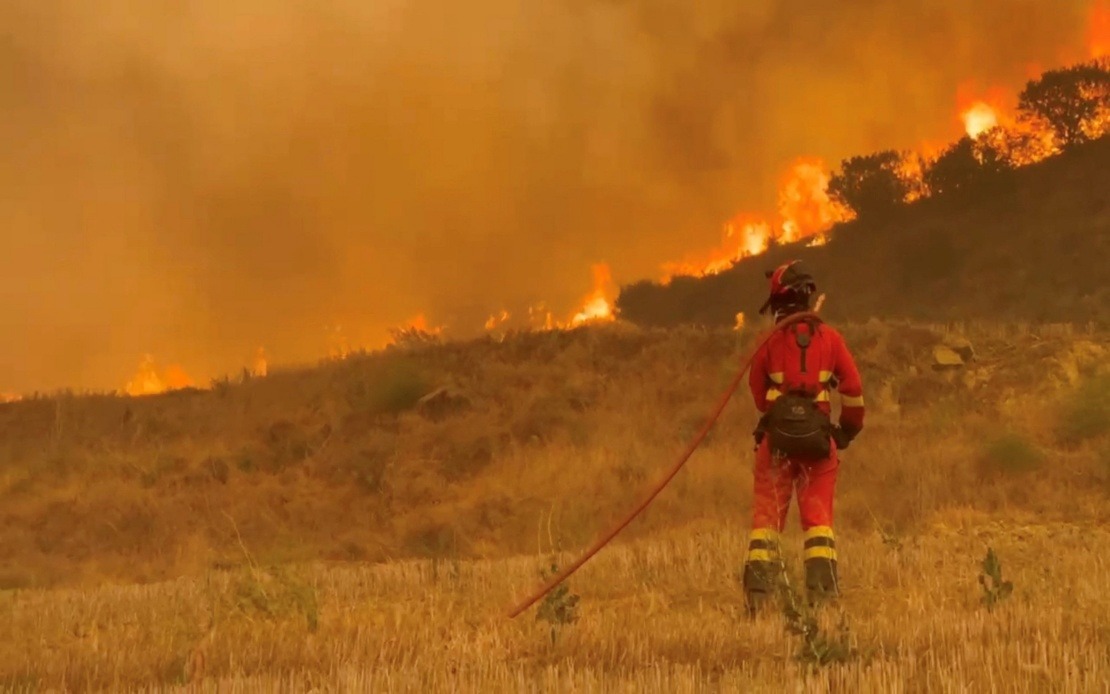
Britain's government is mobilising at the highest level to confront an escalating environmental emergency, with Prime Minister Andy Burnham set to chair an urgent cabinet meeting on Wednesday to coordinate the national response to overlapping climate disasters. The decision to invoke the country's emergency decision-making apparatus—known as Cobra—signals the severity of challenges now overwhelming firefighters, agricultural communities, and the National Health Service simultaneously across multiple regions.
The convergence of extreme temperatures, uncontrolled wildfires, and persistent water scarcity has created a perfect storm of interconnected crises that traditional governance structures are struggling to manage. The New Forest in Hampshire continues to burn intensely, consuming vast tracts of woodland while firefighting resources stretch to breaking point. Simultaneously, the environmental monitoring agency, the Met Office, has issued a rare amber extreme heat warning for Thursday, indicating conditions so dangerous they pose genuine risks to public safety and critical infrastructure.
Water shortages have now reached critical thresholds across the country. On Monday, additional regions in England officially entered drought status, compounding hardship already experienced by farmers managing livestock without adequate grazing conditions or water supplies. Wales had declared its own drought emergency on July 30, following months of record-low rainfall and persistent high temperatures that have depleted reservoirs and groundwater reserves. The combination means that roughly half of England now operates under formal drought conditions, with agricultural productivity and food security hanging in the balance.
The statistical picture has grown stark. The Met Office confirmed this week that the UK is tracking toward recording its warmest summer by average temperature in the entire measured record. This projection carries enormous implications for infrastructure designed around historical climate norms, electricity grids strained by cooling demand, and vulnerable populations lacking air conditioning. The previous benchmarks that guided building codes, health services, and emergency planning have become obsolete.
The public health toll has already materialised in shocking numbers. During the May and June heat waves alone, the UK Health Security Agency reported 2,877 excess deaths—people whose deaths were statistically attributable to heat-related causes. This represents a nearly doubling of the 1,504 excess deaths recorded during the summer heat wave of 2025, suggesting that either temperatures are climbing faster or population vulnerability is increasing, or both factors are at work simultaneously.
The political response has fragmented along predictable lines, with environmental advocates demanding systemic action rather than crisis management. Zack Polanski, leader of the Green Party, seized on the emergency meeting to push for transformative measures, arguing that the moment demands confronting root causes rather than merely treating symptoms. His proposals—imposing taxes on fossil fuel corporations to fund wildfire suppression resources, establishing cooling centres throughout communities, instituting maximum working temperatures, and halting new North Sea oil and gas licensing—represent a fundamentally different framing of the problem as one requiring economic restructuring rather than operational adjustment.
For Malaysia and other Southeast Asian nations, the British experience offers cautionary lessons about climate tipping points, even in wealthy developed economies. The UK possesses advanced meteorological services, substantial financial resources, and sophisticated emergency management systems, yet these prove insufficient when climate impacts accelerate beyond designed thresholds. The intersection of heat, drought, and fire creates cascading system failures that overwhelm sectoral responses. Malaysian planners should note how rapidly these crises metastasised from being distinct problems into a unified existential threat requiring cabinet-level coordination.
The emergency meeting itself represents an implicit acknowledgment that the crisis has outgrown standard departmental channels and requires cross-government synchronisation. Convening Cobra signals that energy policy, agricultural support, health service capacity, emergency services deployment, and infrastructure management must operate as integrated systems rather than siloed bureaucracies. This institutional recalibration may prove as significant as any specific policy outcomes, indicating how climate breakdown forces governments to reorganise their fundamental operating structures.
The meteorological warnings for the coming days suggest the crisis may yet intensify before any policy responses take effect. The amber heat warning for Thursday operates on a different urgency scale than traditional weather forecasts—it functions as an alert that normal daily life should be suspended and protective measures activated. Hospitals should expect surges in heat-related admissions. Power systems may approach failure. Outdoor work becomes genuinely dangerous. This represents the lived reality of climate change moving from abstract statistical projections into immediate, measurable threat.
Looking forward, the question becomes whether this emergency convocation generates genuine policy innovation or merely coordinates existing response capabilities. The proposals from environmental advocates demand structural economic changes that clash with established interests in fossil fuel industries and energy markets. The political feasibility of implementing taxation on energy corporations, accelerating renewable infrastructure deployment, and restricting new hydrocarbon extraction while managing immediate humanitarian crises remains deeply uncertain. Yet the absence of systemic change ensures that future emergencies will recur with escalating frequency and intensity.

