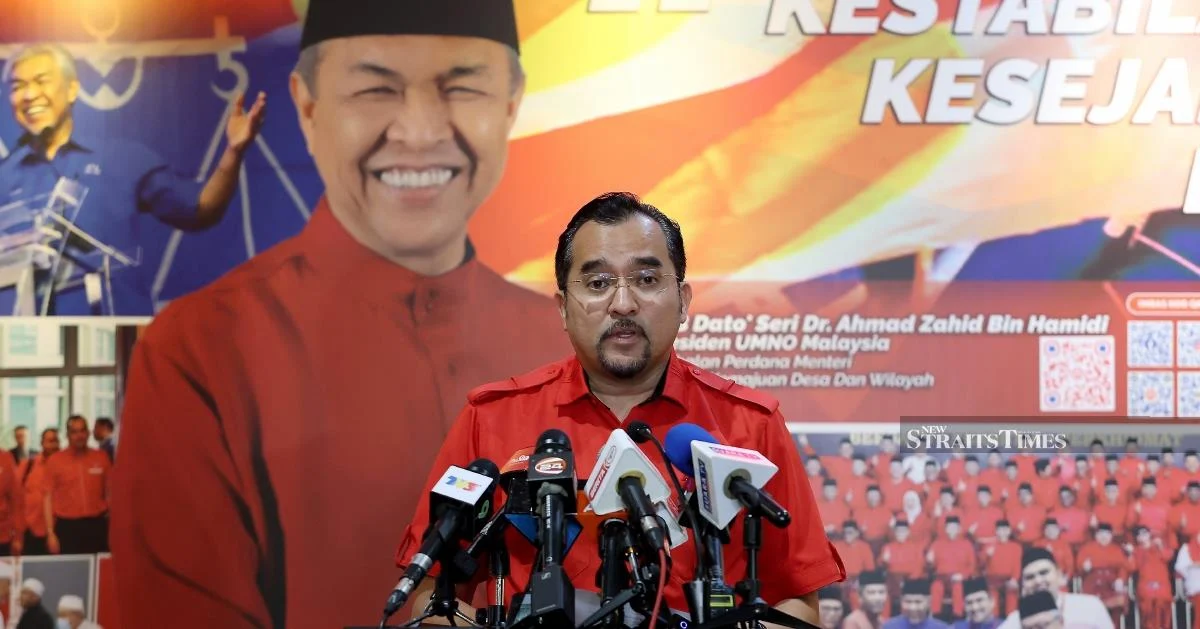
Umno will steer clear of personal attacks and negative campaigning in the forthcoming state elections in Johor and Negri Sembilan, focusing instead on substantive policy platforms and tangible benefits for voters, according to party secretary-general Datuk Dr Asyraf Wajdi Dusuki. The commitment signals an attempt by the country's oldest political party to elevate the tone of political discourse as it approaches crucial electoral contests that will shape the political landscape across two significant states.
Datuk Dr Asyraf's declaration reflects broader concerns within Malaysia's political establishment about the deteriorating quality of campaign rhetoric. In recent years, state and federal election cycles have increasingly been marked by personal invective, character assassination, and inflammatory rhetoric that observers argue detracts from substantive policy debates. By publicly committing to a standards-based approach, Umno appears to be positioning itself as the more principled political actor, potentially appealing to voters fatigued by acrimonious political exchanges.
The party's strategy for Johor and Negri Sembilan campaigns will centre on articulating how Umno's policy agenda serves ordinary Malaysians. This encompasses everything from economic development initiatives to social welfare programmes and infrastructure investment. By emphasising concrete deliverables rather than attacking opponents' character or background, Umno hopes to demonstrate governance capability and voter-centric policymaking. The approach acknowledges that voters increasingly demand substantive conversations about how parties will improve their daily lives.
Johor, as Malaysia's second-most populous state and a critical political battleground, demands particular attention to campaign standards. The state has long been considered an Umno stronghold, though recent electoral cycles have seen competitive challenges from opposition coalitions. Maintaining campaign discipline while articulating a compelling policy vision becomes crucial for consolidating support and preventing erosion of the party's traditional voter base. The stakes are sufficiently high that any misstep in campaign conduct could amplify opposition narratives about Umno's political integrity.
Negri Sembilan presents a different political calculus, though similarly important for Umno's electoral ambitions. The state has experienced shifting political fortunes, with power alternating between coalitions in recent years. A measured, policy-focused campaign allows Umno to appeal across demographic divides by emphasising competent governance and inclusive development rather than divisive rhetoric. This positioning is particularly valuable when seeking to rebuild political capital in states where the party's electoral fortunes have fluctuated.
The secretary-general's comments also carry implications for Umno's internal dynamics. By establishing clear campaign guidelines emphasising policy substance over personal attacks, party leadership sends a message to grassroots members about acceptable conduct. This helps prevent individual candidates or division leaders from engaging in rogue campaigns that might contradict the party's stated principles. Party discipline in campaign messaging strengthens overall electoral coherence and public perception of organisational unity.
Umno's pledge intersects with broader Malaysian political debates about democratic norms and electoral conduct. As a nation with considerable experience managing competitive electoral politics, Malaysia has developed concerns about campaign culture becoming overly personalised and vituperative. Political parties that voluntarily adopt higher standards for campaign conduct contribute to normalising such expectations across the political spectrum. This can incrementally improve the overall health of public political discourse, benefiting democratic processes more generally.
The timing of this commitment matters considerably. By announcing campaign parameters before formal campaign periods commence, Umno establishes expectations that other parties may feel obligated to acknowledge or match. Should opposition parties subsequently engage in personal attacks or mudslinging, Umno can effectively contrast its conduct as the more principled alternative. This rhetorical positioning becomes a campaign asset in itself, particularly among voters concerned about political civility.
Implementing such a commitment requires careful management of diverse party members with different temperaments and campaign philosophies. State-level coordinators, division leaders, and candidate representatives must consistently reinforce messaging discipline. Umno's party machinery must actively monitor campaigns across Johor and Negri Sembilan, providing guidance when rhetoric risks drifting toward unacceptable territory. Enforcement mechanisms matter less than fostering genuine cultural buy-in among campaigners who understand the party's strategic reasoning.
For Malaysian voters and observers of political developments, Umno's declaration offers a modest but meaningful signal. It suggests that despite increasing polarisation in Malaysian politics, at least some major parties recognise the importance of elevating campaign discourse. Whether sustained in practice remains to be seen, but the public commitment creates accountability benchmarks against which the party's actual conduct can be measured throughout campaign periods in both states.
The broader implications for Southeast Asian political trends warrant consideration as well. Regional democracies frequently grapple with campaign culture and political civility questions. Malaysia's experience developing norms around campaign conduct through major parties' voluntary commitments provides useful precedent. If Umno successfully maintains discipline across its Johor and Negri Sembilan operations, it demonstrates that contemporary political parties can compete fiercely while adhering to substantive rather than personal campaign standards.