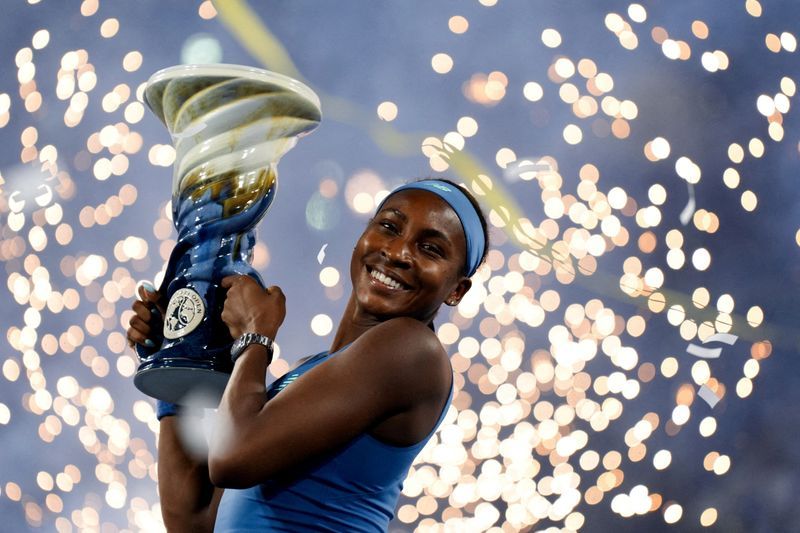
The women's draw at the upcoming US Open is wide open after the tournament's top two seeds have stumbled into the final Grand Slam event of the season, creating an unexpected opportunity for former champions Coco Gauff and Iga Swiatek to capture the prestigious crown at Flushing Meadows. With world number one Aryna Sabalenka struggling through the latter stages of her campaign and second-ranked Elena Rybakina dealing with injury concerns from the Cincinnati event, the traditional order has been disrupted in ways that could fundamentally reshape the tournament's outcome.
Sabalenka's pursuit of an unprecedented third consecutive US Open title has been undermined by an inconsistent second half to her season, during which she has failed to maintain the winning form that carried her through the early months of the year. Her performances since capturing the Sunshine Double have been marked by troubling patterns—lost leads in critical matches and difficulty closing out points when it matters most. The Belarusian star's vulnerability heading into New York stands in sharp contrast to the dominance she displayed when sweeping Australian Open and Miami titles, raising serious questions about whether she possesses the mental and physical reserves necessary to make history on the hard courts of Queens.
Meanwhile, Rybakina's exit from Cincinnati with a leg injury has cast considerable doubt over her tournament prospects before the main draw even commences. The Kazakhstan-born player, who was seeded second going into the US Open, now faces uncertainty regarding her fitness and readiness to compete at the highest level over the demanding fortnight required to capture a major title. This physical setback arrives at precisely the wrong moment for a competitor attempting to make an impact at a venue where her form had previously shown promise.
In stark contrast stands Gauff, the 2023 champion who has orchestrated a remarkable turnaround in recent weeks. The American's groundwork in Cincinnati proved transformative, culminating in her first title victory of the season that demonstrated a newfound command of her previously troublesome serve. Her run through Toronto and into the Cincinnati final showcased a player operating with genuine confidence and tactical maturity, qualities that will serve her well navigating the tournament's dense field of challengers. Beyond purely tennis considerations, Gauff benefits from the electric atmosphere New York provides to American players, particularly one as marketable and beloved among casual fans as she has become.
Former world number four Mary Joe Fernandez, offering expert analysis for ESPN, identified Gauff as the player currently demonstrating the most accomplished tennis on the hard court circuit. This assessment carries weight given Fernandez's intimate knowledge of the professional game and her proximity to current developments. Beyond individual accolades, Gauff carries additional motivation as one of only two top American contenders alongside fourth-seeded Jessica Pegula, positioning the pair as carriers of national pride in a tournament where American women have noticeably underperformed earlier in the season.
Swiatek arrives in New York having shed the considerable burden of domestic criticism in Poland following her breakthrough Toronto title win in the closing days of August. The Polish champion's journey throughout the season has been decidedly uneven, marked by premature exit after premature exit at the year's major competitions. She failed to advance beyond the quarter-final stage at any Grand Slam event prior to the US Open, a troubling trend for someone accustomed to competing deeper into major tournaments. However, her candid reflection on her own readiness—acknowledging how she was seeking victories before her game had genuinely rounded into form—suggests a player approaching this event with clearer perspective and more realistic expectations.
At eighth in the rankings, Swiatek boasts formidable credentials through her six previous major titles, even though the current season had not treated her with particular generosity until recently. Her dispatching of Rybakina to claim the Toronto trophy provided tangible evidence that her game could return to championship level when circumstances aligned. The timing proves crucial, as Grand Slam tournaments reward momentum and confidence in ways that regular tour events cannot replicate.
Beyond the established contenders, the broader field contains numerous dangerous alternatives capable of mounting credible championship campaigns. Mirra Andreeva, the teenage Russian who remarkably captured her maiden Grand Slam crown at Roland Garros just months ago, represents the new generation pushing against established hierarchies. Czech player Linda Noskova similarly announced her arrival among elite competitors with her breakthrough Wimbledon triumph last month, adding another youthful challenger to the mix. Meanwhile, Alexandra Eala of the Philippines has captured widespread attention by defeating multiple major champions including the four-time Grand Slam winner Naomi Osaka during her recent WTA 500 victory in Washington.
Osaka herself cannot be discounted despite her extended absence from the circuit due to maternity leave. The Japanese star, who claimed US Open titles in 2018 and 2020, maintains a devoted following at Flushing Meadows and has demonstrated sufficient form in recent months to suggest she remains capable of constructing deep tournament runs. Though she has not captured a major since the 2021 Australian Open, consistent performances and a recent appearance in the Bad Homburg final indicate that her competitive edge has genuinely returned following her break from professional tennis.
According to ESPN's Patrick McEnroe, the women's draw cannot reasonably be characterized as entirely open, yet somewhere between six and eight different players possess legitimate claims to winning the championship. This assessment underscores how thoroughly the traditional hierarchy has been disrupted by injuries, form fluctuations, and the emergence of fresh challengers. The uncertainty creates narrative tension and genuine unpredictability—elements that have somewhat diminished in recent seasons when established champions maintained more consistent dominance.
For Malaysian and Southeast Asian readers, the prominence of Eala as a regional player competing at the highest level adds particular resonance to this year's tournament. Her victories over established stars demonstrate that competitive tennis transcends the traditional powerhouse nations, a development that should encourage growing interest in the sport across the region. The US Open provides an ideal platform for emerging players to capture global attention and validate their claims to major-tournament competence.
The convergence of Gauff's revitalized form, Swiatek's momentum-building Toronto title, and the faltering performances from top seeds Sabalenka and Rybakina creates a genuine departure from anticipated script. Rather than witnessing a coronation of pre-tournament favourites, the tournament promises a more unpredictable narrative in which multiple pathways to championship glory remain genuinely viable. This dynamic promises engaging competition across the fortnight at Flushing Meadows.

