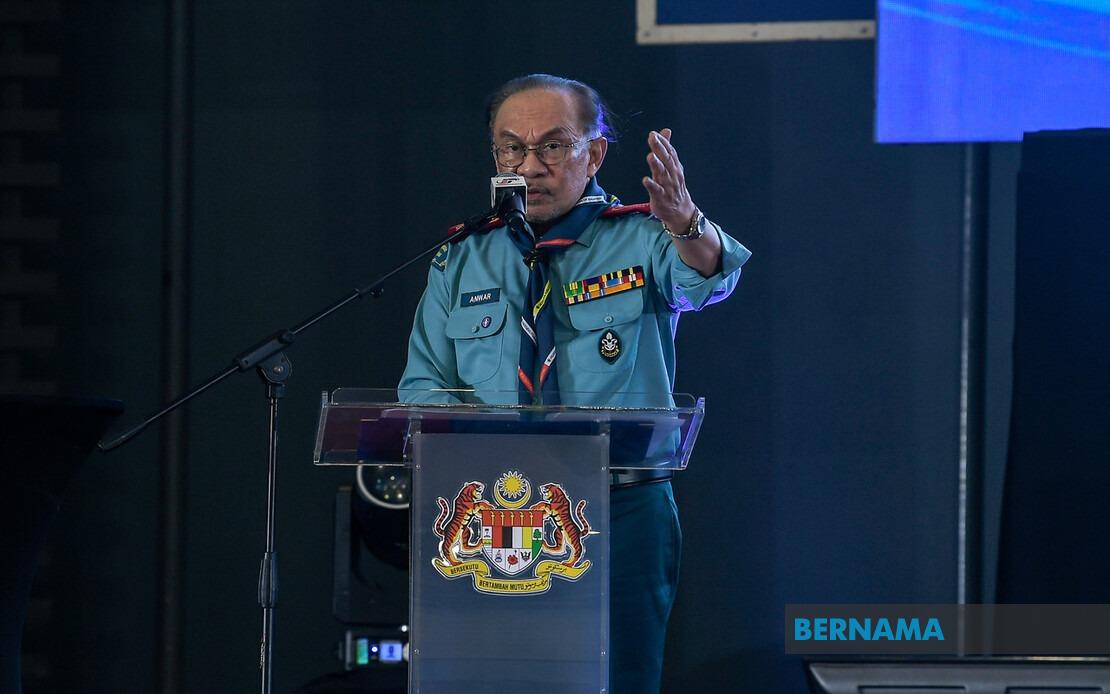
Prime Minister Datuk Seri Anwar Ibrahim has sought to dispel concerns that efforts to strengthen Malay as Malaysia's official language would undermine competency in other languages, arguing instead that a multilingual approach benefits the nation's economic and educational prospects. Speaking at the Ambang Merdeka Sahabat MADANI 2026 programme at Universiti Teknologi MARA (UiTM) Permatang Pauh on August 29, Anwar emphasised that linguistic diversity should be viewed as complementary rather than competitive, with each language serving distinct purposes in an increasingly globalised society.
The Prime Minister's remarks address longstanding sensitivities around language policy in Malaysia, where discussions about the primacy of Malay have occasionally sparked concerns among minority communities about the status of English, Mandarin, and Tamil. Anwar's intervention suggests a deliberate attempt to reframe the national conversation, positioning multilingualism not as a threat to national identity but as a pragmatic strategy for enhancing Malaysia's competitiveness in regional and global markets. His framing reflects broader developments in Southeast Asia, where countries increasingly recognise that linguistic proficiency in multiple languages enhances rather than dilutes economic performance and social cohesion.
Crucially, Anwar underscored that all Malaysian citizens, irrespective of their ethnic background, must achieve strong command of Malay while simultaneously cultivating excellence in additional languages. This formulation suggests a hierarchical approach where Malay retains primacy as the unifying national language, yet other languages occupy essential supporting roles. The distinction matters for Malaysian audiences accustomed to sensitivity around language hierarchies, as it clarifies that the government views Malay as foundational without treating other languages as optional luxuries.
English received particular attention in Anwar's address, reflecting its undeniable status as the dominant global language for commerce, diplomacy, science, and technology. Rather than positioning English as a competing threat to Malay, Anwar described it as a complementary tool that should be embraced within Malaysia's educational and economic systems. He explicitly rejected the notion that promoting Malay requires diminishing English competency, a distinction that carries weight given historical debates in Malaysia about education policy and the balance between nationalist and pragmatic considerations. The framing suggests that contemporary policymakers increasingly recognise the impracticality of choosing between national identity and global participation.
Mandarin occupied a particularly significant place in Anwar's remarks, acknowledged as one of the region's major economic languages whose importance continues to grow. This recognition reflects Malaysia's geographic position within Southeast Asia and the extraordinary economic weight of China and Chinese-speaking populations throughout the region. For Malaysian businesses and professionals, Mandarin proficiency opens access to supply chains, investment opportunities, and markets that have become increasingly central to regional economic integration. Anwar's endorsement of Mandarin learning signals governmental comfort with economic realities that earlier decades might have treated with more ambivalence, particularly in contexts where Chinese education has sometimes faced political scrutiny.
Tamil received mention as another language Malaysians wished to strengthen, underscoring Anwar's apparent intent to encompass the linguistic aspirations of Malaysia's Indian and Tamil communities. While Tamil has faced ongoing challenges in Malaysian education and public life, its inclusion in Anwar's hierarchy of supported languages represents a gesture toward inclusive cultural recognition. The Prime Minister's framing positions Tamil not as a minority concern but as one component within a rational, multilingual national strategy.
Central to Anwar's argument lies the concept that language competency represents neither a zero-sum competition nor an ideological battleground, but rather an economic necessity. He explicitly encouraged Malaysian children to develop Chinese language skills provided their Malay foundation remained solid, framing this as an investment in future economic opportunity rather than a retreat from national identity. This reframing transforms linguistic policy from a cultural-nationalist question into a practical human capital question, one where countries must equip citizens with tools necessary for prosperity in a multipolar, multilingual economic world.
An important dimension of Anwar's intervention concerns regional economic dynamics. Southeast Asia has emerged as an increasingly multipolar economic zone where competency in Mandarin, alongside English and local languages, represents genuine competitive advantage. Malaysia's position as a regional hub for commerce, finance, and technology means its citizens operate within intricate linguistic environments where monolingualism poses genuine disadvantages. Anwar's position implicitly acknowledges that Malaysia cannot wall itself off from these regional realities without imposing costs on its population.
Beyond language policy per se, Anwar used his platform to address broader questions of national unity and interethnic harmony. He cautioned against sowing discord among communities and stressed that Malaysia's celebrated social cohesion cannot be taken as permanent without deliberate, consistent effort to maintain it. This framing connects language policy to the deeper question of how diverse societies manage integration and maintain stability. By positioning multilingualism as an expression of shared commitment to national progress rather than as a zero-sum competition between communities, Anwar implicitly argued that good language policy strengthens rather than threatens social peace.
The Prime Minister explicitly invoked principles of sharing, caring, and mutual support as foundations for ensuring all Malaysians benefit equitably from national development. This language suggests that beneath discussions of linguistic hierarchy lies a concern with ensuring that policies remain inclusive and that no community perceives itself as disadvantaged by government decisions. For Malaysia's plural society, such reassurances carry particular weight, as historical tensions around language policy have occasionally signalled deeper anxieties about communal fairness and access to opportunity.
An unstated but significant implication of Anwar's remarks concerns educational and employment policy. Schools and institutions must now operate according to frameworks that prioritise Malay while providing robust English and Mandarin instruction, and maintaining other linguistic options. This creates substantial practical challenges for curriculum designers, resource allocation, and teacher preparation, yet Anwar's statement signals that policymakers are committed to navigating these complexities rather than imposing simple, exclusive approaches.
For Malaysian employers and educational institutions, Anwar's framing provides cover for policies emphasising multilingualism. Universities, multinational companies, and professional organisations can present multilingual requirements not as undermining national identity but as responses to the Prime Minister's own articulated vision. This signals a potential shift toward greater institutional flexibility in language policy even as official commitment to Malay remains unwavering.
Ultimately, Anwar's intervention represents an attempt to resolve a persistent tension in Malaysia's language politics by simultaneously affirming Malay's primacy and acknowledging economic and social imperatives for broader linguistic competency. Whether this position finds broader political acceptance remains to be determined, but it signals that Malaysia's leadership recognises the necessity of moving beyond zero-sum framing in its approach to language policy. In a region where multiple languages intersect and economic opportunity increasingly depends on communication across linguistic boundaries, Anwar's articulation of complementary multilingualism may prove pragmatically necessary even if it satisfies no all stakeholders in Malaysia's occasionally sensitive language debates.

