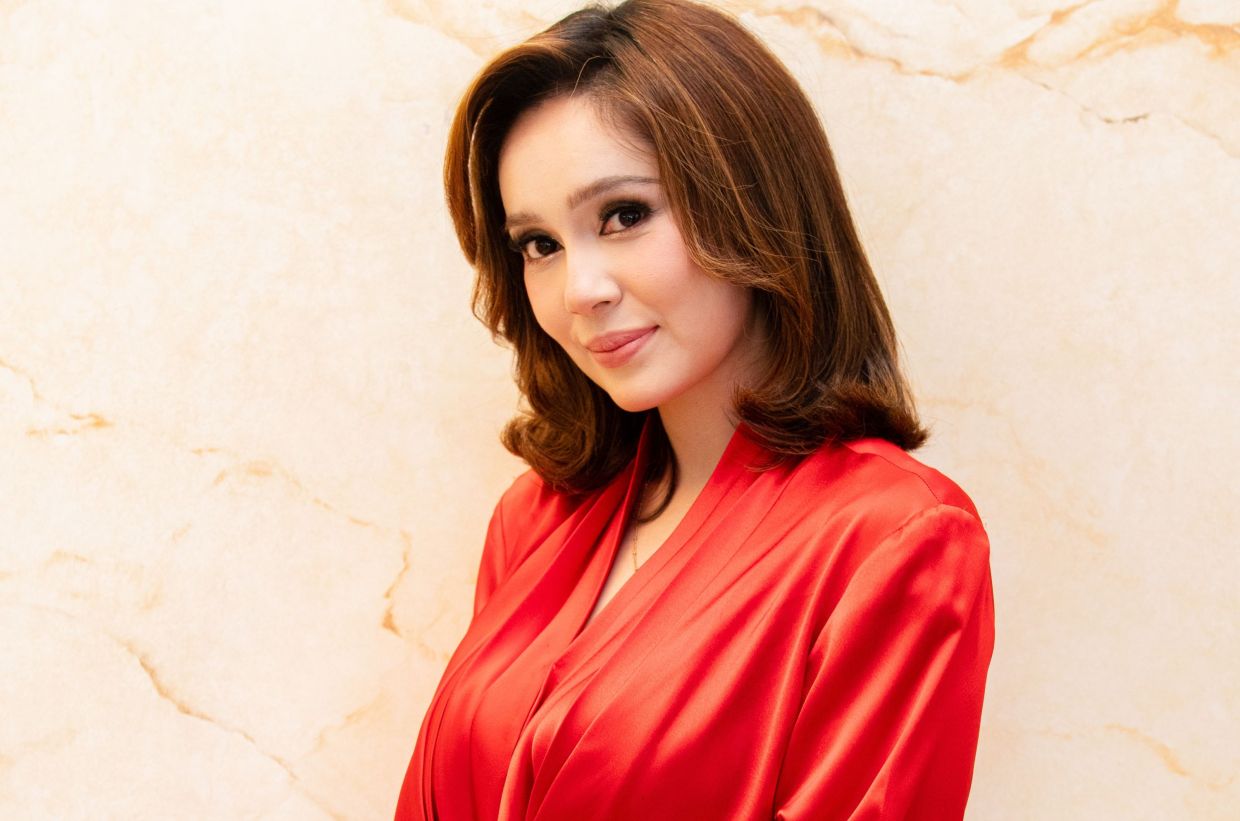
Actress Uqasha Senrose has chosen to focus on professionalism when discussing her collaboration with co-star Aliff Aziz in a new drama series, declining to pass judgment on his personal circumstances despite the significant controversy that engulfed him in March 2024. At that time, Aliff found himself at the centre of a public scandal when he was apprehended for khalwat—an Islamic legal term referring to proximity between unmarried individuals—an incident that ultimately precipitated his high-profile divorce from Malaysian singer-actress Bella Astillah, with whom he shares two young children.
When addressing the elephant in the room, Uqasha adopted a measured and empathetic stance. She articulated that she does not believe it falls within her purview to evaluate another person's private affairs, acknowledging her own fallibility and past mistakes. This perspective appears informed by her own recent tumultuous personal circumstances, lending her comments a particular authenticity that resonates beyond mere platitudes.
Throughout the production process, Uqasha emphasised that no tension materialised between herself and Aliff on set. She described him as consistently professional and focused on his responsibilities as a performer. From her vantage point, what mattered most was the work itself—his execution of his craft and her ability to fulfill her own obligations. She explicitly stated that she never experienced apprehension or discomfort during their working relationship, suggesting a collaborative environment free from the contamination of external drama.
Uqasha's philosophy extends beyond mere tolerance to encompass a fundamental principle regarding livelihood and opportunity. She expressed conviction that she does not believe in depriving anyone of their professional opportunities—their rezeki, as she termed it using the Malay concept of divinely-bestowed sustenance. From her perspective, acting is Aliff's professional pursuit, and acting is hers; their shared workplace obligation transcends personal circumstances.
It is instructive to note that Uqasha herself has navigated significant personal upheaval in recent years. She initiated divorce proceedings against her former husband, actor Kamal Adli, in October 2025, with the separation becoming legally final in January 2026. The couple, who share a daughter, experienced acrimonious proceedings during which Uqasha levelled accusations of domestic abuse—allegations that Kamal categorically rejected. This personal trajectory lends weight to her apparent commitment to compartmentalization between private turmoil and professional responsibility.
The drama series in which both actors appear comprises twelve episodes and centres on the complexities of polygamous marriage. The narrative follows Aliff's character Adli, Uqasha's portrayal of Azura, and Elisya Sandha's characterisation of Nikita as they navigate the emotional landscape of such an arrangement. The premise itself invites exploration of morally ambiguous territory and interpersonal complications.
Uqasha was deliberate in her approach to character development, consciously choosing not to draw from her own recent personal devastation when constructing her portrayal of Azura. She recognised that importing her authentic emotional baggage into the role risked compromising the integrity of her performance and the character's distinct narrative arc. Instead, she maintained a professional boundary between herself as Uqasha and Azura as an autonomous fictional entity with her own unique circumstances and journey.
Despite this protective mental framework, Uqasha acknowledged that inhabiting Azura's emotional landscape—particularly a character who endures significant suffering including physical violence—took considerable psychological toll. The role demanded numerous scenes of intense tears and vulnerability, including moments where her character experiences physical aggression. She conveyed that there were instances when she found herself experiencing genuine emotional resonance with Azura's predicament, recognising the cumulative weight of betrayal, second chances, and renewed hardship that defines her character's arc.
What distinguishes this series, according to Uqasha's perspective, is its refusal to engage in moral simplification. No character emerges as entirely virtuous or entirely reprehensible. The narrative demonstrates that individuals who project kindness may harbour less benevolent intentions, whilst those who appear harsh or cruel may possess legitimate motivations underlying their behaviour. This philosophical complexity appears to have attracted Uqasha to the project itself.
Regarding her present circumstances, Uqasha indicated that she has recalibrated her priorities toward her own wellbeing and contentment. Her focus has narrowed to her professional endeavours and her responsibilities as a parent, with emphasis on building stability for herself and her daughter. She articulated that each challenging experience she has endured has functioned as an educational opportunity, fostering personal growth and maturity. Motherhood, particularly, has fundamentally shifted her perspective, instilling in her an understanding that her responsibilities transcend her individual interests and encompass obligations that extend to another human being.

