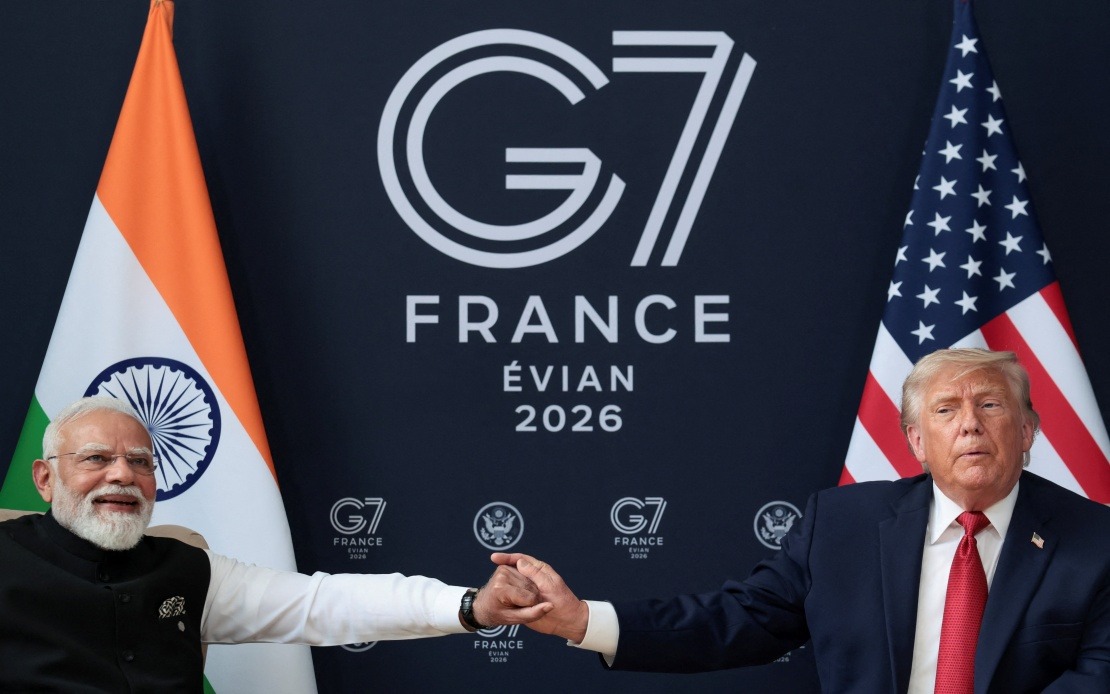
Bilateral trade negotiations between the United States and India have entered a new phase of momentum, with both countries announcing that meaningful progress has been achieved towards a comprehensive trade agreement. Indian Prime Minister Narendra Modi and US President Donald Trump discussed the matter during their bilateral meeting held on the sidelines of the Group of Seven summit in Evian, France, on Wednesday, signalling renewed commitment from the world's largest and third-largest economies to bridge commercial differences.
India's External Affairs Ministry released a formal statement capturing the positive tenor of the discussions, indicating that both leaders expressed clear satisfaction with the trajectory of ongoing negotiations. The statement outlined that Modi and Trump have instructed their respective trade officials to accelerate work on reaching what they described as a "balanced, mutually beneficial, and commercially meaningful agreement" as rapidly as possible. This language suggests both sides believe the framework for a deal is now sufficiently developed to justify pushing toward a final resolution without delay.
The diplomatic choreography surrounding this announcement carries particular significance for the region. The US-India relationship has become increasingly central to American strategy in the Indo-Pacific, where New Delhi serves as a counterweight to Chinese economic and strategic influence. For India, securing favourable trade terms with Washington is critical to maintaining its own economic momentum and avoiding deeper tariff regimes that could constrain growth across multiple sectors. The progress announcement therefore reflects not merely commercial calculation but also the broadening geopolitical understanding that underpins this partnership.
US Trade Representative Jamieson Greer is scheduled to visit India in the coming week to advance the negotiations further, indicating that substantive discussions will continue with minimal delay. Greer's visit represents a concrete commitment to translating the leaders' optimism into tangible progress, with his presence likely to focus on resolving technical details and sectoral concerns that have previously complicated the negotiation process. This hands-on engagement by senior trade officials reflects the importance both governments attach to concluding an agreement.
Trump's characterisation of Modi as "one of the toughest" negotiators carries both compliment and acknowledgment of the Indian Prime Minister's unwillingness to accept unfavourable terms. The US President's observation that Modi "looks like an angel" but is "as tough as a killer" captures a broader truth about India's approach to trade diplomacy: beneath diplomatic courtesy lies a steely determination to protect national interests. This frankness suggests that the progress announced has come through hard negotiation rather than simple concessions by either side.
The current discussions build upon an interim trade agreement that both countries reached in February of this year, under which the US agreed to reduce certain tariffs to 18 per cent. However, this interim arrangement has since been overshadowed by more aggressive American tariff policies. Trump's imposition of 25 per cent tariffs on India generally, combined with an additional 25 per cent penalty specifically targeting purchases of Russian oil, significantly increased the stakes for finalising a comprehensive agreement. These tariffs have created genuine pressure on Indian exporters and increased the imperative for both sides to reach a final settlement.
The timing of these negotiations matters considerably for Southeast Asian economies like Malaysia. Any US-India trade agreement will reshape commercial patterns across the region, potentially affecting everything from technology exports to agricultural trade flows. Countries in this part of Asia have long served as intermediate suppliers in global value chains, and shifts in US-India bilateral trade could either create new opportunities for regional partners or result in displaced commerce if either country increases domestic protectionism.
India's negotiating position has strengthened considerably given its status as a critical ally in American efforts to counterbalance China's regional influence. Unlike some trading partners who face unilateral American pressure, India brings strategic value to Washington that provides leverage in securing reasonable commercial terms. This asymmetry helps explain why Indian negotiators have proven capable of resisting pressure for one-sided concessions, even when confronted with substantial American tariffs.
The complexity of reaching a comprehensive agreement should not be underestimated. Previous attempts at similar bilateral arrangements have foundered on disputes over agricultural tariffs, intellectual property protections, and sectoral access. Both nations have powerful domestic constituencies that view certain sectors as strategically sensitive, making compromise difficult even when overall political will exists. The fact that officials have been instructed to work toward a final agreement "at the earliest" suggests leaders recognise these technical obstacles and want to prevent bureaucratic delays from derailing momentum.
For Malaysian observers and policymakers, the implications extend beyond direct trade impact. A successful US-India trade agreement would signal that strategic competition between Washington and Beijing need not preclude functional economic relationships in Asia. It would also demonstrate that India can negotiate effectively with the Trump administration without sacrificing core interests, a lesson that may inform how other regional players approach their own American trade discussions. The agreement could also influence India's approach to regional trade frameworks, potentially making New Delhi a more active participant in efforts to build alternative trading architectures that are not dominated by Beijing.
Looking ahead, the next phase of these negotiations will likely prove decisive. With senior American trade officials visiting India imminently and both leaders having publicly committed to reaching an agreement, political capital has been invested in success. The real test will come when negotiators confront the detailed sectoral issues that have previously caused difficulties. However, the clear commitment from Trump and Modi to deliver results suggests that this time, a comprehensive trade agreement may finally move from the category of aspiration to actual achievement.