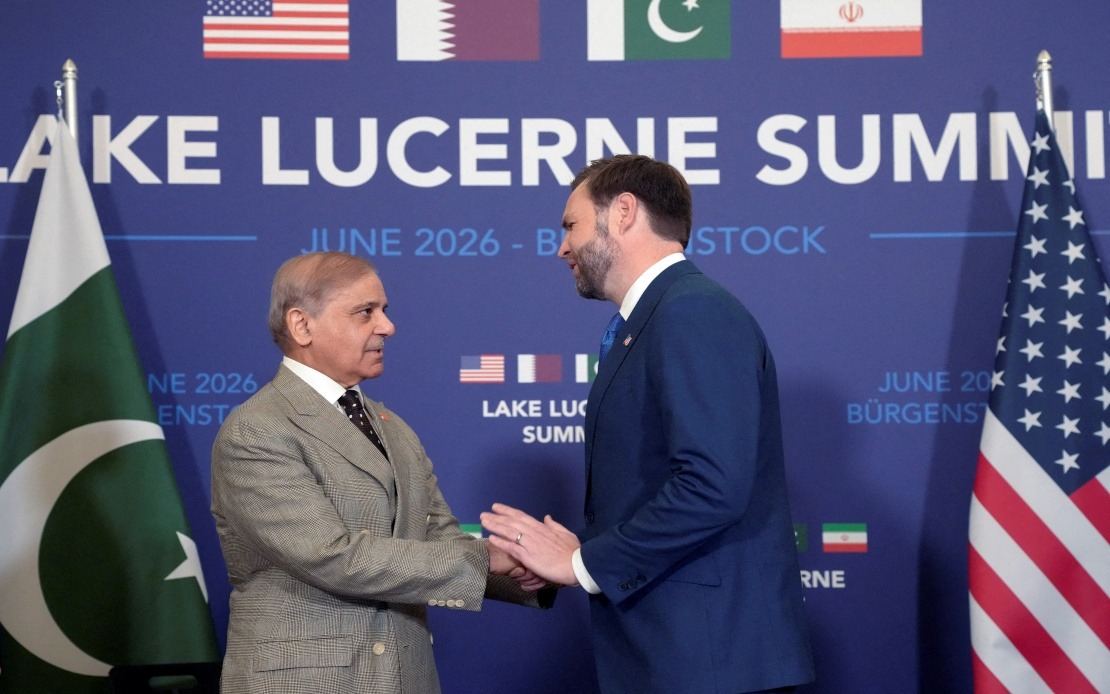
A high-level delegation from the United States gathered with Pakistan's political and military leadership at the Burgenstock resort in Switzerland on Sunday, marking a significant diplomatic engagement as parallel talks proceeded on resolving the US-Iran nuclear dispute. The meeting brought together Vice President JD Vance alongside special envoys Steve Witkoff and Jared Kushner with Pakistan's Prime Minister Shehbaz Sharif and Pakistan Army Chief Field Marshal Asim Munir, according to statements from the White House press office. The timing of this bilateral engagement, held on the sidelines of broader multilateral negotiations, underscores the strategic importance both Washington and Islamabad place on their relationship amid regional security considerations.
The encounter at Burgenstock represents a notable moment in US-Pakistan ties, which have experienced periods of tension and realignment over the past two decades. Pakistan's decision to participate in the mediation process between the US and Iran, alongside Qatar, signals its continued role as a regional power broker despite shifting geopolitical alignments in South Asia. For Pakistan, engagement at this level provides an opportunity to influence outcomes that could directly impact its own security architecture and regional balance of power, particularly given Iran's geographical proximity and historical trade relationships with Pakistan.
Technical-level discussions between American and Iranian delegations, facilitated by mediators Pakistan and Qatar, commenced simultaneously at the same Swiss location. These negotiations operate under conditions of strict confidentiality, reflecting the sensitive nature of discussions regarding Iran's nuclear programme and broader regional security frameworks. The confidential setting permits negotiators to explore substantive issues without immediate public pressure or inflammatory rhetoric that could derail progress.
Underlying these discussions is a ceasefire agreement signed remotely between Iran and the United States on the night of June 18. This memorandum, representing a preliminary accord, established a framework to halt military hostilities that had escalated since February 28. The agreement stipulates concrete timelines for American withdrawal of its naval blockade affecting Iranian shipping, while obligating Iran to restore normal maritime commerce through the Strait of Hormuz—a critical global shipping artery through which roughly one-third of seaborne traded oil passes.
For Malaysia and Southeast Asia, the implications of progress in US-Iran relations carry significant weight. The Strait of Hormuz remains vital to regional energy security and global trade flows, particularly for oil-importing nations throughout Southeast Asia. Sustained disruptions to shipping or military escalation in the Persian Gulf directly elevate energy costs and create supply uncertainties that ripple through Asian economies. Malaysia, as both an energy consumer and major shipping hub through the Strait of Malacca, has vested interest in Gulf stability.
Crucially, Iran's nuclear programme remains the substantive core of unresolved tensions. The preliminary accord commits Iran explicitly to forgo acquisition of nuclear weapons, establishing a pathway toward permanent resolution through a separate, more detailed agreement. Negotiators have established a sixty-day window to develop this comprehensive nuclear accord, creating an intensive diplomatic timeline that reflects both the urgency and complexity of the matter.
Iran's fundamental objective through this process centers on sanctions relief. The Islamic Republic has endured decades of economic restrictions imposed by Washington and international bodies, constraining its access to global financial systems, technology imports, and energy markets. A successful nuclear agreement would theoretically permit normalisation of Iran's economic relationships and expansion of its international trade, potentially reshaping competitive dynamics across Asian markets where Iranian oil and goods could once again circulate freely.
Pakistan's participation as a mediator reflects its delicate diplomatic positioning within South Asian and broader Islamic geopolitical contexts. As a nuclear-armed nation with significant Shia and Sunni populations, Pakistan maintains complex relationships with both Iran and the United States. Its role in facilitating negotiations enhances its diplomatic profile and potentially positions it to extract concessions or reassurances regarding its own security concerns, whether relating to Afghanistan, India, or internal stability.
The presence of special envoys Witkoff and Kushner alongside Vice President Vance indicates Washington's commitment of high-level diplomatic bandwidth to these negotiations. Their participation suggests the US administration views successful nuclear agreement as sufficiently important to warrant sustained engagement by individuals close to the highest decision-making levels. This elevation of personnel from previous diplomatic iterations signals either heightened urgency or the expectation that breakthroughs may require creative problem-solving at senior levels.
For regional observers including Malaysian policymakers, the outcome of Burgenstock discussions will establish parameters for Middle Eastern stability over coming years. A successfully negotiated nuclear accord could reduce regional military tensions and permit Iran's economic re-engagement with global markets. Conversely, failure might trigger renewed escalation, further militarisation, and economic disruption affecting energy supplies and shipping security throughout Southeast Asia. The technical discussions proceeding in Switzerland thus carry consequences extending far beyond immediate participants, touching energy security, trade flows, and geopolitical stability across the Indo-Pacific region.

