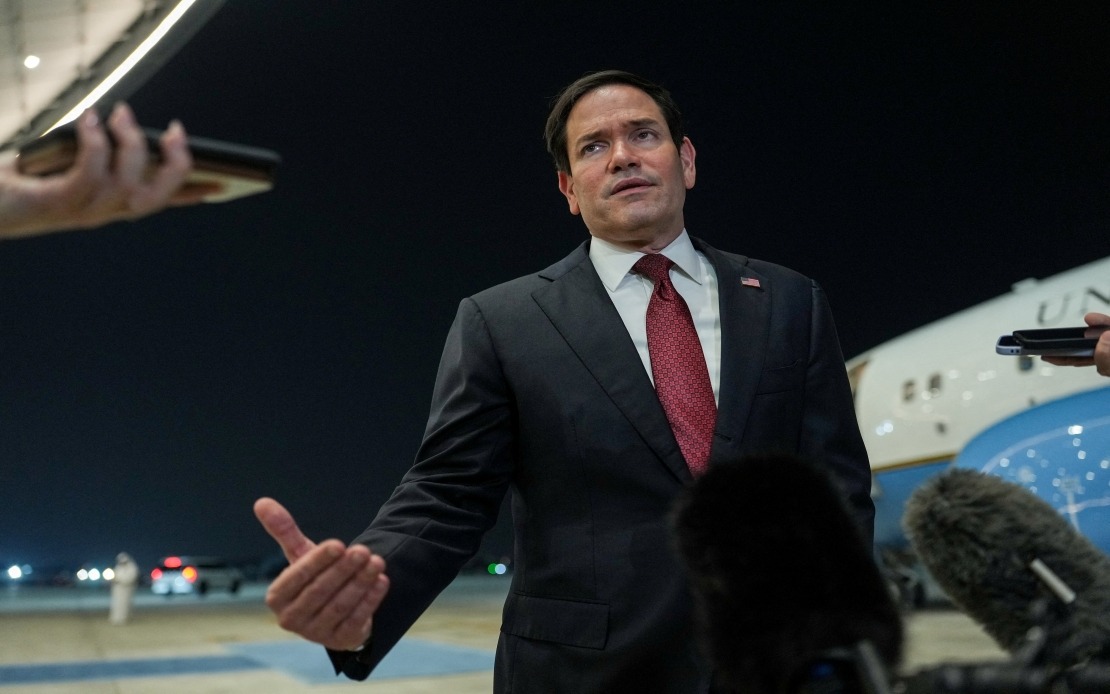
United States Secretary of State Marco Rubio has made clear that Washington will not be bankrolling any reconstruction initiative for Iran, pushing back against reports suggesting otherwise. Speaking to journalists on Tuesday, Rubio stated unequivocally that while discussions about potential investment vehicles for Iran may be occurring, the US government itself will not be providing financial resources to such efforts. His comments come amid broader diplomatic developments between Washington and Tehran that have gained momentum in recent weeks, marking a significant shift in one of the Middle East's most fraught relationships.
The remarks come as speculation has swirled around proposals for a substantial fund—reportedly valued at around US$300 billion—that might be established as part of broader US-Iran reconciliation efforts. When questioned about the possibility that Gulf states might contribute to such a mechanism, Rubio maintained that any investment decisions remain hypothetical at this stage. He emphasised that while Iran itself could theoretically pursue economic development initiatives, such progress would hinge entirely on how upcoming negotiations progress on matters of mutual security concern. The secretary of state's position underscores Washington's determination to maintain leverage in ongoing discussions despite the thaw in bilateral relations.
Rubio's cautious framing reflects the complexity of the current diplomatic moment. While both countries have signalled willingness to engage constructively, fundamental disagreements persist on numerous fronts. The US government's position is that economic benefits for Iran must be conditional on demonstrable progress on security issues that have long troubled American policymakers and their regional allies. This conditionality is particularly pronounced regarding Iran's nuclear programme, which remains a central point of contention between the two nations. The secretary of state suggested that economic opportunities would flow naturally from successful resolution of these outstanding security questions, essentially positioning prosperity as a carrot rather than a starting point for negotiations.
The diplomatic engagement between the two countries has accelerated notably in recent weeks. A significant development occurred last week when Iran and the US signed a memorandum remotely that aimed to bring an end to military hostilities that erupted on February 28. This document represents a major breakthrough in preventing further escalation, establishing clear timelines for key moves by both sides. Washington has committed to lifting its naval blockade that has constrained Iranian shipping, while Tehran has pledged to restore normal maritime commerce through the Strait of Hormuz, a strategically vital waterway through which enormous quantities of global oil trade flows daily. These concrete commitments suggest both parties view de-escalation as mutually beneficial.
Nuclear weapons development remains perhaps the most contentious issue between Washington and Tehran. Under the newly signed memorandum, Iran has committed not to pursue nuclear weapons acquisition, addressing one of the primary security concerns that have animated American policy toward the Islamic Republic for decades. However, the nuclear question is complex and multifaceted, requiring far more detailed negotiations than can be accomplished through a single agreement. Consequently, the two parties have committed to undertaking comprehensive discussions specifically focused on Iran's nuclear programme within a 60-day timeframe. These negotiations will likely prove crucial in determining whether the current diplomatic opening translates into a durable and comprehensive resolution of bilateral tensions.
Recent direct talks between senior delegations from both countries have demonstrated the seriousness with which both sides are approaching these negotiations. Representatives from the United States and Iran gathered in Burgenstock, Switzerland on Sunday for substantive discussions, with Qatar and Pakistan playing crucial mediation roles throughout the process. The US delegation was led by Vance, while Iran's Parliamentary Speaker Mohammad Bagher Ghalibaf headed the Iranian negotiating team. Following the talks, both sides released statements indicating that meaningful progress had been achieved, though neither disclosed specific details about the substance of their discussions or the nature of remaining disagreements.
For Southeast Asian observers and policymakers, these developments carry significant implications. The region has substantial economic interests in Iranian affairs, particularly concerning energy security and freedom of navigation through the Strait of Hormuz. Any sustained reduction in tensions between the US and Iran could stabilise global oil markets and reduce geopolitical uncertainty that has periodically disrupted regional commerce. Malaysian businesses with interests in the Middle East, as well as the broader regional shipping industry, have much to gain from enduring de-escalation. Moreover, reduced US-Iran tensions could free up American diplomatic and military resources currently focused on managing that relationship, potentially affecting regional security dynamics in ways that merit careful monitoring by ASEAN nations.
President Donald Trump had previously dismissed reports about the alleged US$300 billion reconstruction fund, suggesting that media coverage had overblown or mischaracterised discussions that may have been preliminary in nature. Trump's dismissal aligns with Rubio's more measured statements, indicating that the current US administration is maintaining disciplined messaging around these complex negotiations. The administration appears determined to avoid creating unrealistic expectations either domestically or internationally about what might be achieved, or at what pace. This measured approach suggests that despite visible progress, serious obstacles remain in bridging the substantial gaps that have characterised US-Iran relations for four decades.
Rubio's distinction between hypothetical future possibilities and current government commitments carries important weight in this context. By explicitly ruling out direct US government funding for Iranian reconstruction, he is signalling that Washington sees economic cooperation as something that might develop gradually and conditionally, rather than as an immediate quid pro quo for security concessions. Other nations, particularly in the Gulf region with which the US maintains close security partnerships, might ultimately participate in investment or reconstruction activities, but only after the security architecture underlying such arrangements has been firmly established. This sequencing—security first, economic benefits later—reflects the traditional approach that Washington has historically favoured when dealing with Iran.

