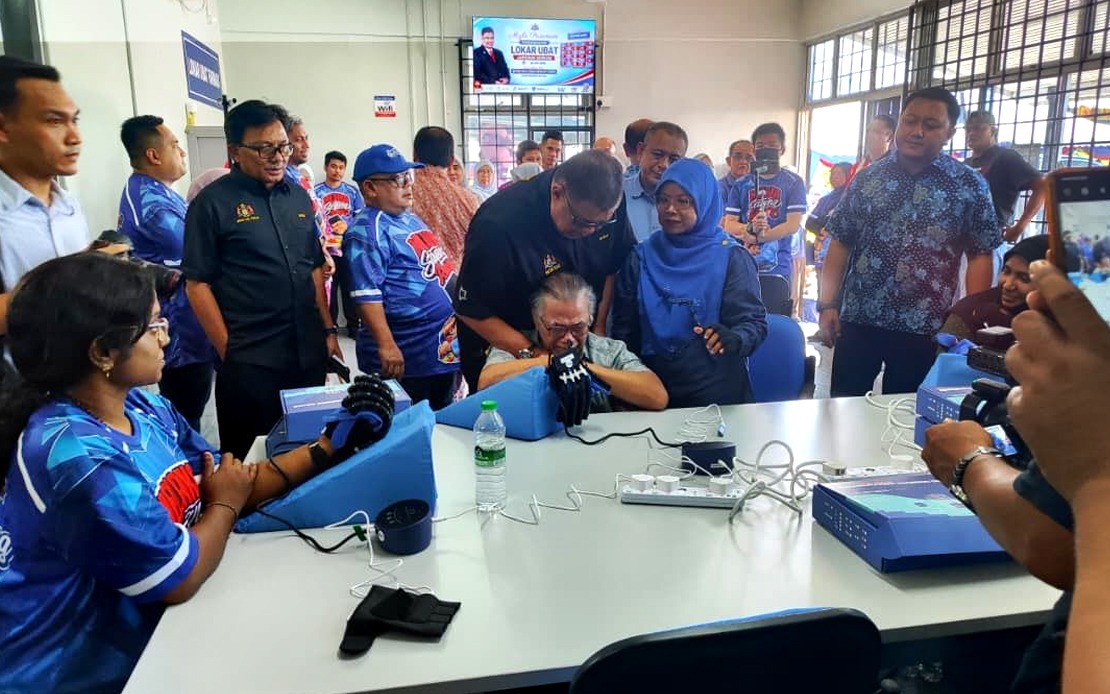
Universiti Teknikal Malaysia Melaka (UTeM) has launched an innovative community rehabilitation facility in Serkam, Jasin that leverages cutting-edge technology to enhance patient recovery and physiotherapy outcomes. The MADANI Community Rehabilitation Centre and Gymnasium, which opened recently under the Finance Ministry's UniMADANI 2024 Grant programme, represents a significant step towards democratising access to advanced rehabilitative care in Melaka and potentially across Southeast Asia. The facility was officially inaugurated by Chief Minister Datuk Seri Ab Rauf Yusoh as part of the Public University Community Empowerment Programme (Komuniti @UniMADANI).
The centre addresses a critical gap in rehabilitation services by integrating proprietary technologies developed by UTeM researchers directly into clinical practice. Rather than remaining confined to laboratory settings, these innovations now serve stroke survivors, accident victims, and individuals struggling with mobility impairment and muscular weakness. This transition from academic research to community-based application underscores the university's commitment to translating technical expertise into tangible health benefits for ordinary Malaysians—a model increasingly important as healthcare systems across the region face mounting pressure to enhance service quality while managing costs.
Among the centrepiece innovations is Roboglove, a sophisticated device designed to facilitate targeted hand rehabilitation training. Hand function recovery represents one of the most challenging aspects of stroke rehabilitation, often requiring months of repetitive exercises that can prove monotonous and physically demanding for patients. By automating and optimising these movements, Roboglove enables more consistent, measurable progress while reducing fatigue. The technology holds particular relevance for Malaysia's ageing population, as stroke incidence increases significantly with age and represents a leading cause of disability in the country.
Complementing this offering is the Assistive Lower Limb Chair (ALLC), which automates lower limb exercises for patients unable to perform movements independently. Mobility restoration in lower extremities is essential not merely for walking but for maintaining independence in daily living, reducing fall risk, and preserving psychological wellbeing. Automated systems like ALLC can deliver consistent, graduated therapeutic stimulation across extended sessions, potentially accelerating recovery timelines while minimising caregiver burden—a consideration of mounting importance in Malaysian households where traditional extended-family support structures are evolving.
Perhaps most significantly, the centre incorporates an exoskeleton system that substantially enhances the effectiveness of movement training. Exoskeletons represent one of the most promising frontiers in rehabilitation technology globally, offering precise biomechanical support that allows patients to practice functional movements they cannot yet accomplish independently. For individuals with spinal cord injuries or severe stroke, exoskeletons can literally restore the possibility of standing and walking during therapy sessions, providing both physical rehabilitation benefits and profound psychological reinforcement. UTeM's integration of this technology into a community setting rather than reserving it exclusively for wealthy private clinics or elite research hospitals demonstrates progressive thinking about healthcare equity.
The project emerged under the leadership of Associate Professor Dr Mariam Md Ghazaly and reflects collaborative coordination across multiple stakeholder layers. UTeM partnered with the Serkam State Constituency Development and Coordination Committee (Japerun), the Kampung Pulai Village Development and Security Committee, the Social Welfare Department, and the Social Security Organisation (PERKESO). This multi-institutional approach acknowledges that sustainable rehabilitation services require coordination between academic institutions generating innovation, local government machinery ensuring accessibility, and social safety-net agencies managing patient referrals and financial support. For Malaysian policymakers observing this model, it suggests a template for spreading technological advancement beyond urban centres.
UTeM Vice-Chancellor Prof Datuk Dr Massila Kamalrudin articulated an ambitious vision for the centre's significance, positioning it as a catalyst for nationwide expansion of technology-enabled rehabilitation access. She emphasised that innovation in rehabilitation can substantially improve patients' quality of life by making recovery training more accessible and continuous—factors that directly influence long-term functional outcomes. Her remarks suggest UTeM's intent to replicate this model across multiple locations, potentially establishing satellite centres in other states or regions underserved by advanced rehabilitation infrastructure.
The implications for Malaysian healthcare extend considerably beyond Melaka. The country faces mounting demand for rehabilitation services as non-communicable diseases like stroke, diabetes, and hypertension proliferate. Simultaneously, physiotherapist shortages and concentration of specialist services in urban centres create access barriers for rural and semi-urban populations. By automating and standardising certain rehabilitative functions, technology-driven centres reduce dependency on scarce specialist personnel while maintaining consistency and quality. This scalability addresses one of Southeast Asia's central healthcare challenges: delivering quality care across diverse, geographically dispersed populations with limited human resources.
The MADANI Centre also reflects evolving global rehabilitation philosophy. Contemporary evidence increasingly suggests that intensive, repetitive, task-specific practice—precisely what robotic systems can deliver—generates superior neuroplastic adaptation compared to traditional manual therapy alone. Patients gain the psychological boost of measurable progress and visible improvement as automated systems track performance metrics. For individuals facing potentially years of rehabilitation following major injury or stroke, such motivation proves invaluable in sustaining engagement with recovery.
From a research perspective, the facility functions as a living laboratory where UTeM engineers and clinicians can gather real-world performance data on their innovations. This feedback loop enables rapid iteration and refinement, ensuring technologies evolve responsively to actual patient needs rather than theoretical assumptions. Malaysian universities increasingly recognise that maintaining research relevance requires engaging with community implementation, and UTeM's approach exemplifies this maturation.
The centre's sustainability will partly depend on establishing robust referral pathways from PERKESO, the Social Welfare Department, and primary care networks. Without systematic integration into Malaysia's healthcare ecosystem, even technically sophisticated facilities risk operating below capacity or serving only wealthy private patients. The stakeholder partnerships already established suggest leadership attention to this challenge, though outcomes will depend on ongoing coordination and potentially regulatory adjustments facilitating technology-assisted rehabilitation within Malaysia's publicly funded system.
Looking forward, the MADANI Centre represents a promising proof-of-concept for technology-enhanced rehabilitation accessible to ordinary Malaysians. Success in Jasin could catalyse expansion across Peninsular Malaysia and into Sabah and Sarawak, fundamentally shifting rehabilitation accessibility and outcomes across the nation. For Southeast Asian observers, UTeM's model offers a replicable pathway for universities to translate research into community health impact while addressing persistent gaps in specialist service availability.

