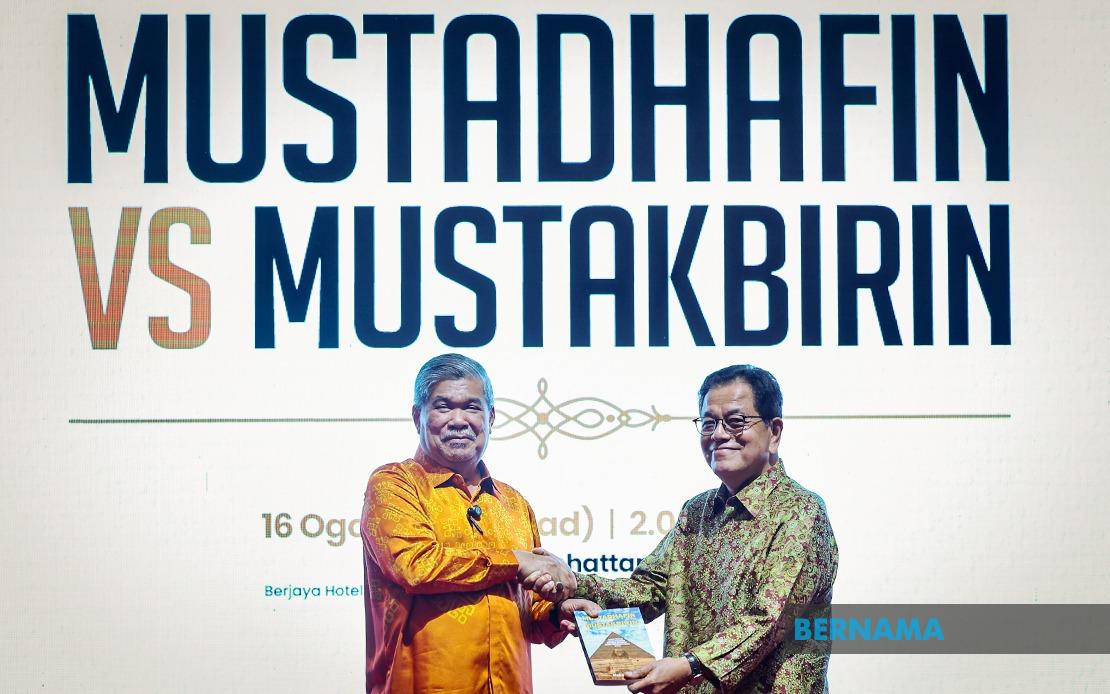
Datuk Seri Mohamad Sabu has issued a stark warning to Malaysians about the dangers of accepting political allegations at face value, arguing that uncritical acceptance of unverified claims nurtures a harmful tribal mentality that undermines rational discourse. The Amanah president and Agriculture and Food Security Minister made his remarks while launching his book, where he advocated for a more discerning approach to navigating the complex landscape of Malaysian politics and global affairs.
In an address to journalists following the book launch, which was conducted by National Journalism Laureate Tan Sri Johan Jaaffar, a director of Star Media Group Berhad, Mohamad Sabu elaborated on the concept of 'asabiyyah'—a tendency to defend one's own group unquestioningly while simultaneously dismissing the positive contributions of rival factions. This mentality, he suggested, is particularly corrosive in pluralistic democracies where multiple parties and viewpoints compete for influence and legitimacy. When citizens adopt such a defensive posture without examining evidence, political discourse devolves into mutual accusations rather than substantive debate grounded in verifiable information.
The minister drew particular attention to recurring claims about the Democratic Action Party, noting that allegations portraying DAP as a communist organisation continue to circulate despite the party's decades-long history as a mainstream political force. Mohamad Sabu questioned whether these narratives withstand scrutiny or whether they represent a form of political rhetoric designed to mobilise support through fear rather than evidence. His implicit message was that voters should interrogate such claims independently rather than perpetuate them uncritically, particularly in an age where social media amplifies unverified assertions across vast audiences within minutes.
Modern information ecosystems, Mohamad Sabu observed, create a structural advantage for sensational allegations over careful factual analysis. Accusations and suspicions travel rapidly through digital networks, finding fertile ground in pre-existing anxieties and partisan predispositions, while substantive facts require more time and cognitive effort to comprehend and integrate. This asymmetry means that falsehoods can achieve massive circulation before corrections gain traction, a phenomenon that poses particular challenges in Southeast Asia where mobile internet penetration has outpaced media literacy development in many communities.
The book that Mohamad Sabu launched represents, in his characterisation, a chronicle of his personal methodology for understanding complex political and international issues. Rather than accepting secondhand accounts or relying on propagandistic narratives, he described adopting a practice of direct inquiry and observation from his youth. This approach, he suggested, requires patience and intellectual humility—a willingness to engage with primary sources, seek out diverse perspectives, and revise one's understanding as new information emerges. In an era of competing disinformation campaigns and polarised political environments, such methodological rigour becomes increasingly valuable.
The substance of Mohamad Sabu's newly launched work extends beyond domestic Malaysian politics into broader geopolitical terrain. His analysis encompasses historical phenomena such as colonialism, the trajectory of Islamic movements across different contexts, the Israeli-Palestinian conflict, and the reconfiguration of global power dynamics in recent decades. These thematic threads, which he has contemplated through the lens of personal experience and careful observation, suggest a framework for understanding how international forces shape national politics and vice versa. For Malaysian readers, such contextualisation can illuminate how local political debates often reflect or respond to broader transnational currents.
The timing of Mohamad Sabu's intervention carries significance within Malaysia's current political context, where coalition politics have created unusual partnerships and shifting allegiances. The cooperation between Amanah and DAP within opposition coalitions has itself become a target for criticism from political rivals, with claims that such partnerships represent ideological compromise or capitulation. By directly addressing the narrative that frames collaboration with DAP as tantamount to endorsing communism, Mohamad Sabu positions critical thinking as a counterweight to divisive rhetoric that treats political opponents as inherently illegitimate or dangerous.
For Malaysian voters navigating a complicated political landscape featuring numerous parties, coalitions, and competing narratives, the case for epistemic vigilance appears compelling. The proliferation of messaging via social media, messaging applications, and other digital channels means that citizens encounter a constant stream of political claims, many of which lack reliable sourcing or evidentiary support. In this environment, the habit of verification—of asking whether a claim is supported by credible sources, whether alternative explanations exist, and whether the narrative serves identifiable political interests—becomes a civic competence as important as the vote itself.
Moreover, the polarisation that results from uncritical acceptance of allegations can corrode the social fabric necessary for democratic functioning. When citizens view one another not as fellow participants in a shared political system but as representatives of incompatible or threatening ideologies, compromise becomes impossible and democratic institutions lose their legitimacy. Southeast Asian democracies, already navigating complex questions of religious identity, ethnic diversity, and post-colonial state formation, face particular vulnerability to such fragmentation. Mohamad Sabu's advocacy for factual verification thus carries implications extending beyond individual political choices to encompass the health of democratic institutions and social cohesion.
The book launch represents more than a conventional media event; it constitutes a public statement about the values and practices that Mohamad Sabu believes should guide political citizenship. By positioning himself as someone who has consistently resisted propaganda and insisted on evidence-based understanding, he models an alternative to both credulous acceptance of official narratives and cynical rejection of all truth claims. Whether this message gains traction among ordinary Malaysians struggling to make sense of conflicting political communications remains an open question, but the attempt to elevate the standard of political discourse through emphasis on verification and critical thinking addresses a genuine challenge facing the nation's democracy.

