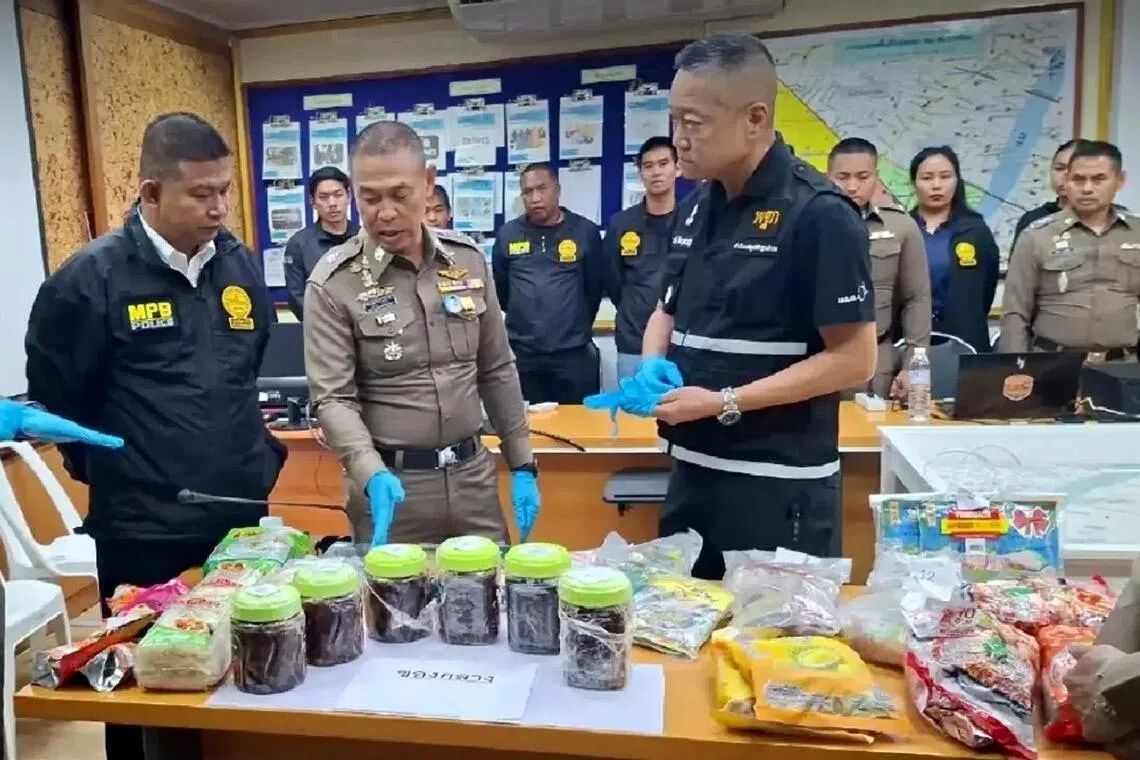
Thai law enforcement has exposed an elaborate international drug trafficking network orchestrated by Vietnamese nationals who strategically routed crystal methamphetamine shipments through Thailand en route to Japan, concealing the contraband within seemingly innocuous containers of tamarind paste. The Metropolitan Police Bureau revealed the operation on July 17 following the interrogation of a Thai accomplice, marking another chapter in the region's ongoing struggle against transnational organised crime that increasingly relies on civilian courier networks and deceptive packaging methods.
The breakthrough came through an unexpected whistleblower—a delivery courier who became suspicious when transporting six jars of tamarind paste destined for Tokyo. The packages registered as unusually dense and heavy during handling, arousing sufficient doubt for the courier to voluntarily alert authorities rather than complete the shipment. Upon examination, investigators carefully extracted foil-wrapped bundles from within the jars, ultimately confirming the presence of more than 2kg of crystal methamphetamine, a particularly potent and addictive form of the drug that commands premium prices across East Asian markets. The seizure underscores how criminal enterprises have evolved their concealment tactics, moving beyond traditional hiding places to weaponise legitimate food exports as camouflage.
The operational structure revealed through investigation demonstrates sophisticated criminal tradecraft designed specifically to insulate leadership from direct liability. Vietnamese organisers based in Hanoi maintained command authority while maintaining extreme distance from actual drug movements, relying instead on layered intermediaries who bore the greatest legal exposure. Anonymous Facebook accounts served as the initial recruitment and coordination mechanism, enabling organisers to hire motorcycle delivery riders without exposing their identities. These riders collected packages from residential properties occupied by Vietnamese nationals scattered across Thailand, creating plausible deniability by transforming the operation into what appeared as disconnected, low-level courier activities rather than a unified criminal enterprise.
The financial architecture further revealed the sophistication of money laundering integrated into the scheme's design. Investigators traced fund flows through a single Thai bank account belonging to Sompong, the arrested suspect, but noted a crucial pattern: Vietnamese operatives would withdraw cash sums ranging between 20,000 and 50,000 baht at irregular intervals before departing Thailand. This deliberate rotation of withdrawal personnel and timing appeared calibrated to avoid triggering scrutiny from banking authorities while ensuring that no single individual accumulated visible wealth that might invite investigation. The strategy reflects understanding that financial trails often provide more reliable evidence than physical smuggling operations, as drug seizures sometimes occur by chance while money movements create traceable records.
The targeting of unwitting couriers represented a particularly cynical dimension of the network's operations. Rather than relying exclusively on knowing participants, the organisation deliberately recruited individuals willing to transport goods internationally without full disclosure of contents. This approach served multiple tactical objectives: it increased the pool of available transporters willing to undertake the journey, distributed legal liability across numerous expendable participants, and complicated law enforcement investigations by introducing genuine ignorance into the supply chain. The pattern mirrors previous cases where unsuspecting travellers discovered too late that their packages contained illegal substances, transforming them into criminal suspects despite their lack of informed consent.
Metropolitan Police Division 7 commander Chaiya Phetpanya and officers from Bang Yi Khan Police Station built their investigation systematically, recognising that dismantling such networks requires identifying not just the physical drug flow but the administrative and financial infrastructure enabling it. The questioning of Sompong, the Thai suspect whose bank account served as the operational hub, provided the critical entry point into understanding how Vietnamese nationals coordinated activities across borders despite never meeting face-to-face. Investigators determined that the network likely involved at least four primary participants, each occupying distinct roles within the hierarchy to maximise operational security.
Authorities have issued arrest warrants for four suspects encompassing Sompong and three Vietnamese nationals whose specific roles ranged from cash withdrawal duties to social media account management to partial operational direction. Sompong has maintained his innocence despite evidence placing his financial assets at the centre of the scheme. Investigators have also directed attention toward Sompong's girlfriend, whom officers believe possessed knowledge of the operation despite formal warrant exclusion. This extended scrutiny reflects law enforcement's understanding that dismantling transnational drug networks often requires pursuing peripheral associates who may have enabled operations through passive cooperation or deliberate assistance.
The case illuminates how Thailand's geographic position as Southeast Asia's central transportation nexus makes it particularly vulnerable to exploitation by international smuggling rings. The country's extensive land borders with Myanmar, Laos, and Cambodia, combined with major air and sea ports, create natural transit corridors that criminal organisations have thoroughly mapped and systematised. While Thai authorities maintain significant narcotics enforcement capabilities, the sheer volume of cross-border commerce provides considerable cover for concealed shipments, particularly when disguised within legitimate food exports that occupy less scrutiny than traditional drug precursor chemicals.
The utilisation of Asian food products as contraband containers reflects evolving smuggler strategies across the region. Tamarind paste, a common Southeast Asian ingredient exported internationally, represents an ideal vehicle because it naturally occurs in sealed containers, maintains consistent appearance, and generates legitimate commercial traffic patterns that customs officials process routinely. Vietnamese organised crime groups have demonstrated particular sophistication in exploiting these export networks, leveraging established business relationships and supply chains that facilitate regular border crossings. This approach differs markedly from older smuggling methodologies that relied on isolated, high-risk individual movements.
The methamphetamine market in Japan represents an exceptionally valuable target for international suppliers, with Japanese demand for crystal meth remaining strong despite ongoing enforcement efforts. Criminal organisations have developed sophisticated distribution networks that reward successful delivery at premium rates, justifying the complexity and risk involved in transnational trafficking operations. The price differential between Southeast Asian production costs and Japanese street values creates powerful economic incentives for Vietnamese and other criminal groups to develop increasingly elaborate smuggling schemes, even when apprehension risks appear substantial.
For Malaysia and other Southeast Asian nations, this case provides important strategic lessons regarding the evolution of drug trafficking methodologies. The integration of seemingly legitimate courier and financial systems into sophisticated trafficking architectures means that effective enforcement requires coordination across banking regulators, customs authorities, and intelligence agencies. The operation's reliance on technology platforms like Facebook demonstrates how mainstream social media enables criminal coordination while operating beneath the traditional intelligence-gathering thresholds that focused exclusively on dark web communications. Regional law enforcement bodies increasingly recognise that dismantling such networks demands understanding their comprehensive operational ecosystems rather than addressing isolated drug seizures.
The investigation's ongoing nature suggests that Thai authorities anticipate uncovering additional participants and shipments as they pursue Sompong and the three Vietnamese suspects named in arrest warrants. Each successfully disrupted trafficking corridor potentially prevents multiple shipments reaching foreign markets, though the fundamental economic drivers attracting criminal participation remain unresolved. As long as price differentials and demand disparities exist between production and consumption markets, organised crime groups will continue innovating concealment and distribution methodologies. The Bangkok police discovery represents a tactical victory in the broader strategic conflict against transnational drug trafficking, but underscores the necessity for sustained, coordinated regional enforcement efforts targeting both supply reduction and financial system vulnerabilities that enable such operations.

