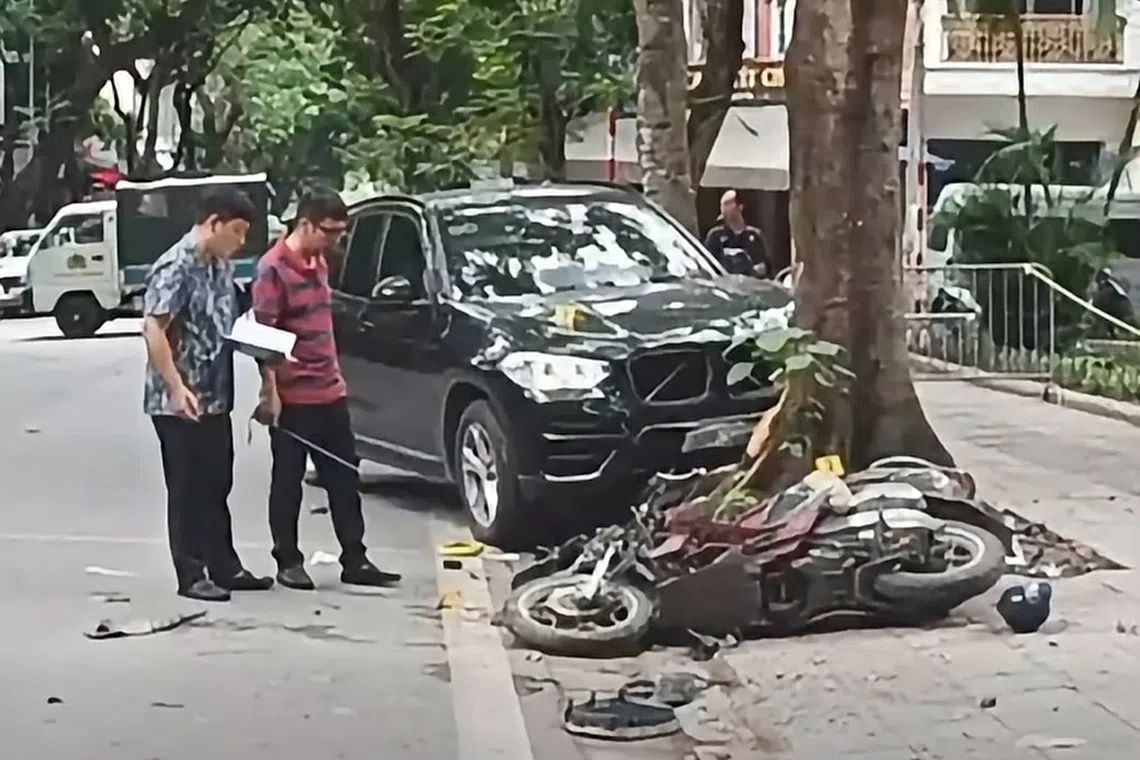
A rare intervention by Vietnam's state broadcaster has highlighted the growing power of youth-driven social media activism in the communist nation. Vietnam Television devoted six minutes to a fatal traffic accident that occurred in Hanoi in May 2025, an unusually extended treatment for a single incident in a country where over 10,000 people die annually in road crashes. What distinguishes this case is that it involved Nguyen Sy Cuong, a 64-year-old former deputy of the Vietnamese National Assembly, whose luxury car collided with a motorbike carrying an 18-year-old girl and her father.
The collision proved catastrophic for Do Ngoc Phuong Thuy, whose right leg was severed in the crash. She succumbed to her injuries ten days later, shortly before she was due to sit her high school graduation examinations. Despite the severity of the incident, official reporting ceased abruptly after May 31, leaving the case shrouded in obscurity as police investigation proceeded without public disclosure. For over a year, the matter appeared closed from a public perspective, with no further information emerging through traditional channels.
The silence shattered dramatically more than a week before the state television report. Millions of posts flooded Vietnamese social media platforms, particularly Threads, employing hashtags such as #NguyenSyCuong and #BMW to mobilise attention toward the unresolved incident. The movement coalesced around demands for transparency and accountability, predominantly driven by Gen Z users and young adults who articulated frustration at the apparent impunity enjoyed by a connected former official. Internet users subsequently alleged that authorities attempted to suppress the campaign through content removal, yet determined activists circumvented restrictions by sharing material across multiple platforms including Facebook, Instagram and X.
The grassroots memorial campaign took on symbolic physical dimensions when young people, often masked, began placing flowers at the accident site, designated as tree number 55. This location rapidly acquired coordinates on Google Maps and acquired the designation "Justice Tree" among supporters. The authorities responded by dispatching cleaners to remove the tributes, yet the movement evolved into a virtual memorial where hundreds of thousands paid respects online, demonstrating the difficulty of suppressing coordinated digital activism.
Social activist Nguyen Hoang Vi, who maintains a blog addressing education and social policy issues, offered insight into the campaign's emotional resonance. The victim's age proved critical to mobilising broad youth participation, as peer empathy created immediate identification between the deceased and her advocates. Beyond emotional connection, the prolonged official silence appeared to function as a breaking point, crystallising youth frustration with a system where authorities demand public trust in justice while withholding the evidence and reasoning that would substantiate such confidence. For this generation, witnessing justice meant seeing transparent processes and documented decisions, not merely accepting assertions from officials.
Legal analyst Tran Dai Lam from Hanoi's ANVI law firm contextualised the persistence of the campaign within broader dynamics of information flow and public memory. He observed that incidents do not simply vanish because media attention lapses; rather, cases can resurface rapidly when new details emerge or when sustained public focus revives dormant questions. In this instance, Gen Z maintained attention across the information vacuum, refusing to allow the case to be permanently buried despite institutional preferences for closure.
The VTV broadcast addressed the core dispute by citing police and prosecution sources indicating that Nguyen Sy Cuong had "sincerely confessed and actively and fully remedied the consequences of his actions." According to the official statement, Do Ngoc Phuong Thuy's family declined to pursue criminal charges, leading to Cuong's exemption from criminal liability. The girl's father, Do Viet Hung, appeared in the report expressing gratitude toward internet supporters while stating that the family accepted the investigation's findings and sought privacy for their grief and recovery.
However, the official explanation failed to satisfy expectations for comprehensive transparency. Lawyer Tran Dai Lam assessed that whilst the VTV programme addressed certain legal dimensions, the year-long information vacuum had created expectations that simple assertions of procedural compliance would not fully resolve. Gen Z audiences demanded specificity regarding applicable legislation, particular decisions rendered, and explicit justifications for those determinations. The generation distinguished itself through insistence on detailed knowledge of governmental processes rather than accepting bureaucratic assurances that actions conformed to regulations.
Following the broadcast, virtual flowers continued accumulating at the online memorial, though in reduced numbers. Numerous online commenters expressed dissatisfaction with the official narrative, indicating that state television's intervention had partially rather than definitively addressed underlying grievances. The persistence of scepticism reflected broader youth demand for substantive rather than procedural accountability, a distinction that separates generational expectations regarding official responsibility.
Authorities responded to the campaign with characteristic warnings about destabilisation efforts. A senior police official cited by VTV alleged that the Ministry of Public Security had uncovered "highly dangerous plots and intentions by hostile forces, reactionaries and bad actors" exploiting the incident to incite unrest. The official advised public vigilance, particularly among young people. Pro-government influencers amplified warnings regarding "colour revolutions," invoking Bangladesh unrest as cautionary examples of how ostensibly spontaneous protests could escalate into broader challenges to institutional authority.
Nevertheless, the campaign represented a historically significant moment for youth-driven activism in Vietnam. This constituted the first instance of a social media movement organised primarily by Gen Z successfully elevating matters of personal concern to the level of official government response. The sustained pressure disrupted normal institutional processes for managing such cases, forcing public acknowledgment of a matter authorities had preferred to contain through administrative discretion.
Activist Nguyen Hoang Vi underwent personal reassessment following the campaign's development. Previously she had harboured conventional generational stereotypes regarding Gen Z as self-centred and disengaged from broader social concerns. The mobilisation revealed that this generation engaged civically with intensity comparable to earlier cohorts, albeit through distinct mechanisms and platforms. Rather than indifference, Gen Z demonstrated sophisticated adaptation to contemporary communication technologies to advance demands for justice and transparency, practices that challenge traditional assumptions about youth political capacity in authoritarian contexts.

