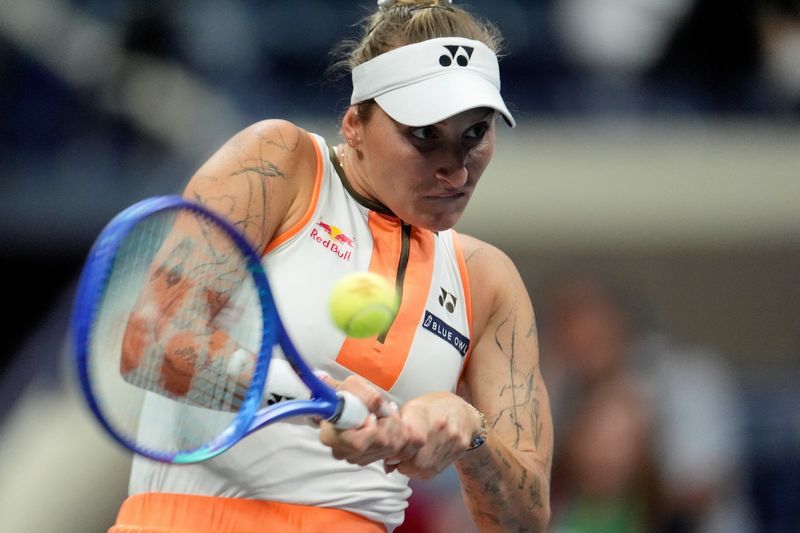
The suspension of Marketa Vondrousova for four years has thrust the contentious issue of anti-doping enforcement in professional tennis back into the spotlight, with the sport's player body now demanding meaningful involvement in shaping the rules governing drug testing. The former Wimbledon champion received her ban on Monday after the International Tennis Integrity Agency determined that she failed to comply with a doping control officer's request to provide a sample during an unannounced test at her home in December. The decision has triggered broader questions about how the sport balances the imperative to maintain competitive integrity with the rights and welfare of athletes themselves.
Vondrousova's account of the incident underscores the personal toll that anti-doping procedures can exact. The 26-year-old Czech player revealed in April that she had reached a psychological breaking point following months of strain, and described the officer's arrival at 8:15 p.m. demanding immediate compliance as a violation of her privacy and sense of security. Her response—declining to open her door—was rooted partly in legitimate safety concerns shaped by the 2016 knife attack on compatriot Petra Kvitova in her residence, a traumatic event that reverberates through the women's tennis community. This deeply personal dimension to her refusal distinguishes her case from purely technical or negligent violations and explains why the incident has resonated beyond the sport's usual regulatory confines.
The Professional Tennis Players Association has seized on Vondrousova's case to articulate a broader critique of the current anti-doping framework. In a statement notably calibrated to avoid pronouncing on her guilt or innocence, the PTPA highlighted the apparent disparity in how the system treats different transgressions. A four-year ban for an athlete who has never tested positive for any banned substance stands in sharp contrast to the lenient sanctions imposed recently on higher-ranked players such as Jannik Sinner and Iga Swiatek, who tested positive but escaped lengthy suspensions. This inconsistency has fuelled the perception that the anti-doping apparatus operates with unclear or subjective criteria, undercutting its credibility.
The PTPA's call for athletes to have genuine voice in rule-making reflects mounting frustration with a system perceived as top-down and insensitive to player concerns. The association explicitly distinguished between defending rigorous testing as essential to clean sport and demanding that those subject to testing protocols be consulted during their formulation. This nuance reveals that the grievance is not anti-testing sentiment but rather the exclusion of athletes from decisions that directly affect their daily lives, safety, and privacy. For Malaysian and Southeast Asian readers, this debate parallels broader governance conversations in the region about whether those affected by policies should participate in their design.
The structural context is instructive. Since tennis aligned with World Anti-Doping Agency standards, the sport's procedures have been standardised across all global athletics. The ITIA has maintained that decisions rest on facts and evidence rather than a player's profile, rank, or origin. Karen Moorhouse, the ITIA's chief executive, reiterated this position, emphasising that testing discomfort is unavoidable but necessary to preserve fair competition. From a regulatory standpoint, this argument is sound: if exceptions were carved out based on personal circumstances or fears, the system could be exploited, undermining its effectiveness. Yet Moorhouse's position sidesteps the legitimate question of whether current procedures adequately weigh player welfare.
Women's safety during out-of-competition testing has emerged as a particularly acute concern, one that intersects with broader patterns of vulnerability. The practice of dispatching testers to players' residences during evening hours creates scenarios that inherently feel unsafe, especially for women living alone. Kvitova's 2016 attack demonstrates that these are not abstract anxieties but real risks that inform rational caution. While Moorhouse noted that testers carry identification and procedures include matching gender and witness assignments, these safeguards may be insufficiently reassuring to athletes with valid security concerns. The absence of dialogue between testers and players about how to reconcile testing unpredictability with safety suggests a gap in the system's sensitivity.
The case also resurfaces questions about how international sports governance frameworks, designed for global consistency, sometimes struggle to accommodate legitimate regional or individual variations. Tennis operates across multiple continents with vastly different cultural norms around privacy, personal space, and security. A testing protocol that functions acceptably in one context may prove problematic elsewhere. This tension between universalised rules and local particularities is especially relevant for Southeast Asian players navigating international circuits, as they too must reconcile their own expectations and safety frameworks with global standards that may not anticipate region-specific concerns.
Vondrousova's inability to compete since January owing to a shoulder injury adds another dimension to her predicament. A player sidelined by injury has different circumstances than an active professional, yet the anti-doping apparatus operates uniformly regardless of whether an athlete is competing. This raises questions about proportionality and whether testing protocols ought to differentiate based on competitive status or recent activity. The combination of injury-related absence and the psychological stress she described creates a portrait of a player already fragile and vulnerable when the testing incident occurred, factors that may influence an appeal to the Court of Arbitration for Sport.
The PTPA's parallel lawsuit against tennis governing bodies over privacy violations indicates that this dispute is far from isolated or resolved. That legal challenge reflects an underlying philosophical divide about whether anti-doping authority supersedes privacy protection or whether both values can be honoured simultaneously through more thoughtful design. International sports bodies increasingly face pressure to incorporate human rights frameworks into their governance, and tennis's anti-doping regime may need to evolve if it is to retain credibility among players and the public.
For the broader tennis ecosystem, Vondrousova's case exposes a legitimacy problem that transcends any individual decision. When high-ranking players who actually tested positive receive minimal sanctions while an uninfected player receives a four-year ban for procedural non-compliance, the system appears arbitrary. This perception erodes voluntary cooperation and morale. Players may increasingly view anti-doping rules with suspicion rather than as a shared commitment to fairness, ultimately undermining the anti-doping mission itself. Moorhouse's assertion that unpredictable testing is essential captures an important truth, but it is incomplete. Testing regimes must also be perceived as proportionate, fair, and respectful of athlete dignity to command genuine support.
The regulatory path forward likely requires genuine negotiation rather than assertion of authority. Tennis could explore modified procedures—such as scheduled testing windows, enhanced safety protocols for residential visits, or exemptions for injured players not competing—without dismantling the testing framework itself. By involving the PTPA and athletes in redesigning these processes, the sport could preserve anti-doping integrity while addressing legitimate concerns. Vondrousova's case is ultimately a warning that even justified rules require legitimate procedures to sustain them. How tennis responds will signal whether the sport can balance competing values or whether it will continue to privilege enforcement over the welfare of those it governs.

