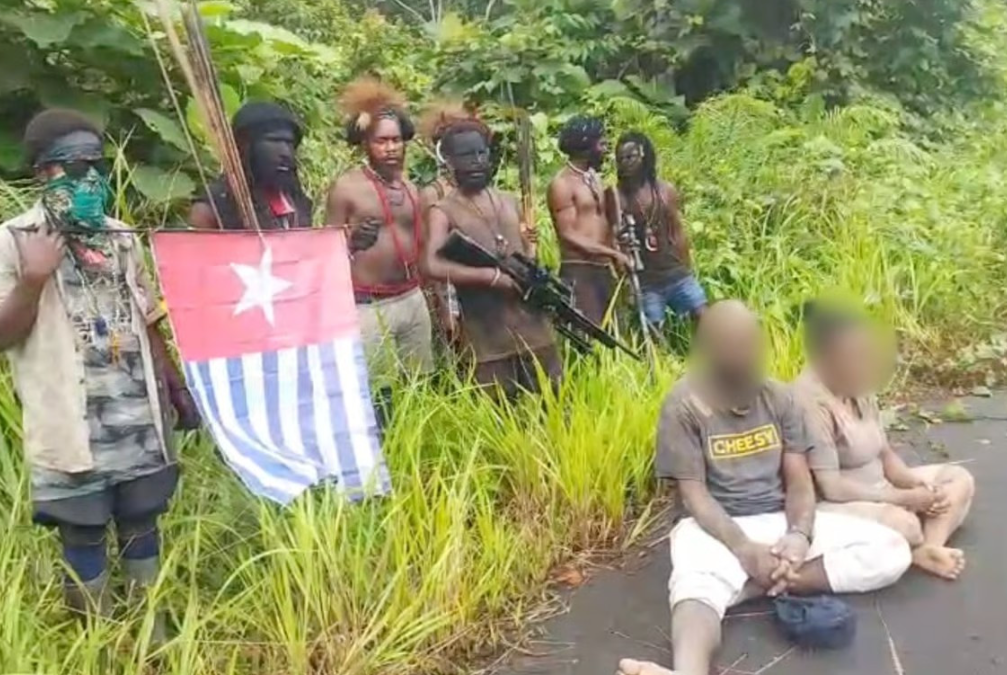
A separatist insurgency in Indonesia's Papua region has escalated its campaign of violence by targeting indigenous residents suspected of collaborating with government forces. The West Papua National Liberation Army-Papua Freedom Organization, known as TPNPB-OPM, has claimed responsibility for the execution-style killings of three civilians in Yahukimo regency in the Papua Highlands in late July, according to statements released through media channels and social media footage that has circulated widely across the region.
The three victims—identified as Kumis Kogoya, his wife Seli Wenda, and an unidentified woman from the Unaukam tribe—were killed near the Trans Papua Highway in Seradala District. Sebby Sambom, a spokesperson for the TPNPB-OPM, confirmed the organization's involvement and attributed the operations to a commander identified as Kopitua Heluka, described as the operations chief for the Yahukimo Area Defense Command. According to the rebel spokesman's statement to local media, the killings took place on July 20 and 21, carried out jointly by regional defense units in the Yahukimo and Ndugama Darakma areas.
What distinguishes these killings from previous rebel operations is the targeting of indigenous Papua residents rather than outside actors. For years, the TPNPB-OPM has primarily focused violence against settlers from other Indonesian islands and security personnel. This strategic shift toward eliminating local informants suggests the rebel movement views civilian support networks for government forces as a critical vulnerability to address. The TPNPB-OPM has publicly warned other Papuan residents against providing intelligence assistance or logistical support to security authorities operating in the region, framing such collaboration as a betrayal of independence aspirations.
Video evidence circulating online documents the executions with disturbing clarity. The footage shows the victims positioned along the roadside while armed rebels, some bearing the Morning Star flag associated with separatist movements, surround them. One video captures a rebel spokesman delivering accusations against the victims, explicitly calling them intelligence agents for the Indonesian government before ordering execution. The deliberate, public nature of these killings—staged for recording and distribution—represents a propaganda component alongside the violence itself, designed to instill fear among potential informants and demonstrate rebel authority in contested areas.
Indonesian military authorities have rejected the rebel characterization of the victims. The Habema Operations Command, the military's administrative body for the Papua region, described all three deceased as civilians with no military affiliation. Lieutenant Colonel M. Wirya Arthadiguna, the military spokesman, issued a statement emphasizing the right of Papua residents to live peacefully and pursue economic activities without fear, while committing security forces to investigate and pursue perpetrators. The military's position underscores a deepening humanitarian crisis in which residents face threats from multiple armed actors, caught between separatist movements and government security forces.
The broader context of violence in Papua reflects a deteriorating security environment that extends beyond direct military confrontation. The TPNPB-OPM has declared substantial territorial zones as war areas, prohibiting government military and police deployment into those regions. More consequentially for civilian populations, the rebels have banned civilian aviation operations, citing concerns that small aircraft—essential for reaching isolated communities in the mountainous terrain—serve primarily to transport security personnel. Associated Mission Aviation, a humanitarian organization operating flights to remote settlements, has become a direct target following the killing of American pilot Nicholas F. Gosselin, whom rebels accused of facilitating military movements despite the airline's stated mission of delivering food, fuel, and medical supplies.
This restriction on air transport creates a humanitarian bottleneck with serious implications for Papua's interior communities. Unlike lowland regions with road networks, much of the Papua Highlands remains accessible only by small fixed-wing aircraft. Blocking these flights effectively isolates remote populations from medical care, commercial goods, and external contact. Communities that previously depended on regular supply flights now face potential shortages and deteriorating health services. The humanitarian cost of the separatist movement's tactics falls primarily on indigenous Papua residents who lack capacity to defend themselves or access alternative supply routes.
The killings of Kumis Kogoya, Seli Wenda, and the unnamed Unaukam woman represent a tactical recalibration by separatist forces. Rather than concentrate exclusively on confronting uniformed security personnel, the TPNPB-OPM has begun systematically eliminating civilian support networks. This approach aims to sever the intelligence and logistical pipelines that enable government operations in remote areas. By publicly executing suspected informants, the organization seeks to deter other residents from cooperating with authorities, thereby expanding areas of rebel operational control and reducing government presence through intimidation.
For broader Southeast Asian observers, the Papua conflict illustrates the challenges faced by insurgent movements in mountainous, dispersed populations where civilian collaboration with state security becomes essential. The tactic of targeting local informants rather than focusing solely on security forces reflects recognition that long-term territorial control depends on suppressing popular support for government authority. Such dynamics have parallels in other regional conflicts where separatist or revolutionary movements attempt to achieve dominance through terror campaigns against civilian populations deemed insufficiently committed to the nationalist cause.
The strategic implication extends beyond Papua itself. Indonesia's government faces pressure to demonstrate security capacity while protecting civilians from rebel violence—a difficult balance when communities lack secure communication with authorities and fear reprisals from separatists. International organizations tracking human rights concerns have monitored the Papua conflict closely, and execution-style killings with documented evidence complicate the security narrative in ways that may attract increased external scrutiny. Regional countries with interest in Papua's stability, including Australia and nearby island nations, remain attentive to escalation patterns that could expand beyond current conflict zones.
Indigenous Papuan residents inhabiting disputed territories face an untenable security situation where association with government becomes potentially fatal while resistance to rebel demands risks other consequences. The execution of three civilians for suspected intelligence gathering demonstrates that no category of resident remains entirely safe from the conflict's violence. As the separatist movement tightens control over territory and population through intimidation, the humanitarian space for ordinary Papuans continues contracting, with basic services like aviation and commerce subject to rebel interdiction.

