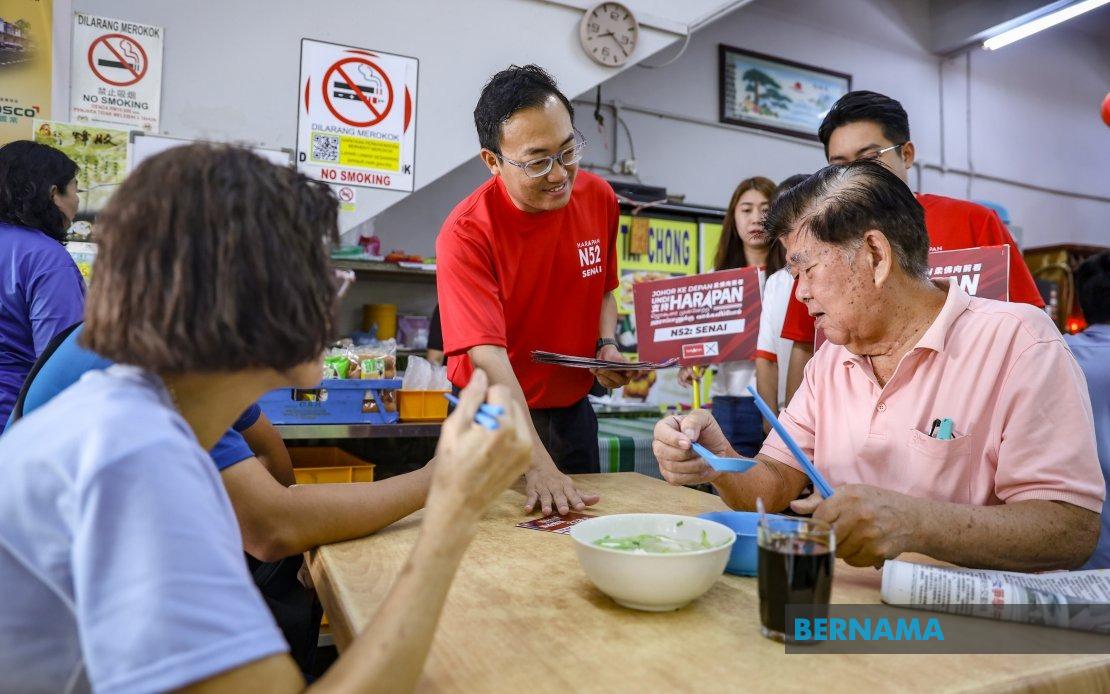
Senai's incumbent state assemblyman Wong Bor Yang is pressing his case for re-election on the strength of tangible improvements delivered to his constituents during his previous tenure, expressing confidence that Pakatan Harapan will retain the seat in the 16th Johor state election scheduled for July 11. Speaking in Kulai, Wong positioned himself as a pragmatic administrator with a distinctive political journey spanning Malaysia's recent democratic transitions, arguing that his varied experience across different power structures equips him uniquely to serve the Senai constituency with practical solutions rather than partisan rhetoric.
Wong's political narrative is built on continuity rather than novelty. Since 2014, he has held roles ranging from special officer in the Kulai MP's office to local councillor from 2018 onwards, before securing election as state assemblyman. This trajectory, he contends, demonstrates sustained commitment to the Senai community and progressive familiarity with administrative machinery. Unlike newcomers who may require a settling-in period, Wong frames his previous term as a natural extension of a decade-long relationship with district governance, giving him established networks and institutional knowledge that benefit constituent services.
Flood management emerged as a signature achievement in Wong's tenure. The Senai state seat encompasses several areas historically vulnerable to flash flooding, a persistent challenge that Wong addressed through sustained advocacy rather than one-time gestures. When positioned as part of the opposition, he employed petitions and assembly debates to pressure government agencies into action. This persistence yielded tangible results: the state government allocated RM1 million to upgrade drainage infrastructure serving Taman Aman, channelling improved water flow into Sungai Skudai. Working in coordination with Kulai MP Teo Nie Ching, he also secured an additional RM3 million for drainage upgrades in Peladang Kulai Besar and Saleng, successfully removing both areas from the district's notorious flooding hotspots list.
Beyond essential infrastructure, Wong has also championed heritage preservation and community amenities. Senai's more than 100-year historical legacy became a focus for cultural regeneration, with Wong overseeing the conversion of a defunct cinema into a community operations centre. A deteriorating badminton facility underwent transformation into a family recreational destination branded as Tiny Lake under the Sejati MADANI programme, signalling an attempt to diversify the constituency's quality-of-life offerings beyond basic service delivery. These initiatives reflect an understanding that electoral competitiveness increasingly depends on amenities that enhance social cohesion and community identity.
Healthcare deficiencies have crystallised as Wong's emerging priority for a potential second term. A journalism graduate from Shih Hsin University in Taiwan, Wong has applied advocacy skills honed in media work to highlight Kulai Hospital's capacity constraints. The facility's 93-bed configuration, he argues, is fundamentally mismatched to demographic projections forecasting the district's population expansion to 500,000 by 2030. This mismatch presents both an electoral vulnerability and a genuine governance challenge, as inadequate healthcare infrastructure affects public confidence in local administration. Wong has made repeated calls for hospital expansion and continues pressing for resolution of bureaucratic land issues that have stalled construction of a new health clinic in Taman Mewah, positioning healthcare reform as a cornerstone of his second-term agenda.
Wong's election strategy depends substantially on persuading voters that demonstrated performance trumps political messaging. He characterises the Johor electorate, particularly in Senai, as politically mature and capable of distinguishing genuine track records from rhetorical promises. This framing implicitly acknowledges that new opponents may deploy conventional campaign tactics emphasising personality or party affiliation, but argues that voters in the constituency have sufficient experience to evaluate candidates against concrete outcomes. The Senai electorate comprises 66,635 registered voters, making delivery of visible public goods a credible basis for electoral persuasion.
Yet Wong enters the campaign facing a genuinely competitive three-cornered contest. Barisan Nasional candidate Tai Chee Chee and Bersama candidate Tew Chien How both represent challengers capable of fragmenting the vote. In Malaysian electoral contests, particularly at state level, three-cornered fights introduce volatility; Wong's control of the incumbent advantage is counterweighed by vote-splitting dynamics that can punish the leading candidate if opposition support consolidates. The outcome depends partly on factors beyond Wong's messaging, including broader regional sentiment toward Pakatan Harapan and any last-minute tactical decisions among opposing camps.
Wong's political biography itself constitutes part of his campaign narrative. His transition from journalism to public service, then through different electoral configurations, positions him as someone who has observed Malaysian politics from multiple vantage points. This intellectual vantage point may resonate with constituencies valuing analytical capability, though it could equally invite criticism from opponents suggesting he has been a political opportunist adjusting positions as power structures shifted. The early voting scheduled for July 7 precedes the main polling on July 11, allowing constituencies to participate in staggered elections reflecting administrative capacity.
For Malaysian voters observing state elections in Johor, Wong's campaign illustrates broader regional trends in subnational politics. Increasingly, state assemblyman candidates compete on specific constituency deliverables—flood mitigation, healthcare, recreational facilities—rather than abstract ideological positioning. This outcome-focused electoral competition creates pressure on elected representatives to translate campaign promises into physical infrastructure and measurable service improvements. Wong's emphasis on quantifiable achievements (RM4 million in drainage funding, removal of flooding hotspots, facility upgrades) reflects this emerging expectation that state-level politicians demonstrate administrative competence through tangible delivery rather than rhetorical persuasion alone.
The Senai campaign also illustrates the continuing relevance of local MP coordination in state-level contests. Teo Nie Ching's collaboration with Wong in securing drainage funding demonstrates how elected representatives at different levels can pool influence to solve constituency problems. This cross-level cooperation, when visible to voters, strengthens the electoral case for incumbent candidates and suggests that re-election carries practical benefits through established networks and relationships that new candidates cannot immediately replicate.
As polling approaches, Wong's strategy hinges on converting his diverse administrative experience and concrete achievements into sustained electoral support. The flood management initiatives carry particular weight because they address a recurring constituency vulnerability; residents directly affected by drainage improvements represent constituencies with tangible reasons to return the incumbent. Healthcare reform messaging, by contrast, operates more prospectively, appealing to voters concerned about future adequacy rather than past deficiencies. Balancing these narratives—celebrating delivery whilst mobilising support for future priorities—constitutes the fundamental challenge of his re-election campaign.

